

VisionQuest Easter Eggs Only True Marvel Fans Noticed
Contains spoilers for "VisionQuest"
"WandaVision" showed just how powerful Wanda Maximoff's (Elizabeth Olsen) magic truly was. Through her grief, she summoned a hex that turned a small New Jersey town into a sitcom universe so she could have Vision (Paul Bettany) back following his death in "Avengers: Infinity War." While that show examined the more magical side of the Marvel Cinematic Universe, "VisionQuest" is going all in on the technology and how it intersects in fascinating ways with magic.
At the end of "WandaVision," we discover S.W.O.R.D. has created a new version of Vision, which the fans dubbed White Vision. After duking it out with the hex-manifested Vision, he flies off, and we pick up with him on the run and hiding. He's mostly like the Vision we originally knew, but without the original's emotions and experiences, and it's causing a great deal of existential angst.
A lot has happened with Vision over the years, and "VisionQuest" is the final Marvel project to come out before "Avengers: Doomsday." It represents a ton of history within the MCU, bringing back references dating to 2008's "Iron Man," and may even contain a few hints for where this franchise is going next. So even if you think you caught every Marvel Easter egg on "VisionQuest," here are a few more you might've missed during the first watch.
Roy's Ultimate Electronics
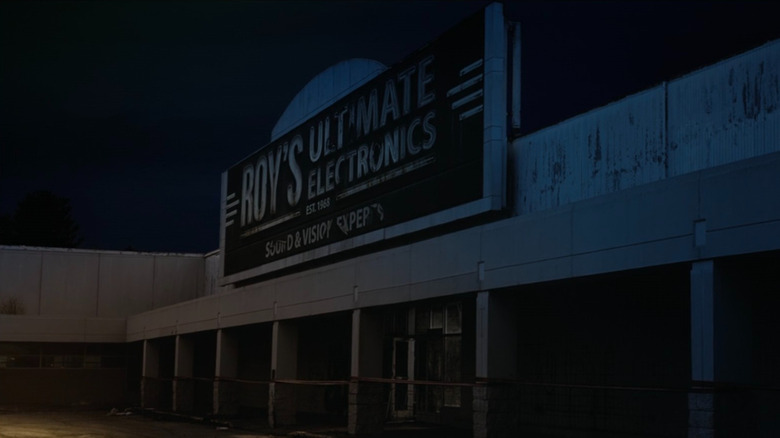
The first episode of "VisionQuest," "No Strings," sees White Vision take refuge in an abandoned shop called Roy's Ultimate Electronics. This is a sneaky reference to Vision's origins, as the Marvel character was created by Roy Thomas and John Bescema.
An untold truth of Vision is that Thomas didn't originally want to create a synthezoid character. Instead, he wanted to bring back a character from the golden age of comics named Aarkus. Aarkus is an extraterrestrial hailing from another dimension who debuted in 1940 from Joe Simon and Jack Kirby. Aarkus would also be referred to as the Vision during this time. However, when Thomas wanted to bring the character back in the '60s, Stan Lee was hesitant to add an alien to the Avengers roster. He suggested using the Vision name but coming up with a new origin, which is how the character became the son of Ultron.
The electronics store sign contains a couple of extra fun Easter eggs. It reads "Est. 1968," and 1968 was, in fact, the year the new Vision arrived in Marvel Comics. The very bottom reads "Sound & Vision Experts," and it's safe to say that if anyone could be considered an expert in all things Vision, it would be his creator, Roy Thomas.
Countdown to Doom
"VisionQuest" can't help but feel like an appetizer to the main course that is "Avengers: Doomsday," coming out in theaters on December 18. Despite the MCU struggling at the box office in recent years, "Doomsday" is bound to be a huge hit. It's already blowing everyone away at the box office.
At first glance, it wouldn't seem like "VisionQuest" has anything to do with "Doomsday." It's wrapping up some plot threads introduced on "WandaVision" and bringing Vision closer to reuniting with his sons, Tommy (Ruaridh Mollica) and Billy (Joe Locke). Vision could swing by to help the Avengers take on Doom, and maybe Tommy and Billy will get roped into a Young Avengers line-up in either "Doomsday" or "Avengers: Secret Wars." But "VisionQuest" has given us one fun Easter egg to point to Doomsday on the horizon.
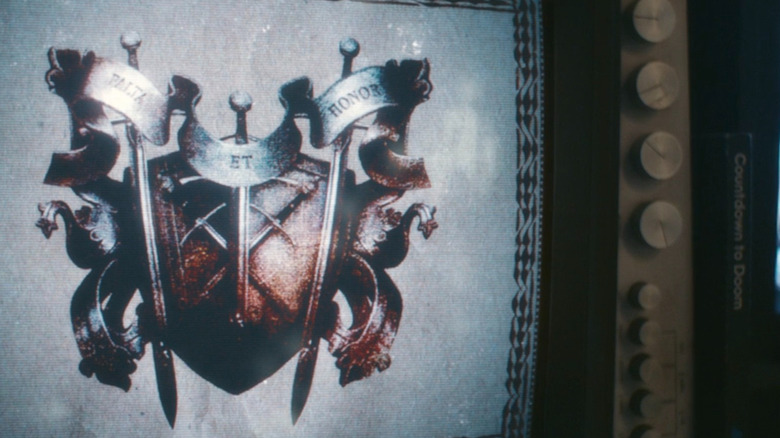
In Episode 2, "Theseus," F.R.I.D.A.Y. (Orla Brady) runs through Paladin's (Todd Stashwick) backstory. At one point, a coat of arms appears on a computer screen, and if you look to its right-hand side, you'll see something labelled "Countdown to Doom." This is clearly a nod to the fact "Doomsday" is, in fact, coming, but what could it mean in the context of the scene?
There's a science fiction book called "Countdown to Doom" by Robert Goodman about aliens visiting ancient Egypt. Was Ultron catching up on some light reading (or is it a deep baseball joke about Ultron star James Spader and "Stargate")? Or maybe Ultron is advanced enough to where he's monitoring outside threats and is aware that something is happening in the multiverse. Much like how the Leader (Tim Blake Nelson) foresaw a multiversal threat in "Captain America: Brave New World," perhaps Ultron can keep tabs on Doom (Robert Downey Jr.) from inside Vision's mindspace.
D.U.M.-E. and U. provide a callback to Iron Man
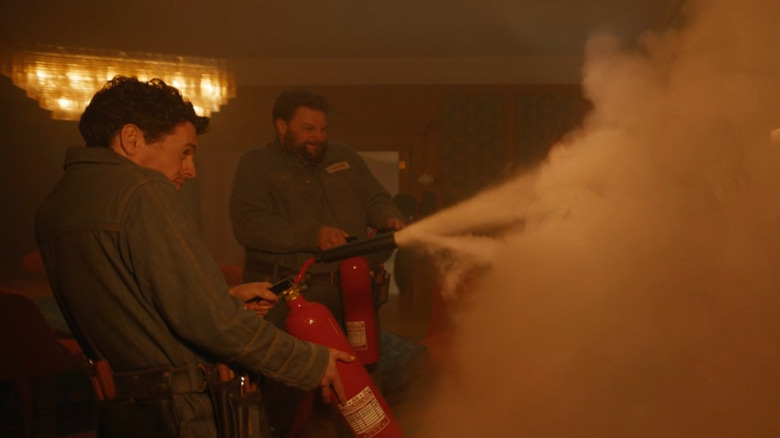
Early in Episode 3, "Reboot," Vision experiences some critical failures. We see this manifest within his mindspace as an actual fire, and D.U.M.-E. (Henry Lewis) and U. (Jonathan Sayer) are ready and waiting with fire extinguishers. Unfortunately, as rudimentary AIs, neither one is exactly the smartest calculator in the database, and instead of using the extinguishers on the actual fire, they wind up spraying E.D.I.T.H. (Emily Hampshire).
This is a direct callback to 2008's "Iron Man." In that film, Tony Stark (Robert Downey Jr.) has robotic arms to assist him with his Iron Man armor flight tests. Tony insists that D.U.M.-E. only use the extinguisher when he's actually on fire, but the arm winds up spraying him even when he's fine. It's a fun gag and a problem D.U.M.-E hasn't gotten any better at solving in the years since "Iron Man."
This isn't the first time "VisionQuest" referenced D.U.M.-E.'s tendencies to be over-reactive with a fire extinguisher. Back in Episode 1 when we first meet D.U.M.-E., his list of skills states "Fire Suppression." The MCU is closing in on 20 years of existence, and there are still plenty of nods that reward folks who have been watching and paying attention all that time.
Paladin's various tussles across the MCU
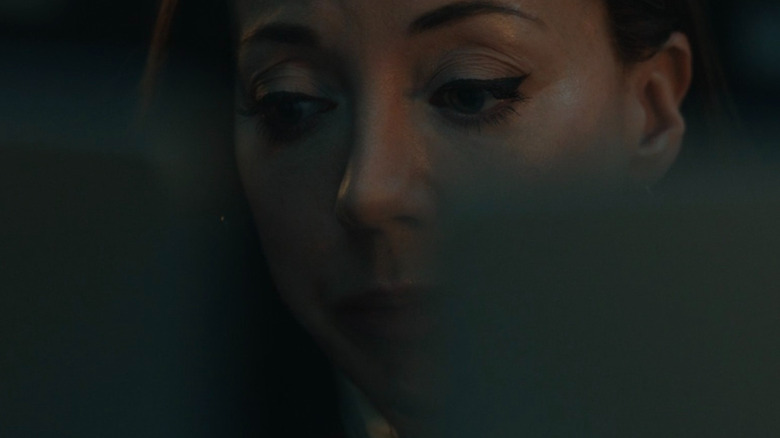
Paladin becomes the latest antagonist to grace the MCU. It's our first time seeing him, but Episode 3 offers a full backstory to show how he's spared with some of the biggest names in the franchise. First, his Handler (Diane Morgan) offers to send a gift basket to the Ten Rings Syndicate for the adamantium armor Paladin acquired. The Ten Rings were initially introduced in the first "Iron Man" movie, but they received a lot more lore in "Shang-Chi and the Legend of the Ten Rings." The Ten Rings are a clandestine criminal organization, and it sounds like they've likely acquired some stolen adamantium from the marbleized corpse of Tiamut shown in "Captain America: Brave New World."
Handler then mentions how Paladin had to pull shrapnel from an IED out of his gut from a "Brooklyn job." This seems to indicate that Paladin has fought with Punisher (Jon Bernthal) in the past although Paladin refers to him as an "old friend." The handler also brings up "bite marks from that thing half-way between a man and a wolf." We never thought we'd see the Disney+ special "Werewolf by Night" get referenced in the MCU again, but here we are.
Finally, we learn how Paladin took a billy club to the head in Hell's Kitchen, and that could only be Daredevil (Charlie Cox). What's fascinating is how Paladin seems to have a level of respect toward Punisher, Daredevil, and Werewolf by Night (Gael García Bernal). It's clear none of these men were his targets, or else he'd have to go to the ends of the Earth to bring them in. Instead, these sound like random encounters in the line of duty. That was probably best for everyone involved.
Tommy has read Ant-Man's book
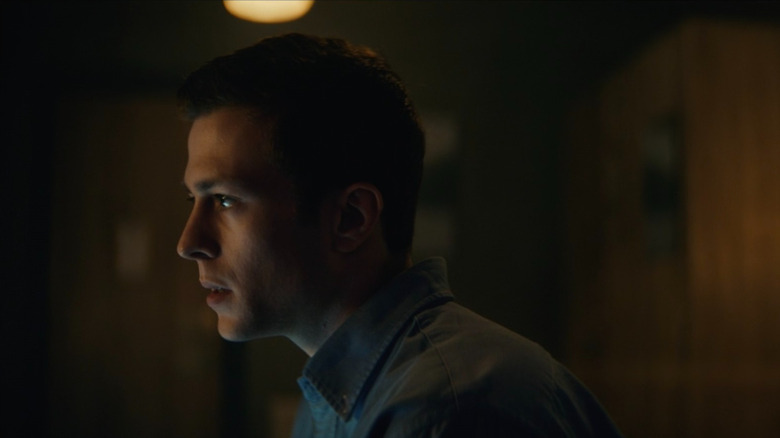
There's so much lore within the MCU that it can be difficult for even hardcore fans to keep up. It must be near impossible for characters actually living within this universe to keep track of who's who, but fortunately, Tommy reveals an easy way for anyone to catch up.
In Episode 3, Tommy is confused about how he has these memories of living in the hex with Wanda and Vision as his parents. However, he mentions that he knows who the two of them are thanks to a book about the Snap. This is likely referring to "Look Out for the Little Guy!" by Scott Lang (Paul Rudd." In "Ant-Man and the Wasp: Quantumania," Lang has written a book and become something of a celebrity in a post-Snap world. No doubt Scott would be able to track down Avengers to get their sides of stories and provide an all-encompassing look at the superhero team.
It's curious to wonder how much time Scott could've spent with Wanda and Vision. He only says one line to Wanda in "Captain America: Civil War." One supposes the two could've spoken at length when they were both imprisoned on the Raft at the end of that film. And maybe they caught up during Tony Stark's funeral in "Avengers: Endgame."
A glimpse into E.D.I.T.H.'s old boss
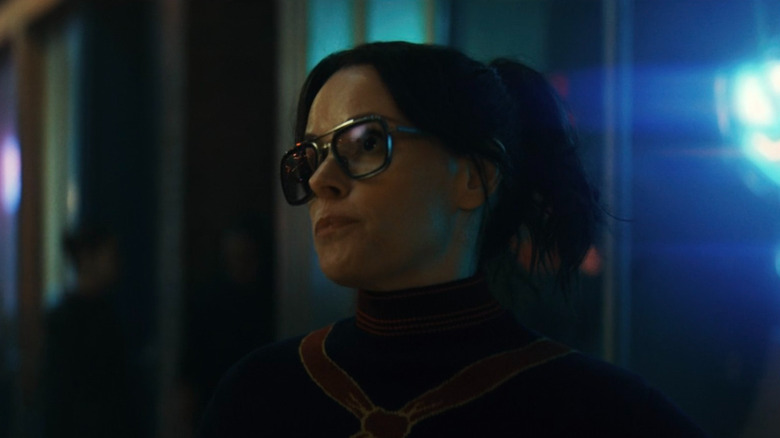
AIs have been integral to the MCU since the beginning. They all come to the forefront during "VisionQuest," and it's no surprise that each one gets a glimpse into their backstory throughout the series. In Episode 6, "Deadlock," Vision is in Madripoor looking for Tommy and lamenting how tired he is of having to navigate the emotional complexity of teens. E.D.I.T.H. pops in while wearing a very specific style of glasses to say, "Tell me about it, my first boss was a junior in high school."
This is a nod to E.D.I.T.H. getting introduced in "Spider-Man: Far From Home." Taking place after the events of "Avengers: Endgame" and Tony Stark's death, the film sees Peter Parker (Tom Holland) acquire Stark-style glasses that contain the E.D.I.T.H. AI system. It gives Peter access to Tony's global satellite network, which is why Mysterio (Jake Gyllenhaal) wants it for himself. He can orchestrate global catastrophes to get revenge on the Stark legacy.
The glasses E.D.I.T.H. wears during that line are a nod to those glasses. The moment also contains the perfect extra Spider-Man Easter egg because, if you listen carefully, you can hear some MCU Spider-Man theme music in the background.
Raza returns
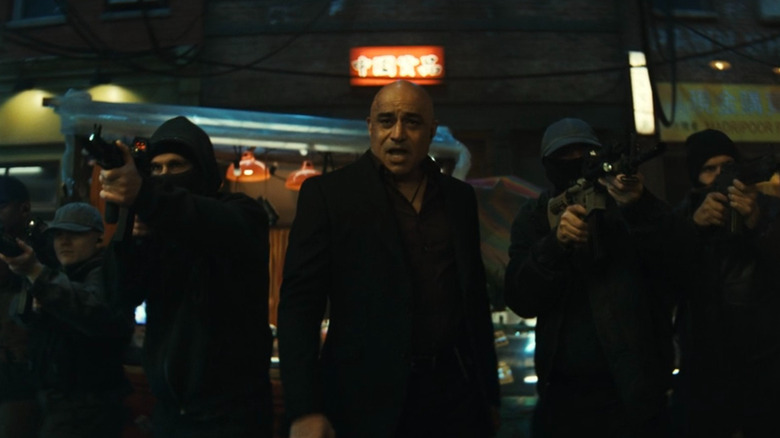
Vision has connections to the origins of the MCU. In "Avengers: Age of Ultron," Tony Stark and Bruce Banner (Mark Ruffalo) create Vision using J.A.R.V.I.S.'s core software. J.A.R.V.I.S. has been Tony's helpful AI assistant since the first "Iron Man" film, so even though Vision is more often affiliated with Wanda these days, his roots begin with Tony.
As such, it only makes sense for "VisionQuest" to bring things full circle and bring back the very first MCU villain — Raza al-Wazar (Faran Tahir). Raza is the commander of the Ten Rings located in Afghanistan. He's the one who orchestrates Tony Stark's kidnapping, forcing him to build the collective a Jericho missile. Instead, Tony gets to work building the first prototype Iron Man armor in the cave and escaping. While Raza recovered some pieces of that armor to make his own, Obadiah Stane (Jeff Bridges) steals it using a sonic device to temporarily paralyze Raza.
Many would've assumed Raza didn't survive that encounter, but he's alive and well in "VisionQuest." And it would appear he's learned some lessons since "Iron Man." If you look closely at his scene in Episode 6, he's wearing an ear device. No doubt he learned some lessons after "Iron Man" and doesn't want to fall victim to more sonic warfare.
Here, Raza is also working for the mysterious client and wants Paladin to hand over Vision. Raza's return is a tad underwhelming since he doesn't really get much to do or stand out. It feels like a callback for the sake of a callback.
Quote the Raven, nevermore
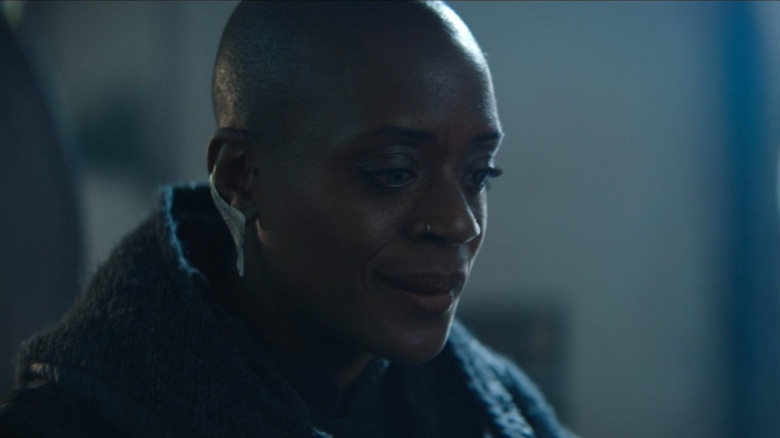
On "VisionQuest" Episode 7, "Immolation," Jocasta (T'Nia Miller) finally has everything she needs to unlock a container of nanites and turn humanity into her puppets. Her code requires voice recognition. To activate it, she recites a passage from Edgar Allen Poe's "The Raven." It's an appropriate poem for "VisionQuest" to utilize.
"The Raven" follows an unnamed narrator mourning his beloved Lenore. He's haunted by her loss and becomes tormented by a raven who won't leave him alone, descending into madness in the process. A central theme throughout "VisionQuest" is grief and mourning, with various characters trying to come to terms with lost loved ones. In fact, Episode 7 begins with a flashback scene of Phineas Horton (Paul Bettany) trying to create a synthetic man to replace his deceased son. His creation is J.I.M. (also Bettany), the original Human Torch. But in his pursuit to get his son back, Horton pushed away his wife and daughter, two loved ones who were still alive.
"The Raven" also ties back to several past Marvel projects. Marvel Comics adapted "The Raven" in 2006's "Haunt of Horror: Edgar Allen Poe" #1, which also adapts "The Conqueror Worm" and "The Sleeper." "The Raven" also inspired a Marvel character named Edgar the Raven. This was the pet of General Belial of the Department of Occult Armaments, which is part of the supernatural side of the Marvel Universe.
Phineas Horton's family has some Vision connections
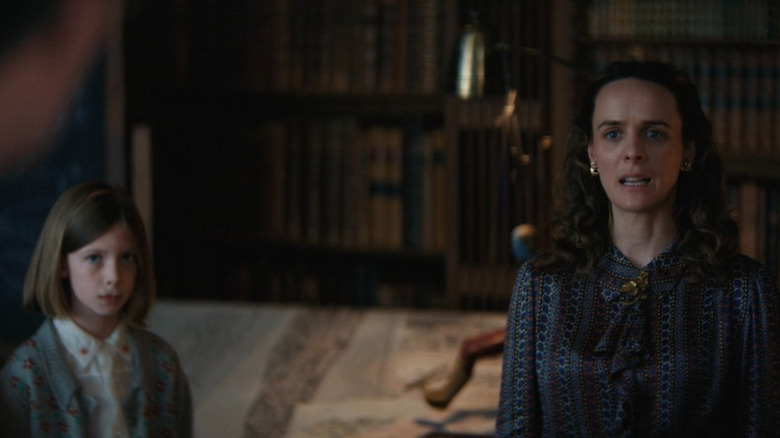
While we've heard references to Phineas Horton and J.I.M. throughout "VisionQuest," we finally get to meet them in Episode 7. The opening scene shows how Phineas has become so consumed with grief that he's actively pushing his wife and daughter away in the pursuit of bringing back his son, something that'll be so much more than just a machine. And the names of his wife and daughter just so happen to be Violette (Charlie Russell) and Victoria (Dulcie Connor).
The fact that both of their names start with "Vi" should ring a bell with anyone who read Tom King's "Vision" series from Marvel Comics that ran from 2015 to 2016. That series followed Vision as he creates a suburban family to live in Virginia away from traditional superhero antics. Vision has a wife, Virginia, and two kids named Viv and Vin. It's a dark family drama where Vision's quiet life slowly unravels despite the family's best efforts to blend into a typical suburban setting.
In Marvel Comics, Phineas' wife's name is Lanette, and he becomes a stepfather to Frankie. "VisionQuest" is casting that bit of comic canon aside in what appears to be an attempt to pay homage to one of the best Vision stories ever told.
The Synthetic Man
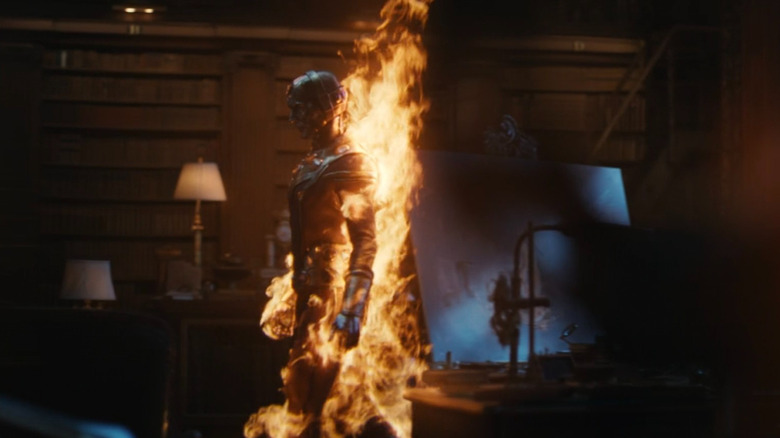
1939's "Marvel Comics" #1 introduced the first hero under the Marvel Banner — Jim Hammond, aka the Human Torch. Years later, Johnny Storm of the Fantastic Four would bear that moniker, but for a while, it belongs to Jim. He was a synthezoid created by Professor Phineas Horton to protect the world. His powers allowed him to burst into flames, and throughout his existence, he aided the New York City Police Department and even fought during World War II alongside Captain America. His appearance on "VisionQuest" is a nod to the history of Marvel but also recontextualizes his existence.
While going up in flames was Jim's superpower in Marvel Comics, he immolates on "VisionQuest" as a result of human emotions being too much for his hardware to handle. Still, Phineas pays tribute to his comic book history of being a hero by mentioning how J.I.M. "saved lives."
This suggests that J.I.M. was a hero long ago. The flashback sequence states that it takes place in 1939, the year he made his comic book debut, and Phineas probably completed J.I.M. shortly thereafter. "Captain America: The First Avengers: takes place in the 1940s, so there should be some overlap. But Steve Rogers (Chris Evans) never talked about a heroic android during his time (though there's a quick glimpse at a version of the Human Torch in Cap's 2011 film), which feels like something he should've mentioned at some point. Maybe J.I.M. was more low-key with his heroics, but either way, the scene is a nod to Jim Hammond's introduction in Marvel Comics, where he saved people long before Johnny Storm was a glint in Stan Lee's eye.
Some WandaVision talent comes back
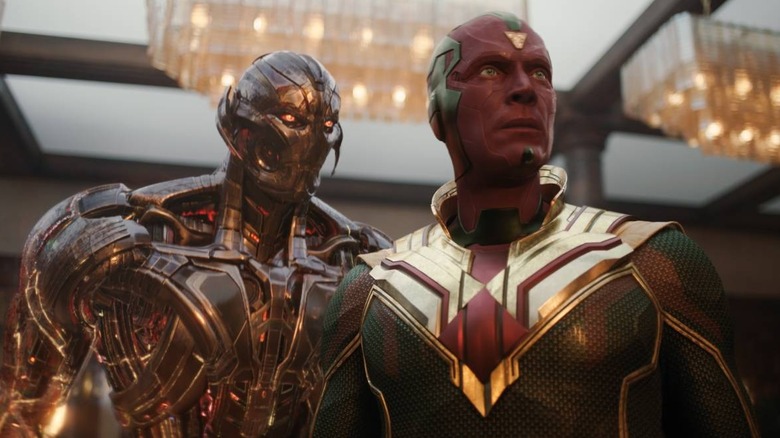
Many Marvel Disney+ series end with a massive fight between the hero and villain. "VisionQuest" Episode 8, "Forever," does see a physical battle between Vision and Ultron, who has a reconstituted body thanks to those nanites, but the more interesting confrontation occurs in a digital space. Ultron mourns Jocasta's death and decides he wants to use the nanobots to kill all humans. Vision doesn't have much time to stop him until the nanobots reach the nearest city, so he goes into the mindspace to try to talk Ultron out of it the only way he knows how — by using sitcoms to give Ultron space to grieve.
It's a delightful throwback to "WandaVision," complete with a brand new theme song for this new fake show, "UltraVision." And the creative team behind "VisionQuest" did their homework by recruiting Kristen Anderson-Lopez and Robert Lopez to pen "Don't Kill the World." That's the same team behind the music on "WandaVision," including the instant ear worm "Agatha All Along."
Singing the track is folk singer Jonathan Coulton, aka JoCo. He's actually a perfect fit for "VisionQuest," as many of his songs are about technology and geek culture like "Code Monkey" and "Mandelbrot Set," the latter being about a fractal math equation. It's a fun detail, and seeing how "VisionQuest" is the conclusion of the "WandaVision" trilogy, it makes sense to take things back to where they all began with one more banger of a song.