

All 7 Yul Brynner Western Movies, Ranked
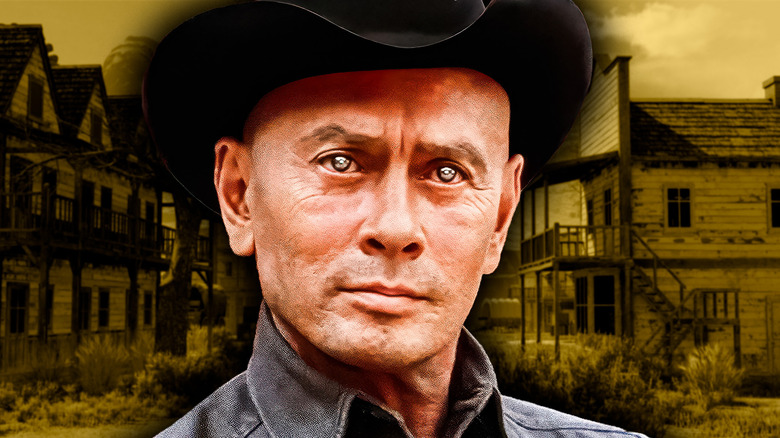
Becoming a successful screen actor requires flexibility if you want to achieve dramatic variety across your performances. But the funny thing about becoming a movie star is that you can build a career off of a stereotype that audiences attribute to you. From the 1950s through the 1970s, Yul Brynner (born Yuliy Borisovich Briner) commanded the silver screen with his stoic demeanor, intense gaze, and unmistakably hairless visage. But in spite of these trademarks, Brynner was excellent at playing characters whose subtle disposition could be read as suave, insecure, or even threatening. And in the context of the era, the Russian-American star was considered an "exotic" presence that, for better and worse, allowed him to play characters of multiple ethnicities.
In spite of his first feature appearance being 1949's "Port of New York," Brynner's path to becoming a household name came with playing King Mongkut of Siam in the feature film adaptation of Rodgers and Hammerstein's "The King and I," which led to his only Oscar nomination and win. 1956 was a big year for Brynner as he also made a splash with crucial roles in Anatole Litvak's "Anastasia" and Cecil B. DeMille's agelessly effects-laden "The Ten Commandments."
From swashbucklers to dramas, there were very few genres Brynner couldn't carry, although it was the Western that delivered some of his most memorable roles. The seven he starred in featured a handful of classics lumped in among a sea of average to terrible oddities that have largely been forgotten. With that said, let's rank every Brynner Western, and discover whether his unique charm elevated the material or sunk it.
7. Catlow
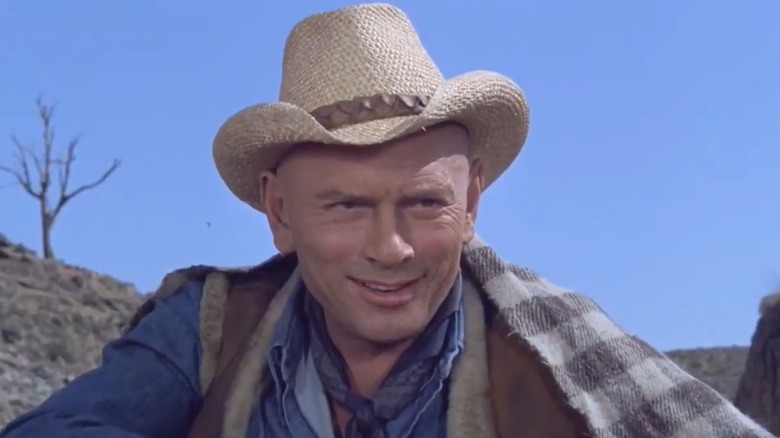
Based on Louis L'Amour's 1963 novel of the same name, the 1971 feature film adaptation of "Catlow" is presented as a buddy movie of sorts. In the wake of fighting alongside one another in the Civil War, Ben Cowan (Richard Crenna) and Jed Catlow (Yul Brynner) find themselves on opposite sides of the law, with the former upholding it as a marshal and the latter relishing in his outlaw life.
Every time they find one another in danger, the other manages to swoop in and save them on account of still being friends. Hot on their trail is Orville Miller (Leonard Nimoy), a gunslinger hired to kill Catlow for his past transgressions. On paper, "Catlow" presents itself as a change of pace for Brynner, as it shows a sillier side of him. Here, he's a big goofball with a silly grin on his face every time he gets caught. Unfortunately, not even a spirited Brynner can prevent this from being a deeply unfunny bore.
Once you see "Catlow," it becomes all too easy to understand why Quentin Tarantino believes it's the worst studio Western of the '70s. There's zero stakes with the central relationship between Catlow and Cowan, as neither of them feels as if they could actually betray one another. Brynner and Crenna don't even fully spend the movie together as a pair. Their cat and mouse escapades cease to be funny or engaging after a while once you realize the film has nothing else propelling the narrative. Nimoy is easily having the most fun here, but his scenes are few and far between to leave any kind of lasting impression.
6. Villa Rides
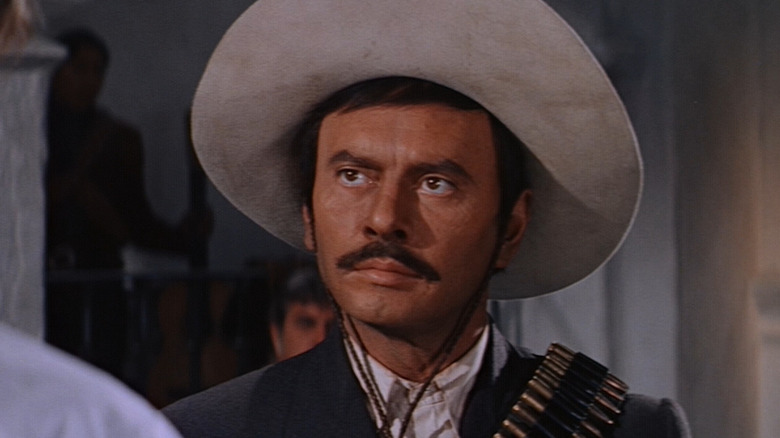
It's hard to discuss the Mexican Revolution without mentioning Pancho Villa, one of the key figures responsible for overthrowing dictator Porfirio Diaz from power in 1911. The controversial leader's plight has been captured on film many times over, whether through documentary footage of the man himself or underwhelming dramatizations like 1968's "Villa Rides." Considering the Buzz Kulik-directed film was an American production, we're introduced to the conflict through the eyes of Lee Arnold (Robert Mitchum), a fictional American pilot whose plane crash lands in Mexico. His flying skills, in addition to his nature as a gunrunner, become useful when Villa (Yul Brynner) and his crew take control of the town he's been staying in. From there, the two form an unlikely bond.
The greatest asset of "Villa Rides" lies in the massive scope of its action sequences involving train heists, aerial assaults, and on-the-ground battles. Kulik captures the enormity of all these men on horseback hurtling themselves towards explosions and gunfire. But otherwise, the film is an inert slog with plenty of violence, and it rarely means anything. It also features one of Mitchum's sleepiest performances, which is a shame considering his quietness carries a heavy intensity. Here, it's because he has very little to work off of.
To make matters worse, Brynner looks ridiculous in brownface, not to mention he hardly mines what makes Villa such an interesting historical figure. There's a more nuanced version of "Villa Rides" in the original Sam Peckinpah script, but we'll never see it
5. Return of the Seven
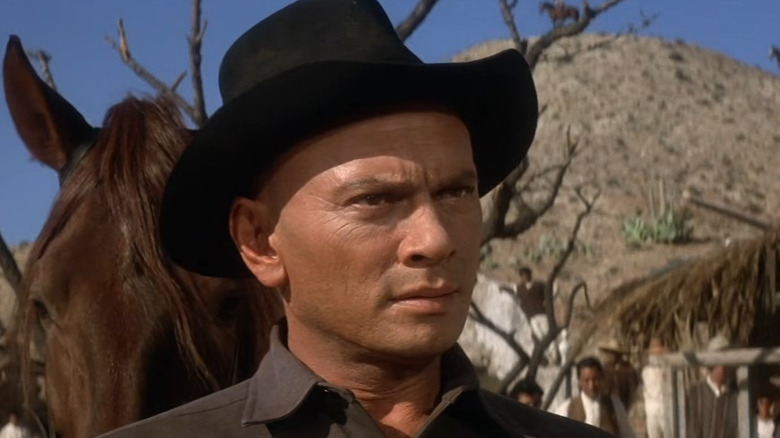
To this day, John Sturges' "The Magnificent Seven" remains one of the seminal American Westerns, and one that was lucky enough to garner its own reputation outside of its Japanese predecessor ("Seven Samurai"). In the years that followed, there was an attempt to recapture the magic of that film through a series of increasingly disappointing sequels. The best follow-up is 1966's "Return of the Seven," largely because it's the only one to feature Yul Brynner returning to the role of gunslinger Chris Adams.
In the years since liberating a small Mexican village from a group of vicious bandits, "Seven" member Chico (Julián Mateos) has since made a home there with his wife Petra (Elisa Montés). But like clockwork, a new threat has come into town in the form of Francisco Lorca (Emilio Fernandez), another bandit leader who has kidnapped a large portion of its population for his own nefarious means. Upon hearing word of Chico's capture among them, Chris recruits a new series of gunslingers (Robert Fuller, Warren Oates, Claude Akins, Virgilio Teixeira and Jordan Christopher) to form a new "Seven" with the intent on bringing them back safe.
While Brynner is committed to hopping back into the saddle, his entourage leaves a lot to be desired. No disrespect to Fuller, but he's no Steve McQueen. "Return of the Seven" unfortunately suffers from a severe case of sequelitis in its attempt to make the same movie over again. The result is a basic Western retread from director Burt Kennedy and screenwriter Larry Cohen that does more or less what you expect.
4. Adiós Sabata
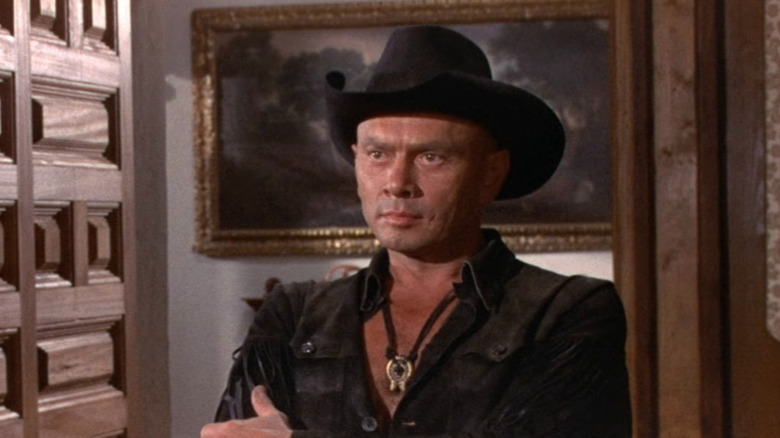
Spaghetti Western series like "Django," "Sartana," and Sergio Leone's "Dollars" trilogy tend to stay loose with their continuity across each film. They largely act as an excuse to follow these exceptionally cool gunslingers on missions based around vengeance, money, or a job. Among them is the "Sabata" trilogy from director Gianfranco Parolini, whose first and third entries ("Sabata" and "The Return of Sabata") feature Lee Van Cleef in the titular role. Right in the middle, however, is 1970's "Adiós Sabata," which sees Yul Brynner filling his boots.
Brynner's character in "Adiós" (who was initially called Indio Black) was retrofitted into being Sabata due to the success of the first movie. In the end, this adventure sees Sabata going on an adventure with a group of revolutionaries to hijack a gold-filled wagon belonging to the Mexico-occupying Austrian army. They learn, however, that the army's violent leader Colonel Skimmel (Gérard Herter) had already taken the gold for himself, prompting Sabata, along with his Austrian business partner Ballantine (Dean Reed), to do whatever it takes to snatch it back for themselves.
You won't find much in the way of character development or narrative thrust in "Adiós." Instead it's 105 minutes of Sabata and crew setting booby traps, getting involved in gunplay, and looking cool while doing it. Parolini knows what you come to his movies for and delivers on what he promises, even if it starts to wear thin by the end. As Brynner's only spaghetti Western, it's not too bad.
3. Invitation to a Gunfighter
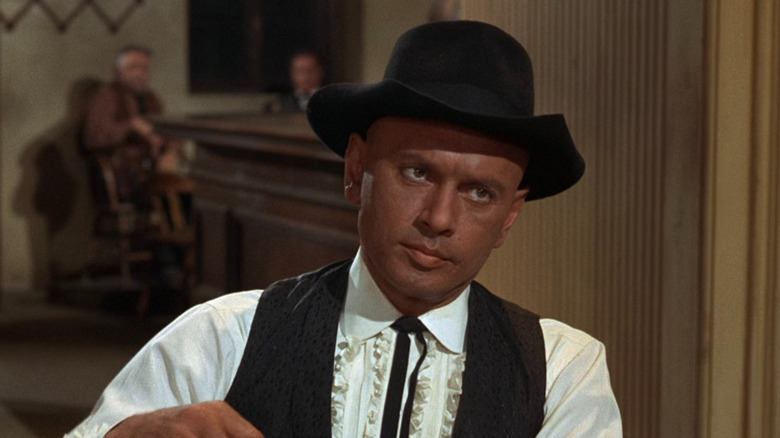
After "The Magnificent Seven," the idea of Yul Brynner as a gunslinger who arrives in town to take care of a menace conjures images of a hero. Richard Wilson's 1964 Western "Invitation to a Gunfighter" rolls with this, but presents the conflict through a much pricklier perspective. Prior to the titular character's acceptance of said invite, a Confederate soldier named Matt Weaver (George Segal) arrives at his New Mexico hometown, only to discover that everyone has turned against him.
In addition to learning that his fiancee Ruth (Janice Rule) has married another man, Matt also discovers his house was illegally sold to another couple, resulting in the death of the man occupying it. Town banker Brewster (Pat Hingle) proposes hiring someone to take him out, resulting in the arrival of Jules Gaspard d'Estraing (Yul Brynner), a biracial French gunfighter who's a lot more sophisticated and intelligent than they expect.
"Invitation to a Gunfighter" is a Western of many contradictions. For one, you have a tale of fighting prejudice in which Brynner is in blackface and the Confederate soldier is presented through a sympathetic lens. But where the film succeeds is in showing how the supposedly pro-Union town has its own ingrained racism that reveals their hypocrisies. Jules' allegiances keep shifting back and forth in his effort to determine whether his mission to kill Matt is a just one. Brynner makes the most of this with a layered performance that relies on the conundrums of moral superiority festering within supposedly good people. "Invitation to a Gunfighter" is more of a drama than an action movie, although the film's highlight sees Brynner go to town on some buildings using his bare hands.
2. The Magnificent Seven (1960)
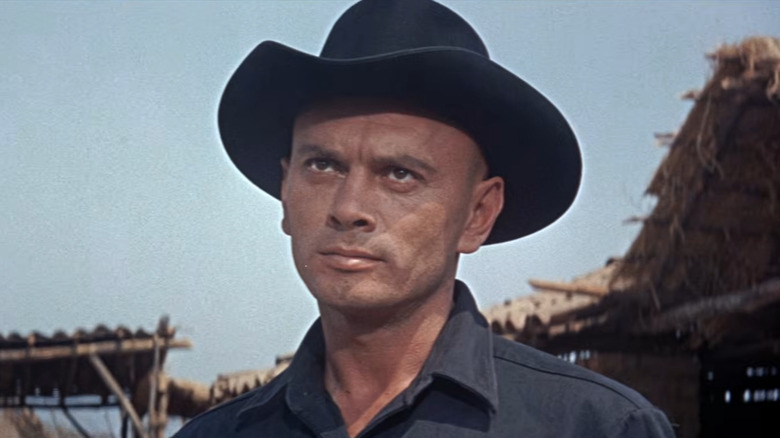
We wouldn't have some of our greatest American Westerns if not for legendary Japanese filmmaker Akira Kurosawa, whose Samurai films served as influences on the genre. Just a few years before Sergio Leone translated Kurosawa's "Yojimbo" into "A Fistful of Dollars" (the first entry in one of the greatest movie trilogies of all time), "Gunfight at the OK Corral" director John Sturges interpreted 1954's "Seven Samurai" through the lens of cowboys and their pistols with 1960's "The Magnificent Seven." Both films share the same general conflict, with a ruthless bandit and his men preying upon an impoverished village. In this case, the central threat is a man named Calvera (Eli Wallach), who takes what he wants and kills whomever he pleases.
Desperate for help, three members of the oppressed Mexican village set out in search of weapons, only to come upon a pair of gunslingers named Chris Adams (Yul Brynner) and Vin Tanner (Steve McQueen) who ultimately decide to help them. Together, the two men assemble a team of skilled marksmen like Bernardo (Charles Bronson), Lee (Robert Vaughn), Harry (Brad Dexter), Britt (James Coburn), and Chico (Horst Buchholz) to ward off Calvera, even if it may cost some of them their lives.
While "The Magnificent Seven" lacks the emotional and visual poetry that made "Seven Samurai" a timeless classic, it remains a sturdy Western front loaded with movie star charisma, thrilling shoot-em-up action, and Elmer Bernstein's iconic theme music. Brynner commands the screen from the moment he's first introduced, as he matches the intensity of Wallach's loathsome antagonist with his dark clothing and a gaze as sharp as daggers. Chris remains one of the great Western heroes of all time for a reason.
1. Westworld (1973)
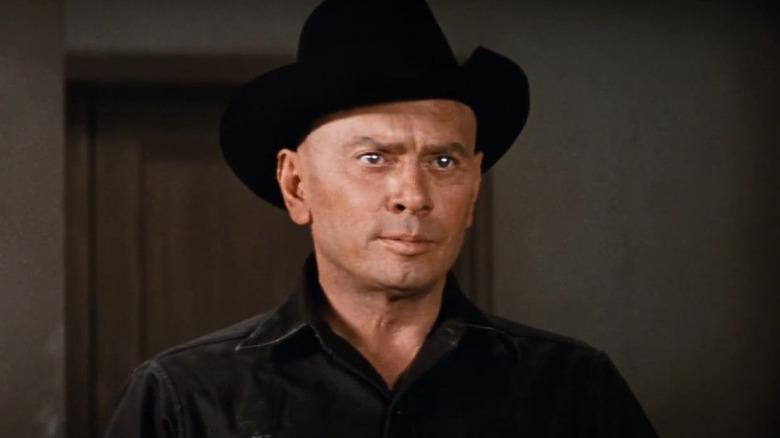
A good number of Michael Crichton's best-selling sci-fi works centered around mankind's unprecedented evolution of technology, and how quickly our hubris can spiral out of control. One of his most memorable stories isn't an adaptation of one of his novels, though, but his own screenplay for 1973's "Westworld," which he also directed. Not only is it considered one of the best sci-fi movies of the 1970s, but the best sci-fi Western of all time.
Prior to Crichton's later tale of dinosaurs breaking free in "Jurassic Park," Crichton's "Westworld" and its attractions gone wrong centers around a theme park run by a company named Delos, which houses various lands for guests to live out their fantasies in. While others take an immersive vacation in Roman World and Medieval World, best friends John Blane (James Brolin) and Peter Martin (Richard Benjamin) decide to take a trip to Western World, with the centerpiece attraction being the highly realistic android known as the Gunslinger (Yul Brynner). A few days into their trip, system failures start going off all around Delos' parks, resulting in John and Peter fighting for survival.
While "Westworld" would be expanded upon with the HBO television series, this is still the superior version. The eerie lack of score and quieter sense of escalation makes Delos' technical failures that much more unsettling. As far as Brynner's roles go, this is his finest hour, as he weaponizes his signature hero aesthetic from "The Magnificent Seven" to throw viewers off guard. It's a frightening performance in which his stoic demeanor wholly makes you believe you're being hunted by an android who will stop at nothing to kill you. Brynner barreling down those dimly-lit hallways is enough to make your skin crawl.