

5 Best John Wayne Movies Directed By John Ford, Ranked
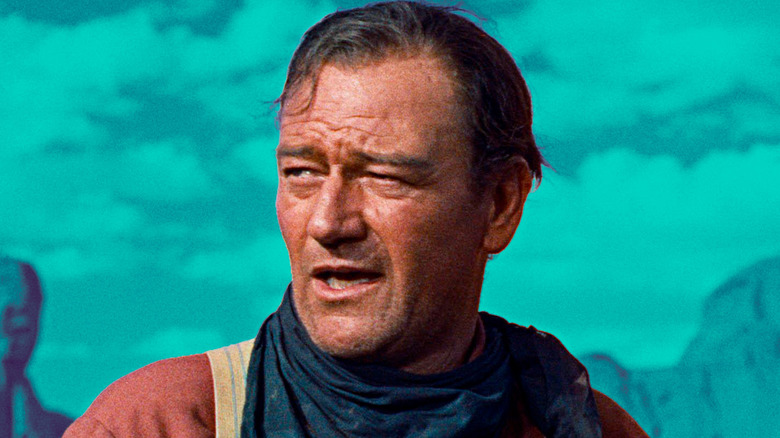
John Wayne made many great movies, but his collaborations with John Ford rank among his A-tier efforts. The actor and director made 14 movies together, with Wayne praising Ford as the best filmmaker in the game. Ford had a reputation for bullying his actors, and Wayne never shied away from confrontation, so they were arguably perfect for each other. With that said, which five movies represent their best work together?
Limiting this list to five movies was difficult because Ford and Wayne teaming up produced a lot of gold. However, they were especially great at making horse operas, which make up all of our chosen flicks. "They Were Expendable" and "The Quiet Man" didn't make the cut, even though they're excellent and deserve a spot on every film fan's watch list.
However, Wayne and Ford's journeys into the wild frontier gave us some of the best Westerns of all time, and that goes a long way. Now that we've covered the semantics, let's check out the best John Wayne movies directed by John Ford.
5. Fort Apache (1948)
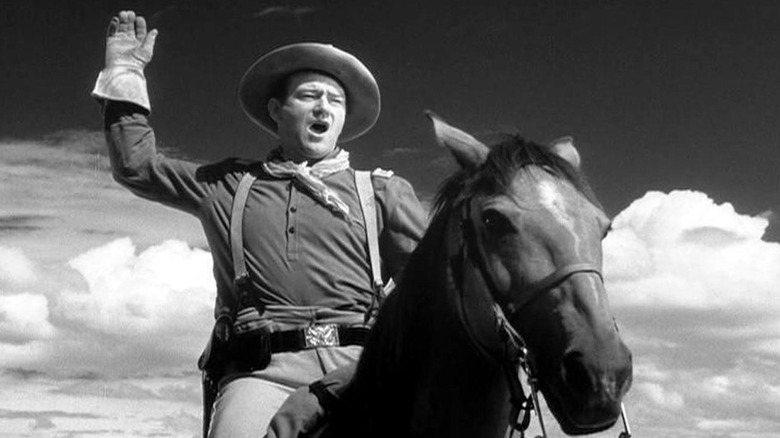
"Fort Apache" is the first installment of John Ford's "Cavalry" trilogy, which also includes "She Wore a Yellow Ribbon" and "Rio Grande." It isn't even the best movie in the trifecta — more on that later — but it's still an excellent flick that showcases Ford and John Wayne at their best.
Wayne stars alongside Henry Fonda, so the Western actor pedigree is strong. The story sees them play military commanders who clash while guarding a remote outpost. Lieutenant Colonel Owen Thursday (Fonda) is a selfish racist who wants glory. Meanwhile, Captain Kirby York (Wayne) is sensible and doesn't want their soldiers to get massacred by the Apaches. The end result is a compelling study of the destructive nature of egotism — one that's anchored by terrific performances from the stars.
Old Westerns are often guilty of portraying Native Americans as ruthless savages. Even some of Wayne and Ford's best flicks are unenlightened in that regard. However, "Fort Apache" is more nuanced, depicting the Apaches in a respectful light while acknowledging that American history hasn't been kind to them. "Fort Apache" doesn't romanticize the Old West — and it's all the better for it.
4. She Wore a Yellow Ribbon (1949)
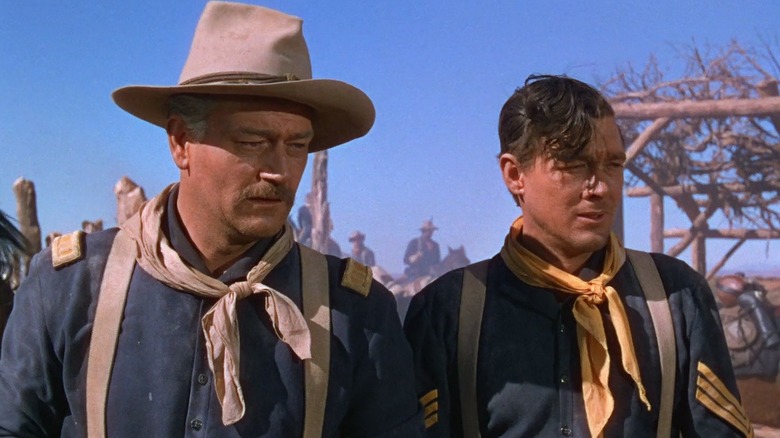
Some of the best art was born through suffering. John Wayne understood this sentiment, as he was almost trampled to death after falling off a horse while filming "She Wore a Yellow Ribbon." Fortunately, the actor survived and climbed back onto the saddle to deliver one hell of a performance.
"She Wore a Yellow Ribbon" sees Wayne play Captain Nathan Brittles, an aging soldier on the verge of retirement. The actor was only 42 when he made "She Wore a Yellow Ribbon," so kudos to Wayne for coming across as older. (The mustache also did some of the heavy lifting aging him, but good acting requires more than well-groomed facial hair).
We all love Wayne because he's one of the great tough guy actors. His character in "She Wore a Yellow Ribbon" is stoic and battle-hardened for sure, but the role also allowed Wayne to showcase his tender side. His performance is imbued with melancholy and sentimentality, making for an emotional viewing experience.
"She Wore a Yellow Ribbon" is also notable for its stunning Technicolor, which captures the stunning vistas of Monument Valley in all their glory. John Ford's Westerns are renowned for their visual splendor, but it really shines here.
3. Stagecoach (1939)
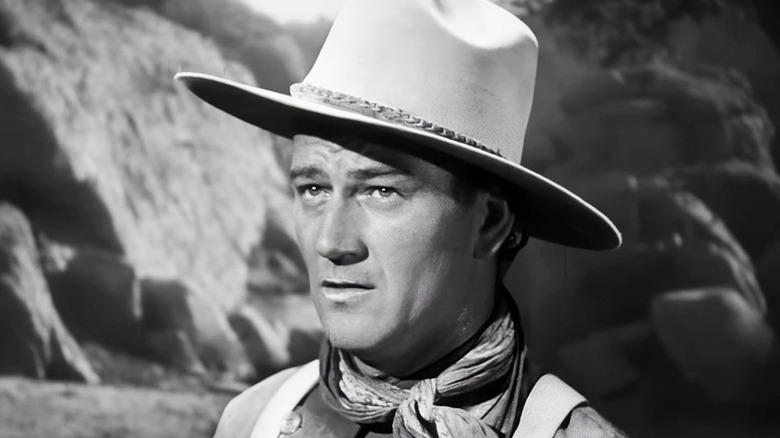
"Stagecoach" is one of the more racially problematic movies in John Ford and John Wayne's respective oeuvres. The Apache characters are portrayed as murderous villains who lack any shred of humanity or nuance. Maybe it can be chalked up as a reflection of the times, but it sours an otherwise perfect Western that every fan should watch.
"Stagecoach" centers around a ragtag group of characters as they journey through Apache country. Wayne plays the Ringo Kid, an outlaw who protects the travelers from those who wish to obliterate them. Ringo also on the hunt for the men against the real villains who got him sent to prison for a crime he didn't commit.
"Stagecoach" is perfect filmmaking. As Roger Ebert noted, it provided the blueprint for every other Western about characters banding together for a dangerous trek across the frontier. The action scenes are also exhilarating — especially the eight-minute horse chase sequence everyone probably thinks about whenever "Stagecoach" is mentioned. What's more, Orson Welles claimed to have watched "Stagecoach" 40 times while prepping for "Citizen Kane." You just know a movie is great when it inspires the creation of one of the best films ever made.
2. The Man Who Shot Liberty Valance (1962)
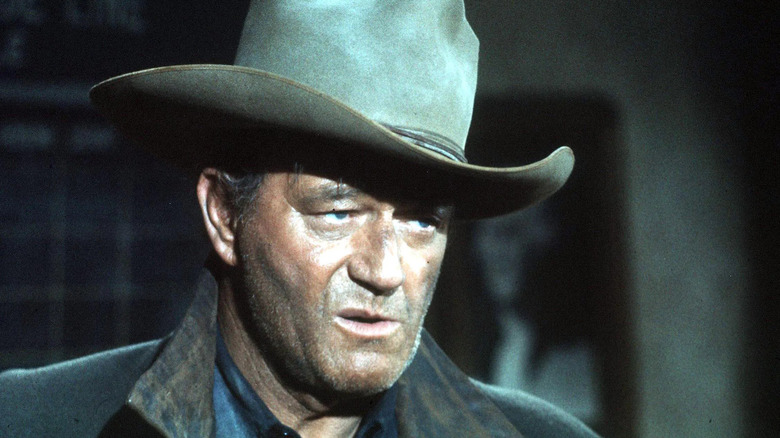
There's a line in "The Man Who Shot Liberty Valance" where a newspaper reporter says, "When the legend becomes fact, print the legend." It's in relation to Ransom Stoddard (James Stewart), who built his political career on the myth that he shot the film's titular outlaw. Tom Doniphon (John Wayne) helped stop the villain's reign of terror, but that story isn't as interesting.
The line also illustrates the deeper meaning of "The Man Who Shot Liberty Valance". The Old West is built on legends, but the real stories aren't glamorous and romantic. The film sets out to remind viewers that the wild frontier wasn't all that. However, it can also be interpreted as a commentary on politicians being valorized by the media, as a reporter literally refuses to print a story that risks grounding Stoddard.
Sergio Leone, director of "Once Upon a Time in the West," loved "The Man Who Shot Liberty Valance." He called it Ford's most pessimistic feature, and he had a point. Either way, it's an excellent flick with an all-star cast, with Lee Van Cleef, Lee Marvin, and John Carradine rounding out the macho ensemble.
1. The Searchers (1956)
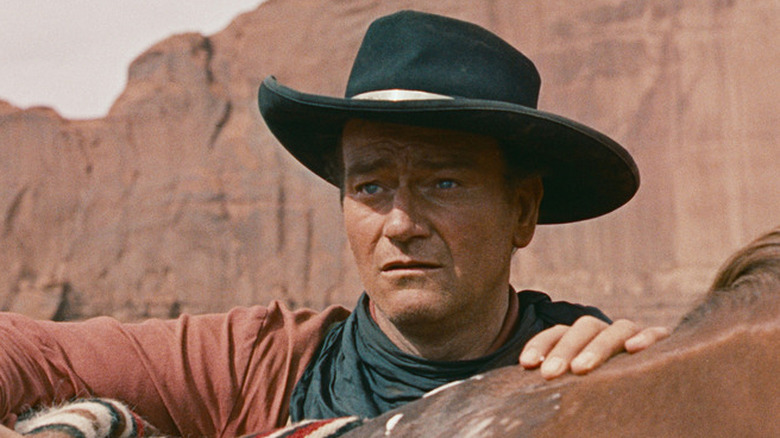
"The Searchers" is another potent examination of the Old West from John Ford — and it's one of the rare movies that sees John Wayne embrace the dark side. He plays Ethan Edwards, a bigoted Civil War veteran who returns home to find that his niece, Debbie (Natalie Wood), has been kidnapped by Comanches. He then sets out to find her, only to discover that she's assimilated into the tribe's way of life.
Ethan ultimately plans on killing Debbie so that she isn't further integrated into Comanche culture. He has a change of heart, but the fact he considered it says a lot about his sketchy worldview. However, Ford's film doesn't portray the Comanches as particularly enlightened characters, either. Every side is blinded by their own prejudices, which can be read as a commentary on how racism and conflict is poisonous to everyone involved.
Wayne gives one of the best performances of his career here. His character is often detestable, but he's also complex and not without some virtues. If you're one of the people who thinks The Duke was a one-note actor, watch "The Searchers" and you will see that he had some serious chops.