

Why Bilbo Left Middle-Earth At The End Of The Lord Of The Rings
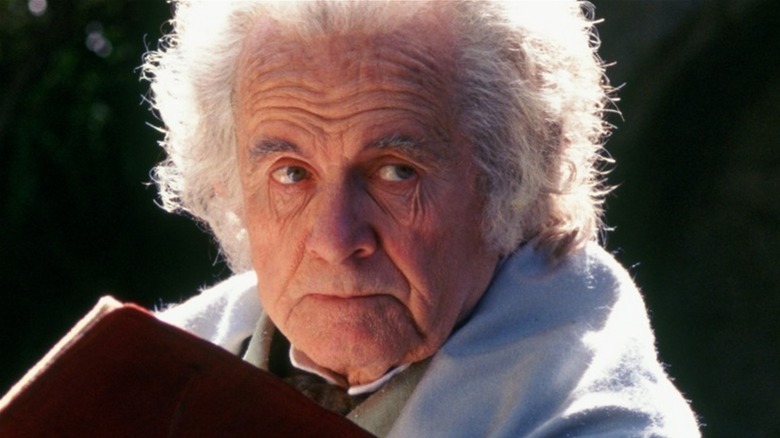
While "The Lord of the Rings" is a story of the triumph of good over evil, it has a surprisingly downbeat ending. One of the most interesting twists is that Bilbo, who plays a minor role in the story after "The Hobbit," ends up heading West, too. J.R.R. Tolkien provided a few reasons for Bilbo's special permission into the Undying Lands in the West. These include his role as a ring-bearer, his affiliations with Frodo and Gandalf, and a desire to experience "pure Elvishness." To understand Bilbo's special pass, though, you have to look at why Frodo (and Sam) were also allowed to go at the end of the story.
At the end of the "Lord of the Rings" books, the adventuring Hobbits return home to war in the Shire. While they win, it's a sobering epilogue to the war with Sauron. After that, the books and movies sync up, with the Shire at peace and Frodo heading West to heal from the wounds that the One Ring created in him. Sam follows West much later in life as a reward for the part he played as one of the Ring-bearers (albeit for a chronologically brief time).
While Bilbo's reason for leaving is similar in ways, it's also more multi-faceted. In an unsent letter written in September 1963, Tolkien started by explaining that part of Bilbo's ticket West came from Gandalf's own planning, saying, "Gandalf had a very great affection for Bilbo, from the hobbit's childhood onwards."
Bilbo was also Frodo's companion and still had a strong attachment to the Ring
While Gandalf liked Bilbo, that isn't the only reason he requested a spot for Bilbo on a boat pointed west. In the same letter, Tolkien added that Bilbo was close to Frodo, elaborating, "It is difficult to imagine a hobbit, even one who had been through Frodo's experiences, being really happy even in an earthly paradise without a companion of his own kind, and Bilbo was the person that Frodo most loved."
Along with having friends in high places and a special affection for his cousin (yes, Bilbo and Frodo are cousins, not nephew and uncle), there was also a reward element at play. The author laid this out, saying, "It is difficult to feel that [Bilbo's] life would be complete without an experience of 'pure Elvishness', and the opportunity of hearing the legends and histories in full the fragments of which had so delighted him."
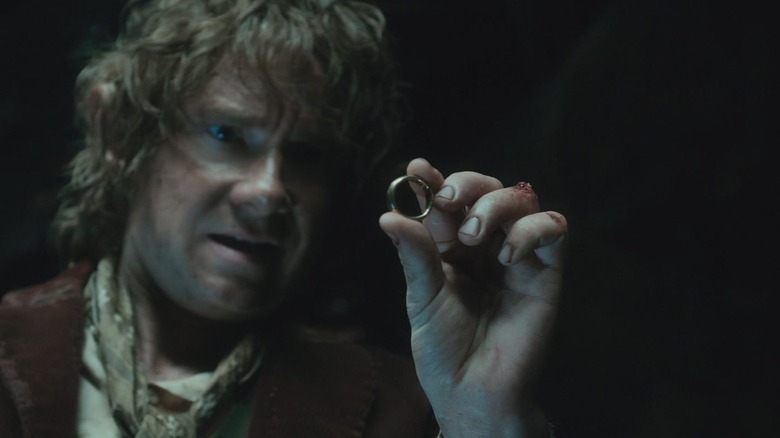
Similarly, Bilbo too had a part of his inner being permanently scarred by his encounter with the Ring. Unlike Frodo, who is careful not to use it often, Bilbo wears the One Ring all the time for decades. Tolkien spoke to this, saying, "But [Bilbo] also needed and deserved the favour on his own account. He bore still the mark of the Ring that needed to be finally erased: a trace of pride and personal possessiveness." The scars run deeper than you'd think based on Bilbo's playful dialogue, too.
Bilbo felt the call of the Ring even after it was gone
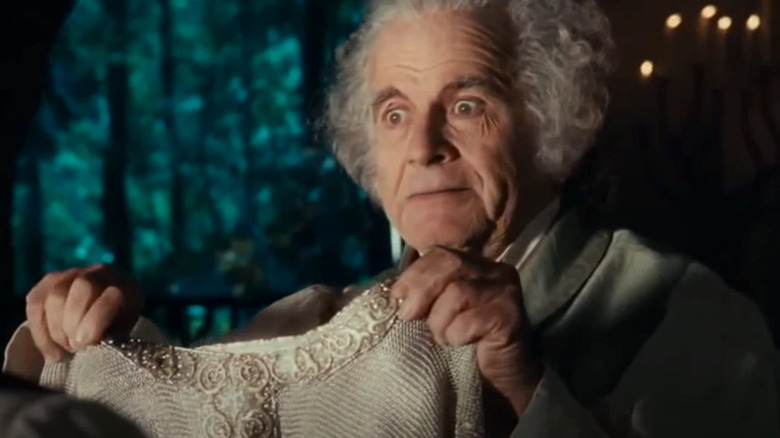
At the end of "The Return of the King," Frodo and his companions reunite with a very old Bilbo in Rivendell on their way back to the Shire. They talk about many things, but at one point, the old Hobbit asks, "What's become of my ring, Frodo, that you took away?" Frodo says he lost it, to which Bilbo replies, "What a pity! ... I should have liked to see it again. But no, how silly of me! That's what you went for, wasn't it: to get rid of it?"
Some of this is attributable to Bilbo being so old at this point, and forgetting things. But it doesn't change that when his mind wanders in old age, it goes back to "his" ring. We're not reading between the lines here, either. Tolkien himself called this out in the same September 1963 letter, saying: "Of course he was old and confused in mind, but it was still a revelation of the 'black mark' when he said in Rivendell ... 'What's become of my ring, Frodo, that you took away?'; and when he was reminded of what had happened, his immediate reply was: 'What a pity! I should have liked to see it again.'"
Despite being easy to overlook at the end of "The Lord of the Rings," Bilbo has some of the most compelling reasons to head West.