

5 Best Paul Newman Western Movies, Ranked
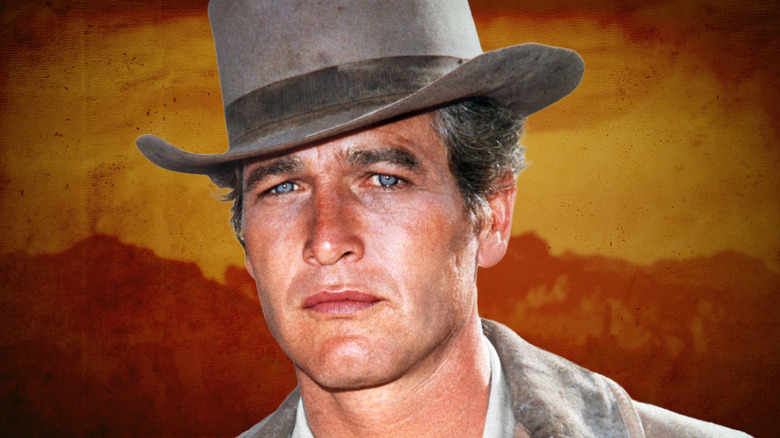
Whether you're a longtime fan of his work or only know him as the guy from bottles of salad dressing, you definitely are aware of Paul Newman, one of the most beloved and respected actors in the history of cinema writ large. A man of many talents who was known as an actor, entrepreneur, filmmaker and director, philanthropist, and even racecar driver, Newman won an Oscar (with way more nominations under his belt to boot), a whopping seven Golden Globes, a Emmy, and a BAFTA (alongside nominations for Grammys and Tonys), making him one of the most awarded and lauded actors not just of his generation, but of any generation. Beyond that, Newman was just ... cool. With his rakish good looks, winning grin, piercing blue eyes, and undeniable swagger, Newman is the kind of actor when you think of a classic Hollywood movie star, and thanks to his varied work throughout his career, he was able to embody all sorts of iconic roles and characters.
So what about Newman's classic Westerns? Throughout his career, Newman made a handful of Westerns, not counting the time he turned down "Dirty Harry" — which makes sense, since the genre was probably at its peak during a large part of Newman's career. It's ultimately a little strange that Newman only appeared in eight Western movies, but some of them are among the most famous films of his entire oeuvre. You might know Newman from "The Hustler," "Cat on a Hot Tin Roof," "The Color of Money" (which won him his sole competitive acting Oscar), or "Cool Hand Luke," but if you're not well-acquainted with Newman's Western works, here are his five best, ranked.
5. Pocket Money
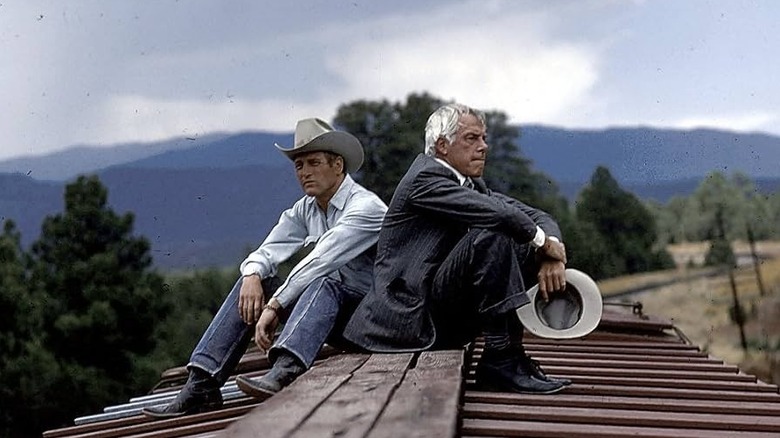
Released in 1972 and adapted from the novel "Jim Kane" by J. P. S. Brown, "Pocket Money," helmed by director Stuart Rosenberg and screenwriter Terrence Malick, stars Paul Newman as a cowboy in serious debt who gets some help from an unlikely source. With a title song written and performed by legendary songwriter Carole King, "Pocket Money" centers around Newman's Jim Kane, an impoverished cowboy in a ton of debt who links up with two shady guys named Bill Garrett and Stretch Russell (Strother Martin and Wayne Rogers, respectively). When Bill and Stretch convince Jim to bring 250 cattle across the Southern border from Mexico into the United States so that he can earn back all of the money he owes, Jim enlists his friend Leonard (Lee Marvin) and asks for his help, but to say the two run into a ton of trouble is a massive understatement.
"Pocket Money" is a relatively simple concept done well by Rosenberg and Malick, and with Malick and future stars like Hector Elizondo in the supporting cast, the world feels real and lived-in ... but it's also, unsurprisingly, a great performance from Newman himself. It didn't receive glowing reviews — Gene Siskel, in his now-lost review, jokingly suggested that the entire movie was an excuse for the stars to vacation in Mexico during filming — but it's still a solid Newman western, and one you should consider checking out if it hasn't crossed your radar before.
4. The Left-Handed Gun
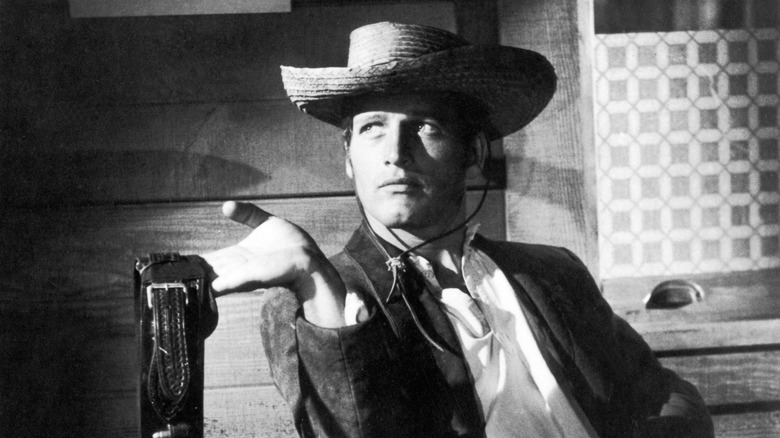
One of Paul Newman's earliest movies and one in which he portrays famous Western outlaw Billy the Kid, "The Left-Handed Gun," which hit theaters in 1958, is directed by Arthur Penn and based loosely on Gore Vidal's 1955 teleplay "The Death of Billy the Kid" — which, like "The Left-Handed Gun," aims to portray Billy in a more sympathetic light than usual. (Newman also portrays Billy in Vidal's teleplay, which originally aired as a part of "The Philco-Goodyear Television Playhouse.") In this take on Billy the Kid, we meet the famous character when he's still going by his original given name William Bonney and before he's killed a whole bunch of people ... and in New Mexico, William, who rechristens himself as Billy the Kid, meets cattle boss John Tunstall, who goes by "the Englishman" (Colin Keith-Johnston). Unfortunately, Tunstall is murdered by enemies as the state's Lincoln County War rages on, and Billy decides to get revenge while running afoul immediately of his former friend turned sheriff Pat Garrett (John Dehner).
"The Left-Handed Gun" isn't the most popular or well-known of Newman's movies, nor is it his biggest Western ... but you should still check out this genuinely fascinating take on Billy the Kid, a figure who looms large in the Western genre.
3. Hud
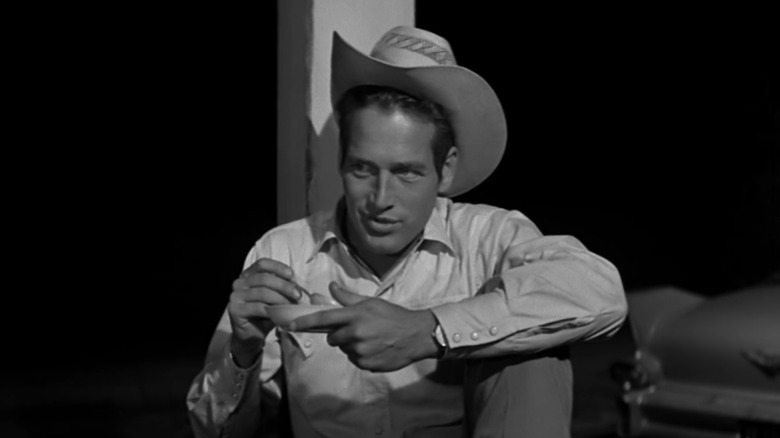
Now we're getting into the good stuff. Released in 1963, "Hud," directed by Martin Ritt and adapted from Larry McMurtry's 1961 novel "Horseman, Pass By" by screenwriters Irving Ravetch and Harriet Frank Jr., isn't just one of Paul Newman's most beloved films generally, but one of his very best Western flicks. Often called a "revisionist Western" because Newman's lead character Hud Bannon is quite definitively an anti-hero, "Hud" tells the story of, well, Hud, the son of a cattle rancher living on the Texas Panhandle. That cattle rancher, Homer Bannon (Melvyn Douglas), possesses principles and scruples that often put him at odds with Hud, a distinctly selfish and arrogant young man who's convinced that he knows more about the trade than his well-established father. As Hud proves to be a terrible influence on his impressionable nephew Lonnie (Brandon deWilde) — and both men lust after the ranch's housekeeper Alma Brown (Patricia Neal) — we watch as Homer and Hud find themselves locked in another battle of wills, clearly continuing a war they've been fighting for years.
"Hud" was nominated for a ton of Academy Awards, including a nod for Newman in the best actor category — and ultimately, Douglas and Neal took home statues for best supporting actor and best actress, specifically. Awards chatter aside, though, "Hud" is definitely one of Newman's best all-around films, and you won't want to miss this great Western.
2. Hombre
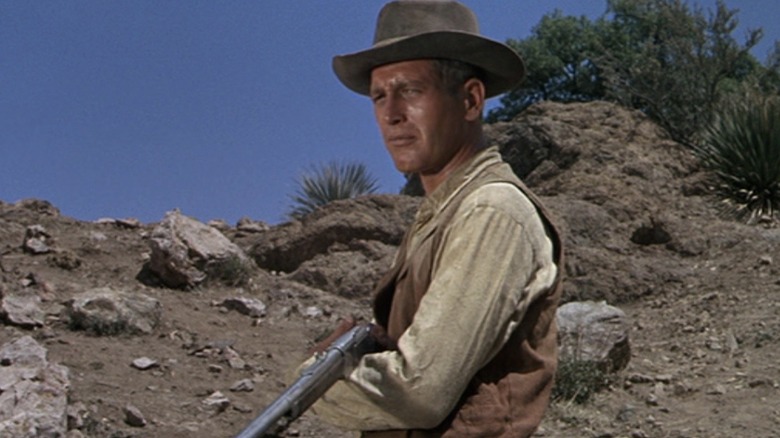
You already saw Martin Ritt's name in this article when we discussed "Hud" on this list, and across the years, he and Paul Newman made six films in total together: "Hud," "The Long, Hot Summer," "The Outrage," "Paris Blues," "Hemingway's Adventures of a Young Man," and "Hombre," the pair's final collaboration. Adapted from Elmore Leonard's 1961 novel of the same name by (once again) Irving Ravetch and Harriet Frank Jr., "Hombre" features Newman as John Russell, a cowboy raised by members of the indigenous Apache tribe. Upon heading into a small Western town only to learn that his adoptive father has passed away and left him a boarding house that he decides he wants to sell.
Throughout the narrative of "Hombre," there's a clear push-and-pull between John's identity as someone raised amongst the Apaches and his physical presence as a white man in the West, and as he prepares to sell the house, a number of genuinely horrifying things happen to John and his allies — culminating in a tragic yet satisfying ending we won't explore here. Bolstered by performances from Fredric March, Richard Boone, Diane Cilento, Martin Balsam, and Frank Silvera, "Hombre" is a truly great part of Newman's body of work, but it's still can't touch his very best Western ... and one of the best Western movies of all time.
1. Butch Cassidy and the Sundance Kid
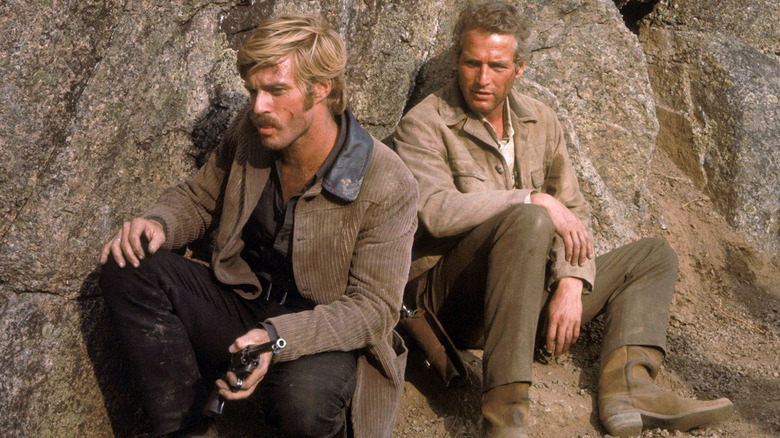
Sorry, but you're actually just not even a real Western fan if you haven't seen "Butch Cassidy and the Sundance Kid." Directed by George Roy Hill and written by William Goldman (the man behind the screenplays for "All the President's Men" and, of course, "The Princess Bride"), "Butch Cassidy and the Sundance Kid" stars Paul Newman and Robert Redford (what a pairing) as the titular Butch Cassidy and his loyal sidekick the Sundance Kid, who are, respectively, the leader of an outlaw group called the Hole-in-the-Wall Gang and an expert sharpshooter. When Cassidy's leadership of the gang is threatened by the "choice" to have Harvey Logan (Ted Cassidy) replace him, Cassidy handily defeats Logan in a knife fight and, emboldened by his success, plans a series of robberies.
The first train robbery goes smoothly and successfully, but during the second, Cassidy mistakenly blows up one of the train cars and puts the entire operation in jeopardy. From there, the film is a madcap chase that starts with Cassidy and the Sundance Kid jumping off a cliff into a nearby river and continues with them absconding to Bolivia, and it's an absolutely action-packed delight from beginning to end. Newman earned his reputation as one of the most charming and talented lead actors of his generation thanks to his body of work, but without question, "Butch Cassidy and the Sundance Kid" is one of his finest films ever ... and it's definitely his best Western.