

5 Western Movies With 100% On Rotten Tomatoes
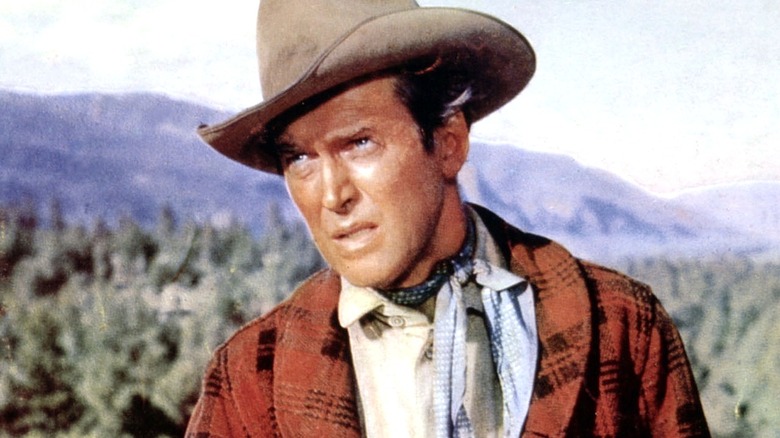
Let's giddy on up and talk about the Western. One of the oldest American film genres, this realm's cinematic legacy can be traced back to the days of "The Great Train Robbery." From there, audiences couldn't get enough of movies starring cowboys, charging horses, and dusty locales. That love has endured into the modern world with movies like "God's Country," "The Harder They Fall," and "Old Henry," and a slew of Western TV shows like "Yellowstone" and its many offshoots, proving this genre's enduring appeal.
Helping keep this reputation alive and well are the classic 20th century Western movies that are now regarded as the very best entries in this genre. This includes five especially revered Westerns that have scored impressive 100% ratings on Rotten Tomatoes. There's nary a negative review in sight for these motion pictures, each of which takes the Western film into new exciting directions while capturing the endless visual possibilities of this rich cinematic tableau. There's all kinds of amazing attributes under the belts of these titles that the various reviews collected by Rotten Tomatoes help highlight.
If one was looking for the cream of the crop of a genre that's heavily defined American cinema, these five Westerns and their Rotten Tomatoes reputations are a divine place to start.
Stagecoach
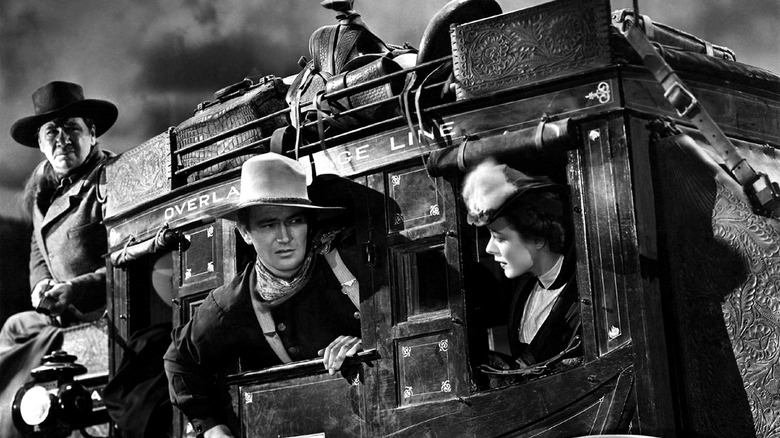
John Ford inadvertently started a new age for cinema with 1939's "Stagecoach," which propelled John Wayne to stardom. Wayne was one of many figures in this title's ensemble, who contend with a dangerous stagecoach ride to Lordsburg, New Mexico. Many of the best John Wayne movies of all time wouldn't have been possible without "Stagecoach" establishing the actor as a major draw. It isn't just historical notoriety, though, that has informed the positive reputation of "Stagecoach."
The film's impressive Rotten Tomatoes score comes down to a multitude of factors. For one thing, "Stagecoach" is packed to the brim with memorable performances. Supporting characters like Doc Boone (Thomas Mitchell) and Dallas (Claire Trevor) have long captivated audiences and done as much to turn this into a classic as Wayne's performance. Then there's the direction by John Ford, one of the most acclaimed American filmmakers of this era. While he's often helmed Westerns of tremendous scope, the more claustrophobic "Stagecoach" is where his gifts for framing really excel. Meanwhile, running at 97 minutes, "Stagecoach" makes the most of its truncated length with lots of suspense and memorable acting.
Though not a lengthy epic, "Stagecoach" provides a lot for viewers to digest afterwards. Even if you're totally unaware of this movie birthing John Wayne's larger cultural significance, "Stagecoach" is still impressive enough to earn its universal critical acclaim.
My Darling Clementine
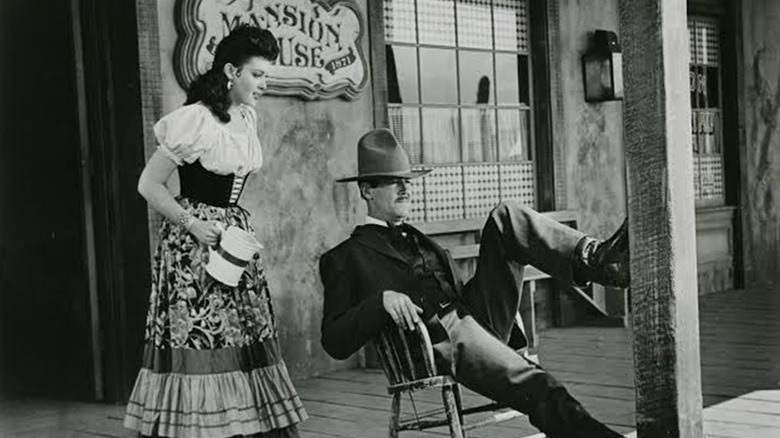
Space is beautifully utilized throughout "My Darling Clementine." John Ford, one of the most Oscar-nominated directors in history and the helmer behind several of the American Film Institute's top 10 Westerns, reaffirms his legendary status with his repeated emphasis on depth within his shots. In one striking image, Wyatt Earp (Henry Fonda) enters a bar inquiring about Doc Holliday's (Victor Mature) presence, with the left side of the frame being a gigantic vacant space. Earp, unsure of where Holliday is, is now alone and this emptiness reinforces his vulnerability. A few seconds into this unblinking shot, adversaries begin filling up that empty space one at a time.
In the span of a single shot, Ford says so much about Earp and his relationship to the denizens of the town Tombstone. If you want magnificent visual storytelling, "My Darling Clementine" will satisfy like a fresh cup of water parches a thirsty person's throat. However, "Clementine" also shines as an acting showcase for folks like Mature. Fonda, meanwhile, carves out a distinctive new personality for Earp that stands apart from the man's towering cultural legend.
It's no wonder the 34 current critics chronicled on the "My Darling Clementine" Rotten Tomatoes page gave it immensely positive raves. This is a sublime Western that can leave audiences gasping in just the way certain unforgettable shots are blocked.
The Treasure of the Sierra Madre
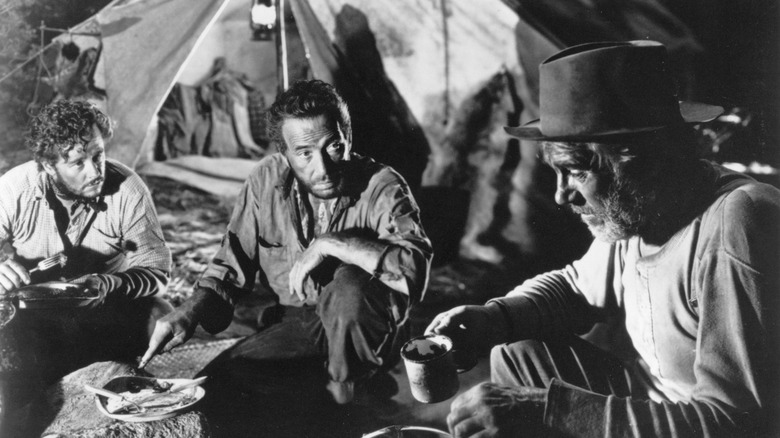
Something delightful about venturing back into old Westerns is witnessing performances or screenwriting that established enduring cinema archetypes. Figures that kids see everywhere in cartoons or genre films (such as characters modeled after Peter Lorre) are often rooted in performers from '30s/'40s cinema. Walter Huston as Howard in "The Treasure of the Sierra Madre" is one such figure, as Huston portrays Walter as the quintessential prospector. Every subsequent pop culture icon that talks in an old Southern drawl or gets excited upon hearing the word "gold" owes a tremendous debt to Huston's performance.
Watching "The Treasure of the Sierra Madre" decades after its release, Huston's performance stands fully apart from the characters and parodies it spawned. The entire movie fires on all cylinders to function as a compelling tale of greed capsizing three men. Better yet, "Sierra Madre" is one of Humphery Bogart's best movies, a triumph given his incredible career. Bogart's gift for playing world-weary souls is a perfect fit for portraying Fred C. Dobbs and his increasing obsession over gold. There's a captivating darkness to this man who Bogart portrays with transfixing ease.
The incredible reviews that "The Treasure of the Sierra Madre" has amassed on Rotten Tomatoes are more than justly earned. Along with giving us the urtext for all movie prospectors to come, this remarkable descent into how selfishness destroys humanity remains an endlessly absorbing tale eons after its premiere.
The Naked Spur
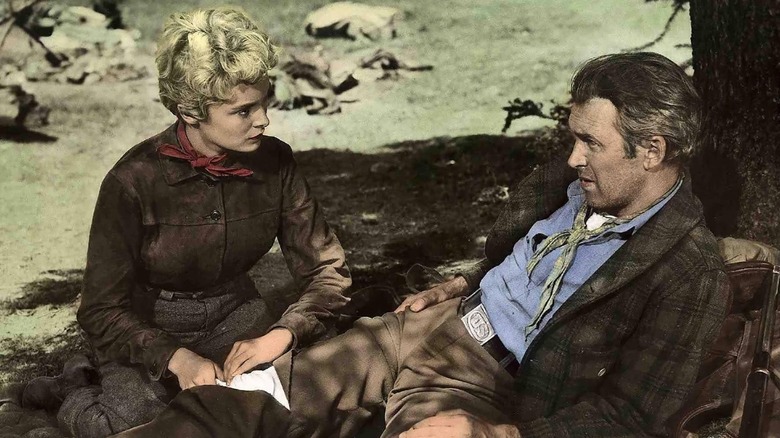
Across Jimmy Stewart's best movies, a large number of Westerns crop up. That prominence partly reflects the dominance of the Western across pre-1970 American cinema (practically every actor intersected with the genre once or twice). Still, Stewart anchored quite a few cowboy-centric films in his time, from "The Man Who Shot Liberty Valence" to "Destry Rides Again" to "Winchester '73." Throw a rock at the best Western movies of all time and you're bound to hit one starring Stewart. One motion picture in this genre that Stewart headlined was Anthony Mann's 1953 effort "The Naked Spur."
Here, Stewart played Howard Kemp, a bounty hunter whose mission to bring in the nefarious Ben Vandergroat (Robert Ryan) gets complicated when he's forced to work with prospector Jesse Tate (Millard Mitchell) and Roy Anderson (Ralph Meeker). The prospect of securing $5,000 forces the trio to work together, but uncertainty and distrust looms over the group. Filmed in vibrant Technicolor, the radiant springtime tableaus seem to mock these internally tortured characters. All that luscious imagery is one of many elements underpinning the movie's universal acclaim on Rotten Tomatoes critics.
The stellar performances from the entire cast, including Stewart in one of his grimier leading man turns, are also constant sources of praise in reviews. "The Naked Spur" proves once more that Jimmy Stewart and Westerns are, as General Miles Quaritch (Stephen Lang) would say, "a potent mix."
The Shooting
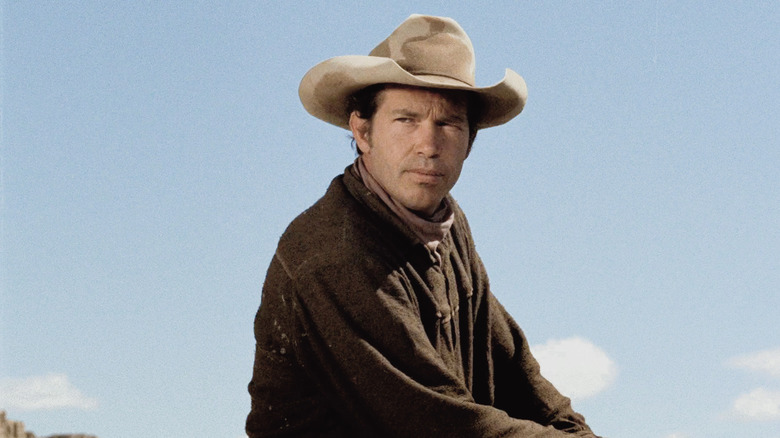
Decades before the Lonely Island short of the same, the 1966 feature film "The Shooting" told a story about people prone to gunfire at the drop of a hat. This film establishes this through an opening credits scene showing Willett Gashade (Warren Oates) on the trail, getting water, constantly looking over his shoulder. Someone's following him. This scene silently establishes that this man is convinced he's in danger, a reality reinforced by Richard Markowitz's unsettling score. This solidifies the dearth of answers and instability plaguing the main "Shooting" players.
Eventually, Gashade and his pal Coley (Will Hutchins) are hired to escort an unnamed Woman (Millie Perkins) to a far-odd destination. Her name, true motives, and backstory remain shrouded in mystery despite Gashade trying his best to wring answers out of her and anyone she talks to. The Western has historically been a place where stoic definitions of masculinity wield immense power. Here, director Monte Hellman and screenwriter Carole Eastman (the latter credited under a pseudonym) craft a Western where conventional "heroes" have no clarity and wander aimlessly across the desert.
Even gun-happy baddie Billy Spear (Jack Nicholson) is racked by pangs of loneliness and resorts to ceaseless violence to maintain "control" over his existence. Between these thematic details, the litany of strong performances, and Markowitz's unforgettable compositions, "The Shooting" certainly earns its lofty Rotten Tomatoes status.