

5 Most Rewatchable Cyberpunk Movies Of All Time
When setting out to define cyberpunk as a genre, writer Bruce Sterling famously described William Gibson's fiction as combining "lowlife and high tech." Gibson drew inspiration from the punk movement and the emerging hacker culture, but cyberpunk rapidly expanded beyond that defiantly underground foundation, with movies, comics, and novels reflecting contemporary anxieties through dystopian settings. The subgenre's ideas have lingered in the cultural imagination far longer than anyone initially realized.
There are countless classics in this enduring wave of sci-fi, and this isn't a comprehensive list of the best cyberpunk movies ever made. Instead, these are the following five films which we find ourselves returning to repeatedly; some of the greatest cyberpunk movies (like "Videodrome") are too bleak to throw on casually, while others (such as "Akira" or "Ghost in the Shell") remain narratively complex even after several viewings, and can't just be thrown on when we're in the mood for something exciting and familiar. This isn't to say that these five movies are less imaginative or offer less food for thought, but that we know them all like the back of our hand, and they still feel every bit as fresh as when we first saw them.
Even if they don't top any list of the best cyberpunk movies, these are the classics we find ourselves returning to, over and over again.
Blade Runner
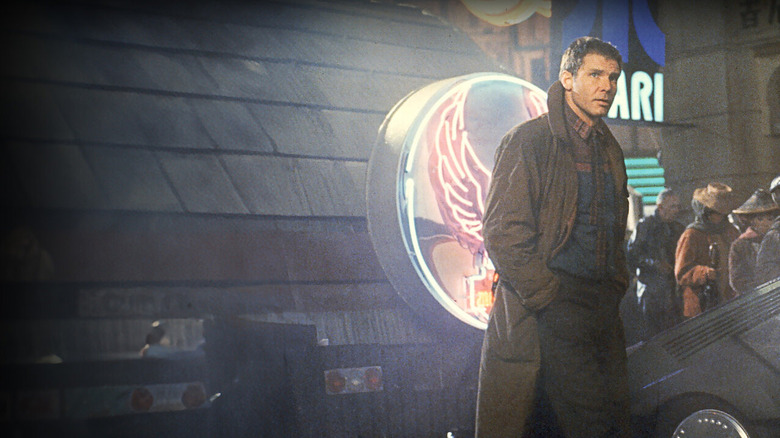
One of the first movies that helped define what cyberpunk would come to mean in the cultural consciousness, it's nearly impossible to do a list on the genre without circling back to Ridley Scott's adaptation of Philip K. Dick's novel "Do Androids Dream of Electric Sheep?" While we said above this isn't the list of the best films in the genre, and that we'd be overlooking any movie with narratives too bleak or complex to be considered rewatchable, "Blade Runner" has become the most unlikely of comfort movies for millions.
A moody tech-noir set in a climate-devastated Los Angeles, overrun by neon billboards and endless rain showers, this sci-fi mystery could hardly be considered cozy, raising existential questions about both the dubious humanity of its Replicant characters and the environmental devastation of its world. There's a reason it flopped at the box office upon original release; arriving in theaters just a few weeks after "E.T. The Extra-Terrestrial," it was a doom-and-gloom vision of mankind co-existing with another form of intelligent life, as despairing as it was eerily beautiful to look at.
Since becoming an enduring cult classic, "Blade Runner" has also become an unlikely comfort film for millions of sci-fi fans, with repeat viewings peeling back the intricate tech mystery to reveal a surprisingly earnest tribute to vintage Hollywood noir. Harrison Ford's Deckard is one of his most complex roles, but also a testament to how well the actor would have fit as a hardboiled detective in that genre's heyday; he makes a brooding, enigmatic figure unexpectedly approachable. It's an eminently rewatchable film despite its overwhelming darkness.
The Matrix
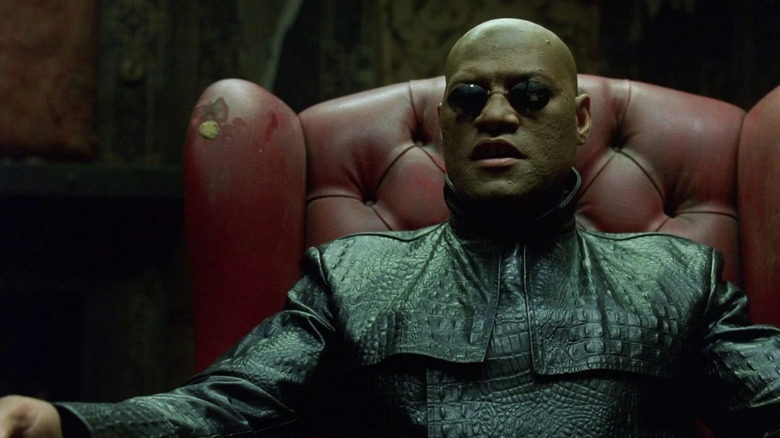
If "Blade Runner" defined what cyberpunk could be, then the Wachowski sisters aimed to redefine the genre for the new Millennium with "The Matrix," pulling from Hong Kong action cinema and the densest sci-fi anime to create a new breed of high-octane Hollywood blockbuster. For proof of its enduring success, look no further than how it birthed multiple phrases into the cultural consciousness, managing to condense existential themes like the possibility we're living in a simulation into terms as easily digestible as the popcorn and soda the movie was best paired with. You don't have to have seen "The Matrix" to have heard people say we're living in the Matrix, or that they've been awakened to a new reality by taking a red pill — although, these days, you're most likely to hear that from people whose views stood at odds with the sibling filmmakers' ideology. Lilly Wachowski famously shouted down Ivanka Trump and Elon Musk for using one of her film's catchphrases to promote their conservative awakenings.
One of the reasons "The Matrix" has remained so rewatchable despite many of the worst people on the internet loudly misinterpreting it isn't just because it offers some of the most gob-smacking, boundary-pushing action set pieces in history, but because its ideas have developed alongside its creators. The film is now widely interpreted as a metaphor for a trans awakening after both directors came out, and the far more divisive sequels saw increasingly heady ideas as a smokescreen for more personal ideas about bodily and creative autonomy. They have their fans, but they've never been fully able to recapture the pure lightning-in-a-bottle energy of this first movie. It's by far the best of the franchise.
Robocop
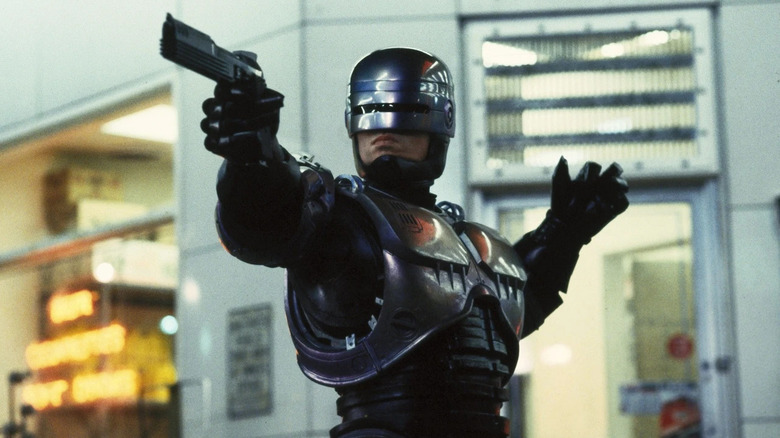
It was director Paul Verhoeven's wife, Martine, who was most responsible for this next cyberpunk classic being brought to life. The controversial Dutch filmmaker rejected the offer to direct the movie twice, not making it past the first page on his first attempt, and his limited grasp of English made him miss the satire on his second go round. It was only when his partner looked at the script that he was persuaded to give it a chance, won over by the core of the story being a man losing his identity. This was foundational because, outside of filmmaking, Verhoeven has long been interested in the relationship between Jesus Christ the historical figure and the biblical one, even joining a scholarly group called the Jesus Seminar to research it further. Viewed through this lens, he started to interpret "Robocop" as a story of a resurrected "American Jesus."
The result was one of the defining Hollywood movies of the Reagan era, where dense cyberpunk themes of existentialism sat next to a satirical takedown of the 40th President's agenda, depicting a dystopian Detroit ruined by corporate greed and authoritarian methods of tackling crime. That it has remained rewatchable as something more than a 1980s time capsule in the nearly 40 years since release is a testament to how much Verhoeven had his finger on the pulse of America. The movie frequently flipping channels between gruesome hyper violence and TV commercial pastiches — the result of a director from overseas looking at the country in horror through the screen, not just representing the 1980s, but every decade since. But the key to the endless appeal of "Robocop" is that if you want to turn your brain off and view it as the kind of reactionary action fantasy it's lampooning, it works every bit as well.
The Terminator
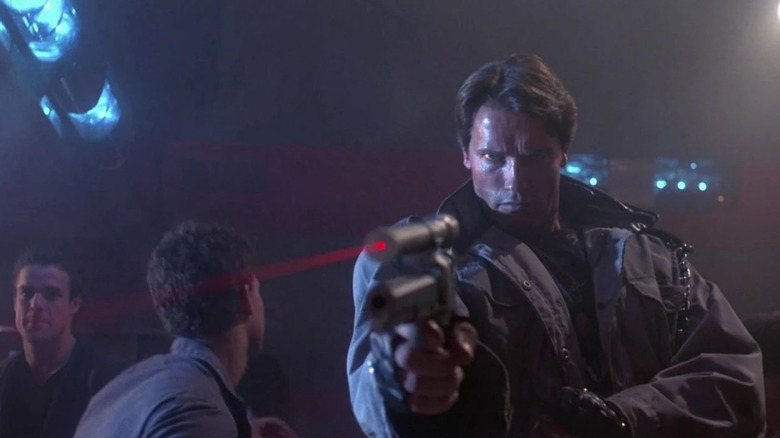
Originally conceived as a John Carpenter-inspired slasher, James Cameron's breakout movie gradually became a time-traveling tale of AI gone wrong as he developed it — and as much as we love the 1991 sequel "Judgment Day," his first "Terminator" is far more rewatchable because of how he keeps his apocalyptic sci-fi lore to its bare minimum. We don't need to learn anything more than the brief overview Kyle Reese (Michael Biehn) delivers to Sarah Connor (Linda Hamilton) about Skynet and the resistance movement fighting it, because Cameron otherwise tells his story via each destructive action set piece. There are world-ending stakes on the line, but he approaches the material as the purest of chase movies; a bloody cat-and-mouse tale so thrilling on a base level that it's easy to forget that the future of civilization rests in the story's balance.
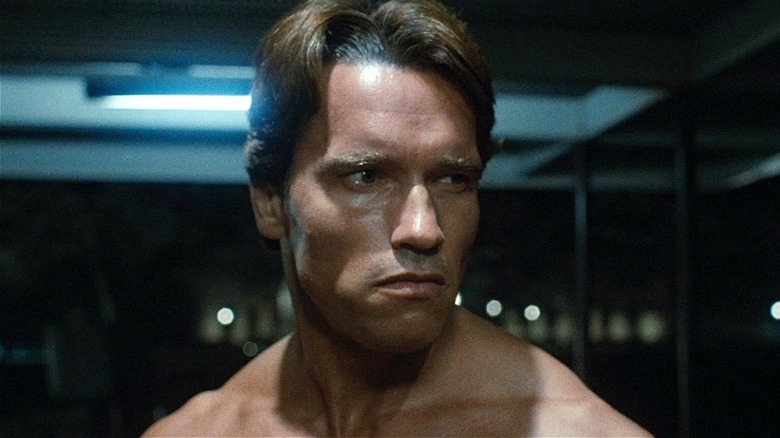
Of course, a thriller like this is only as strong as its villain, and Cameron tailored his movie to Arnold Schwarzenegger's then-limited dramatic strengths. His few lines of dialogue became instant catchphrases, and after years of not quite becoming a classic Hollywood hero, the director got him to embrace his hulking physical presence as one of the ultimate villains of them all. Yes, Cameron flipped the script completely with the sequel to even bigger success, but Schwarzenegger might be even more effective as this variant of Terminator; a remorseless, monosyllabic killing machine which he brings to life via intense charisma alone. He became a conventional Hollywood leading man after this, making his breakout role the rare one to cast him against type.
Total Recall
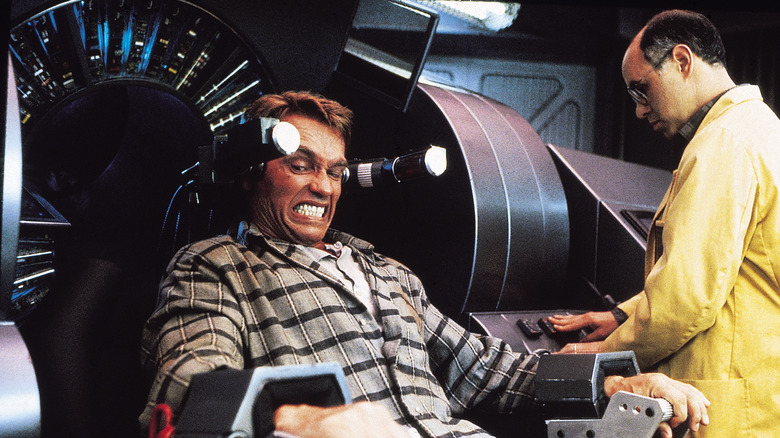
More Arnold Schwarzenegger, Paul Verhoeven, and Philip K. Dick next, with this 1990 adaptation of the author's short story "We Can Remember It For You Wholesale." Stuck in development hell for several years, it was eventually picked up by Schwarzenegger as a passion project, with the Austrian Oak hiring Verhoeven after seeing "Robocop" (which he was one of the actors originally considered for). The expansive, Mars-set mind-bender cast the star as Douglas Quaid, a construction worker who believes he's been implanted with false memories of being a secret agent by the mysterious ReKall company. But after his disastrous visit to the company's facility, he finds himself caught in the center of an elaborate spy mystery. As "The Matrix" would later that decade, it's an unashamedly populist blockbuster movie that trusts its audience's intelligence to unpack weightier existential themes and debate whether the action we're seeing is real or just an implanted memory.
Verhoeven has long said the movie was written to support either interpretation, and his hope is that repeat viewings will only further make the audience question what they perceive as the movie's reality. It's ultimately a more conventional (but no less thrilling) action blockbuster than his "Robocop," but it still contained the satirical bite of the previous movie's depiction of a dystopian future; this was a world where air was privatized, and TV news networks were shown to misrepresent current events in real time. Where "Robocop" bluntly smacks you in the face with its parody of American culture, "Total Recall" is far more rewarding on multiple viewings. Both are incredibly rewatchable for different reasons.