

The No. 1 Movie On July 15, 1960 Was An Oscar-Winning Biblical Epic
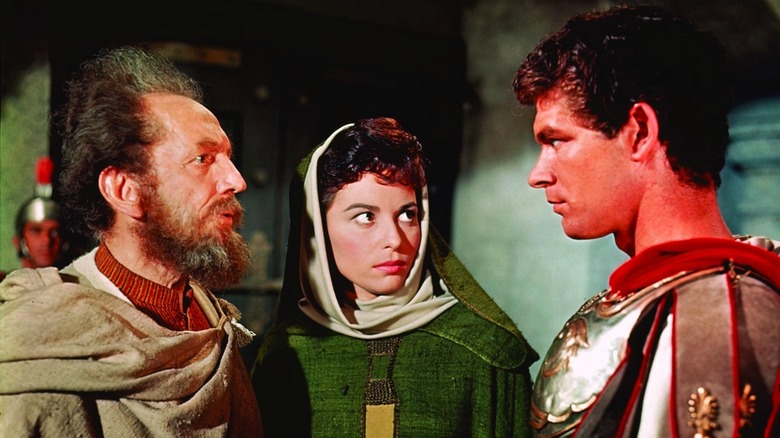
They don't make them like they used to. Seriously, you'll be hard pressed to find a nearly four-hour biblical epic get made in this day and age, but it doesn't really matter because we'll always have 1959's "Ben-Hur," which remains one of the best historical films of all time.
The film sees Judah Ben-Hur (Charlton Heston) betrayed as a child and ascend to the role of a champion charioteer after saving a Roman commander. With his newfound status, he sets out to find the man who betrayed him all those years ago and reunite with his family.
Initially released on November 18. 1959, "Ben-Hur" was the number one film at the box office on July 15, 1960. However, it didn't reach the top spot immediately, not getting there until February 1960, 11 weeks into its run. It went on to make $74 million total worldwide during its original release, the equivalent of about $850 million in today's money.
Its box office milestone occurred a couple of months before the 1960 Oscars ceremony, which took place on April 4 of that year, where it won best picture as well as 10 other honors, including best director for William Wyler and best actor for Charlton Heston. "Ben-Hur" is the epitome of a slow burn, but audiences soon recognized what critics and industry professionals knew all along, and proof-positive that 1959 was one of the greatest years in movie history period.
Ben-Hur set the bar for epic filmmaking
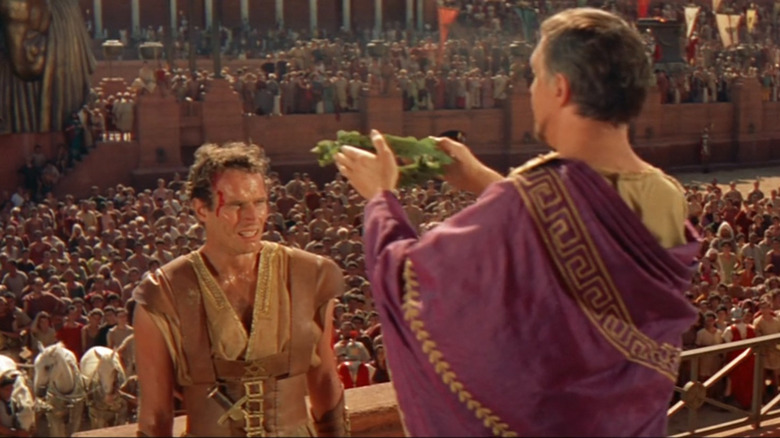
In 1959, "Ben-Hur" was the latest in a long string of biblical epics, following up "The Robe" and "The Ten Commandments." But it wound up blowing all of those out of the water. Audiences responded well to the action sequences, particularly the centerpiece chariot race. And while its story and biblical themes ties to the life of Jesus Christ, it can even be enjoyed by secular viewers.
Religious themes and iconography were essential to telling the story of "Ben-Hur." The film came out in the midst of the Hays Code, which was in effect from 1934 to 1968. This forbid any radical ideas or images, such as excessive violence, promiscuity, and homosexuality.
In fact, Gore Vidal, who did touch-ups on the "Ben-Hur" screenplay, has said that he included subtext to imply that Ben-Hur and Messala (Stephen Boyd), the man who betrayed him years ago, were ex-lovers. Heston denied such interpretations, but it makes for a fascinating reading.
There have been various interpretations of "Ben-Hur" over the years, and the 1959 version isn't even the first. But the 2016 rendition is easily one of the worst remakes of all time, losing much of what made the original so special, subtext and all. "Ben-Hur" might be over 60 years old, but it hasn't missed a step and is still worth watching today.