

5 Best Space Horror Movies Nobody Talks About Anymore
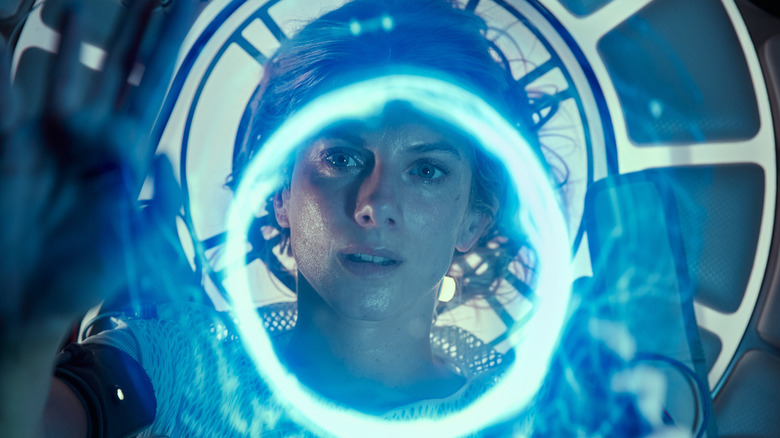
Space can be a frightening place, so it's no surprise that several filmmakers have opted to take advantage of this fact by taking their horror movies away from planet Earth. From the "Alien" franchise to little-known sci-fi thrillers like "Europa Report," the space horror subgenre has offered some pretty great thrills to scary movie enthusiasts over the course of the decades. While the genre has also been something of a schlock magnet — as the likes of "Jason X" and "Leprechaun 4: in Space" are all too happy to prove — the scene is also fairly rife with comparatively well-known works like "Pitch Black" and "Event Horizon."
However, there are also several great space-themed horror films that have failed to occupy the sizable place in the zeitgeist they woud deserve in terms of sheer quality. Let's take a moment to dig into the space horror genre's unsung heroes by highlighting five underappreciated gems that, for one reason or another, just don't get talked about these days.
Planet of the Vampires
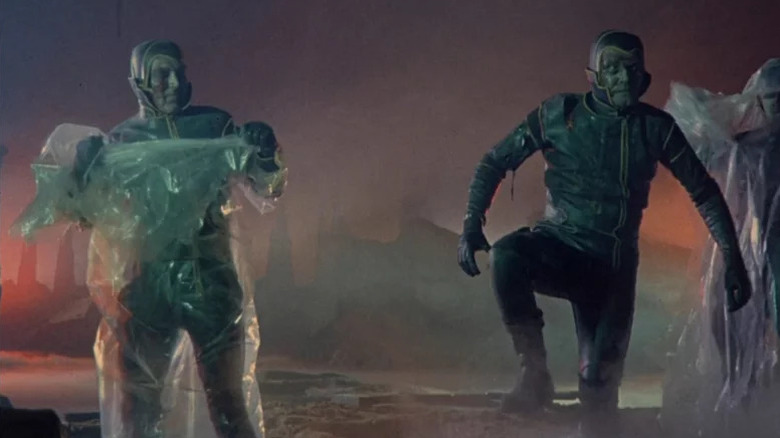
Italian 1960s scary movies might mostly be associated with the giallo genre, but horror legend (and giallo progenitor) Mario Bava also liked a different approach. His 1965 space horror movie "Planet of the Vampires" is technically not quite what it says on the label: Instead of space vampires, the villains are ethereal parasitic aliens that turn dead bodies into space zombies -– which, come to think of it, is hardly less horrifying. As two spaceships crash on the mystery planet Aura, they're targeted by incorporeal aliens. These Aurans possess the bodies of the people who died during the crash and proceed to cause all sorts of havoc.
What makes "Planet of the Vampires" so scary is the fact that it doesn't pull a single punch. Few horror movies reward people who become too attached to the characters, but this film is a particularly good example of the "anything can happen to anyone" mentality. There are also some twists on the way that show just how imaginative "Planet of the Vampires" can get — including the very last scene of the movie, which provides a fun gut punch that spells doom for a planet that's far more familiar to the audiences than Aura. Combine all this with Bava's skilled hand and gorgeous visuals, and "Planet of the Vampires" isn't just a great 1960s horror movie — it's a great space horror movie for any era.
Sputnik
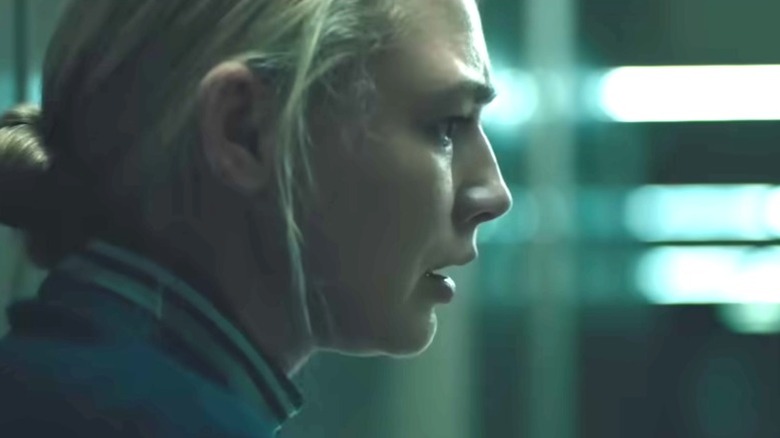
Being a Russian film and premiering less than two years before the country's 2022 invasion in Ukraine that's still ongoing, it's no big shock that "Sputnik" has fallen by the wayside in the international discussion of space horror greats. Viewed purely as a movie, though, Egor Abramenko's 2020 film is one of the better genre works of recent years.
Unlike many other movies on this list, "Sputnik" only begins its story in space, and the bulk of its action takes place in a high security facility on Earth. After two cosmonauts encounter something strange outside their spacecraft, it crashes back on Earth and only one man, Konstantin Veshnyakov (Pyotr Fyodorov), survives. There's just one problem, though: There's something very strange growing inside him.
This, of course, is something that a seasoned sci-fi horror veteran already suspects from the get-go. "Sputnik" will still artfully sit on this revelation for a while, approaching the incident through the eyes of Dr. Tatyana Klimova (Oksana Akinshina), who initially simply expects to perform a psychological assessment of the cosmonaut. When the truth does unfold, "Sputnik" provides a twist on the alien monster theme that's particularly unnerving. Combining space horror, claustrophobic military facilities, and cynical government experiments that have a little to no regard for human life, "Sputnik" tells a harrowing story that goes in directions that you might not expect.
Oxygen
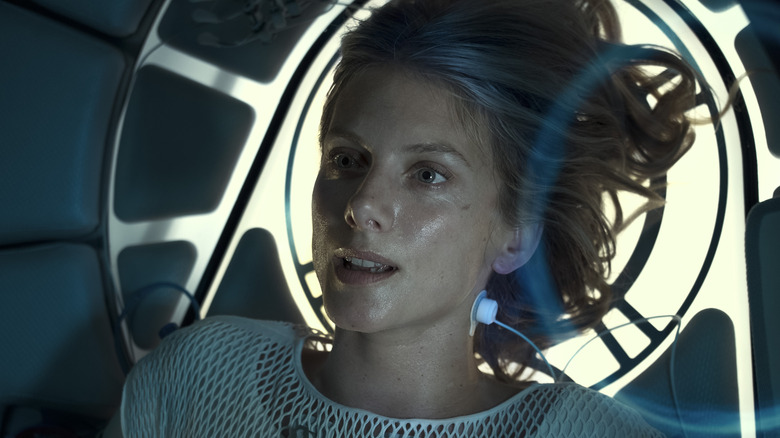
Alexandre Aja's 2021 Netflix film "Oxygen" is not for the faint of heart, especially if you happen to be claustrophobic. The movie begins when a woman (Mélanie Laurent) wakes up inside a cryogenic pod without any sense of who or where she is, let alone why she's there. The only thing she has for company is an artificial intelligence (voiced by Mathieu Amalric) that's in charge of the unit, but she doesn't have full access to its functions. Also, much like the title suggests, she's rapidly running out of one very crucial element, making it just a matter of time before she suffocates to death. What's more, the authorities and loved ones she's able to connect via the pod's communication systems refuse to help her or even truly acknowledge her existence.
This is just the basic setup, though. "Oxygen" reveals its secrets slowly, and we find out hair-raising truths about what's really going on and who the woman really is. To describe the plot any further than this would be to venture unnecessarily into spoiler territory, but it's safe to say that by the time the ending of "Oxygen" arrives, the movie has pulled the rug from under the viewer multiple times.
All in all, it's surprising that "Oxygen" doesn't appear more often in the conversation of great and terrifying sci-fi movies. Twisty, tense, and incredibly frightening at times, this French-language film nevertheless delivers the goods for fans of the genre.
Lily C.A.T.
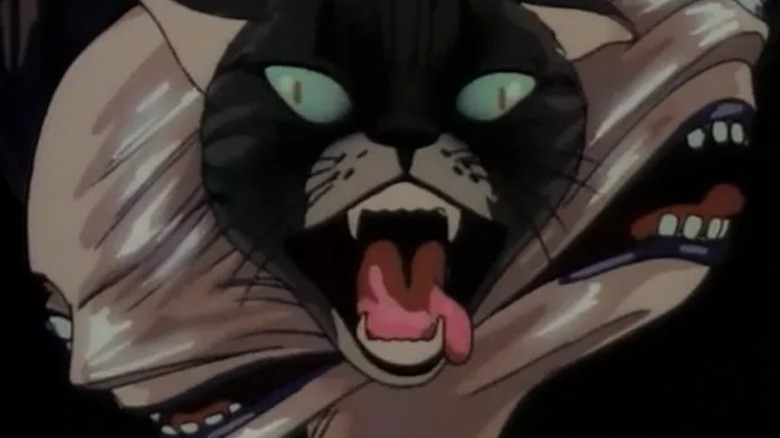
Eric Vilas-Boas of Vulture once called "Lily C.A.T." one of the scariest horror anime ever made. In all fairness, the movie knows where to borrow: It is, in effect, Ridley Scott's "Alien" redressed as a cosmic horror anime, with a spoonful of John Carpenter's "The Thing" and several extra bits and bobs thrown in. The key difference is that the monster of "Lily C.A.T." isn't a slimy alien creature, but an extremely creepy robot cat that somehow manages to be even more unnerving than your average Xenomorph.
Directed by Hisayuki Toriumi of "Eagle Riders," "Gatchaman," and "G-Force: Guardians of Space" fame, "Lily C.A.T." offers exactly what you could hope for from an 1980s horror anime cooked from such wild ingredients. The 1987 movie embraces outlandish cosmic horror themes that it then gleefully mashes together with its obvious inspiration, creating a unique experience that needs to be seen to be believed.
What you actually think of "Lily C.A.T." depends on your stance on the anime medium, of course. For viewers who think they'll enjoy the experience, the film is very much worth visiting because of its inherent strangeness, truly impressive monster design, and relentless barrage of nasty events. "Lily C.A.T." makes for a viewing experience that's difficult to forget.
Prospect
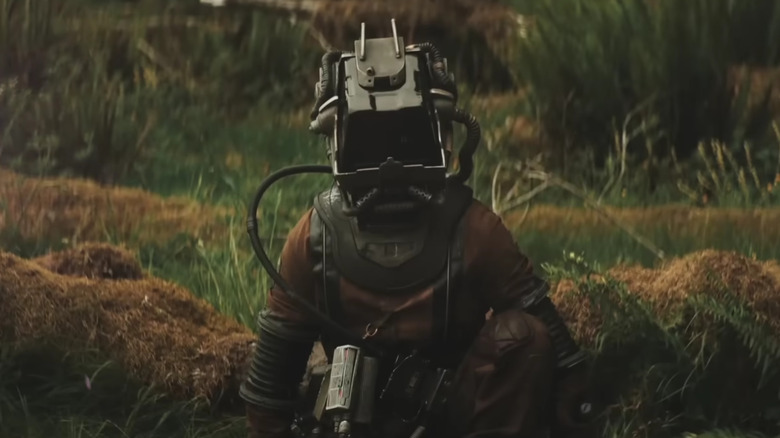
Pedro Pascal's journey from "Law & Order to "The Last of Us" and beyond has featured plenty of victories. It's hard to bet against Pascal when it comes to small screen sci-fi and fantasy, but his genre track record on the big screen is somewhat more spotty. Case in point: Zeek Earl and Chris Caldwell's 2018 film "Prospect," which Looper's sister site Slashfilm once called the best indie science fiction movie since Duncan Jones' "Moon." Yet, thanks to the movie's virtually nonexistent box office performance, you're unlikely to have seen it — or perhaps even heard about it.
In hindsight, the movie's survival horror elements would probably have been noticed more had it arrived after Pascal expanded his talents in this front with HBO's "The Last of Us." The action happens on a moon that's full of poison spores, and our hero is teenage prospector Cee (Sophie Thatcher), whose father (Jay Duplass) is in conflict with Ezra (Pascal). Soon, Ezra and Dee have to form an unlikely and highly uncomfortable alliance to survive the moon's harsh conditions and hostile outside forces.
The spores, an unlikely duo of Pascal and a teenage girl, and antagonistic factions to clash against do indeed read like "The Last of Us" in space, made years earlier than the HBO hit show. That's not quite what "Prospect" is, but it's still an excellent showcase of Pascal and Thatcher's work – and it's fun to see Pascal in a quasi-villain role.