

5 Most Disturbing Horror Movies Of The 1990s, Ranked
While the 1980s were a Golden Age of slasher movies, horror went in several different directions the following decade. The biggest slasher movies of the 1990s turned out to be satirical — either full-on comedies like "Scream" or winking, teen-centric takes on popular horror like "I Know What You Did Last Summer" and "Urban Legend."
The genre also shifted in a significantly more psychological direction, producing several phenomenal films that blended the boundaries of what horror could be. Movies like David Fincher's serial killer masterpiece "Se7en" still get fans arguing about genre definitions; is it really a horror movie if it's also a mystery? Is it horror if it's also a thriller? (The answer to both, by the way, is a resolute "yes!") While the most disturbing horror movies of the '90s may not have been as gleefully gory as their counterparts the previous decade, that also means they're somewhat more elegant, more insidiously strange, and more mind-bending than twisted.
They are, however, all disturbing. As humanity approached the new millennium, moviegoers grappled with the state of society, taking a look around and finding each other quite frightening. The movies below vary greatly in tone and approach, but they all have one thing in common: They mine horror from mundanity, insisting that scares can come from the most ordinary-seeming parts of life.
5. Jacob's Ladder
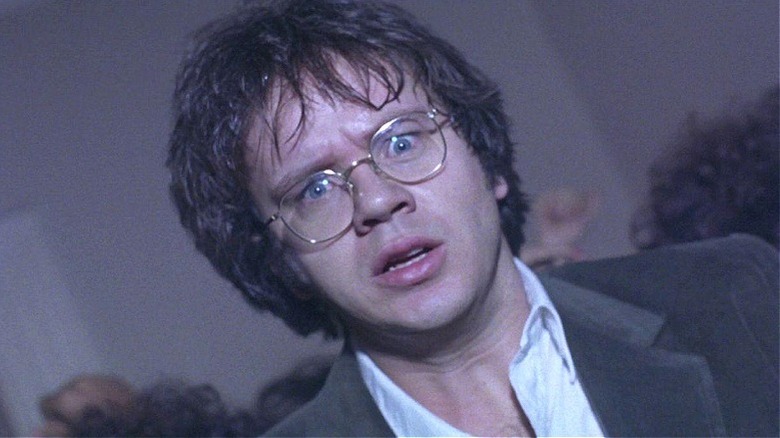
Tim Robbins plays the titular character in the 1990 film "Jacob's Ladder." He's a Vietnam veteran who saw some seriously twisted things in an unimaginable context, and then was expected to just go back to his normal, American life. As many veterans experience in real life, that's a trickier proposition than it seems. Jacob has had his sanity shattered by what he's seen, and he soon begins to experience reality as a slippery, flashback-filled collage of horrific imagery.
This is a movie all about psychological trauma and the ways that witnessing something dark and depressing can affect you for the rest of your life. At first, it's unclear whether what Jacob is experiencing is based in something supernatural, psycho-religious, psycho-sexual, or something else altogether. By the end of the film, the actual answer doesn't matter; the point is that we've spent the film's runtime immersed in the mind of a man who's been utterly failed by every aspect of the society he was supposed to be fighting for.
Smartly, "Jacob's Ladder" is a great period piece film. It's interesting to see the '90s looking back on the 1970s, especially at the start of a decade that would be filled with isolated conflicts but looked at as a time of peace. Watching "Jacob's Ladder" now — and realizing just how little we've learned about how we should treat each other — makes the movie even more disturbing than it was at the time.
4. The Silence of the Lambs
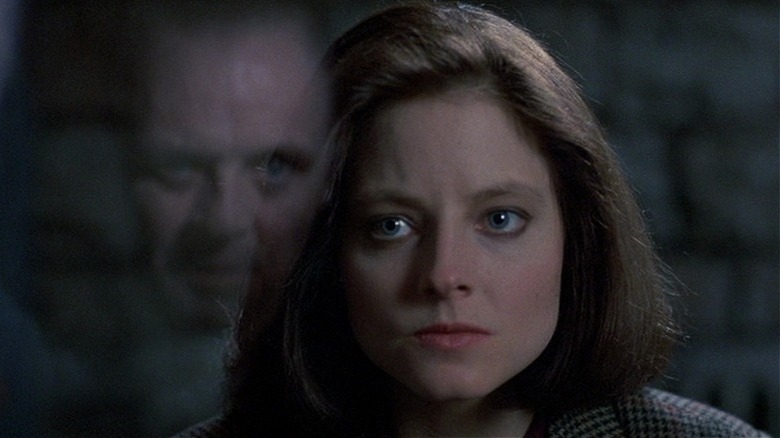
As with "Se7en," you'll occasionally come across people who try to argue that "The Silence of the Lambs" isn't a horror movie. Well, those people are wrong and you shouldn't listen to them. One of the primary functions of horror isn't just to scare the audience, but instead to induce dread; and there's plenty of dread dripping from just about every frame of this Jonathan Demme film.
After all, it's not just a movie about an investigation into a serial killer; it's also a film about a cannibal. "Silence of the Lambs" doesn't just want you to be thrilled by the tense conversations that unfold between Clarice (Jodie Foster) and Hannibal (Anthony Hopkins). It wants you to be physically revolted by it, to lean away from the screen, and to close your eyes so you can't see just how creepy Hopkins looks when he smiles.
After watching the movie a few times, you may even pick up on the fact that Hannibal doesn't blink throughout "Silence of the Lambs." "If you don't blink, you know you can keep the audience mesmerized," Hopkins explained (via ABC News). Well, it turns out you can also keep them seriously disturbed.
3. Audition
In the 2000s, the horror genre was awash with torture porn. Movies like "Hostel," "Saw," and "Wolf Creek" made a meal out of medicalized torture, showcasing a sadistic, close-up look at the toll violence takes on the body. Many critics now see the torture porn cycle as a reaction to the war on terror, audiences flocking to theaters to see bodies brutalized just as the country was embroiled in debates about our post-9/11 methods of "enhanced interrogation." "Hostel" director Eli Roth admitted as much (via The Guardian), explaining that the film was "very much a reflection of my disgust with the Iraq War and the Al-Qaeda beheadings[.] It's not just about people who want to kill us, but about capitalism gone awry and American imperialism."
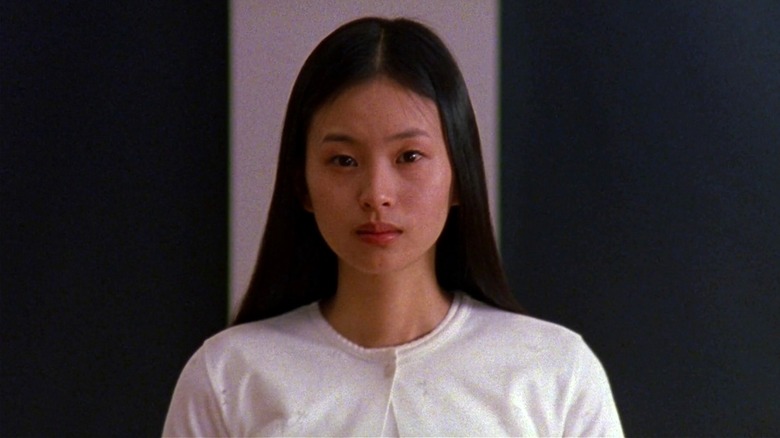
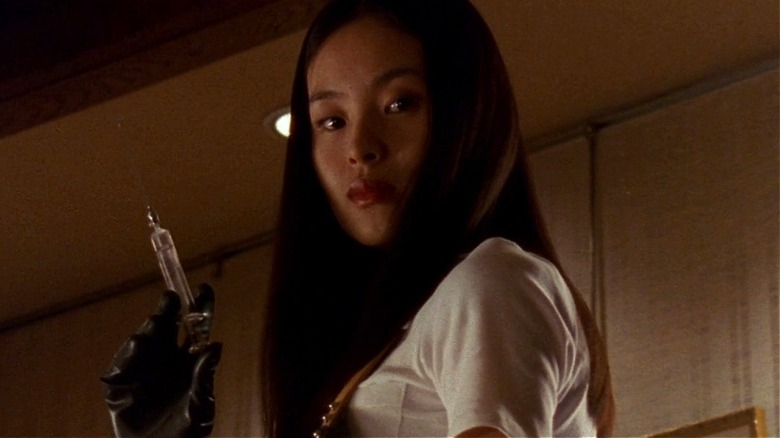
The genre doesn't just trace its roots to the photos out of Abu Ghraib, though. Takashi Miike's 1999 film "Audition" capped off the decade with one of the most disturbing horror films ever made, prefiguring torture porn by several years. The movie is about a lonely man named Shigeharu (Ryo Ishibashi). Looking for a way to meet women, he pretends to be a casting director and sets up a series of auditions, lying to the ladies who come to try out for him. One of those women is Asami (Eihi Shiina), and she doesn't take too kindly to being mislead about the purpose of her audition.
Part of what makes this film so disturbing — especially in comparison to the gorefests that came later — is that it's relatively restrained. This is a slow-burn horror film like little else, which builds to an utterly brutal climax that makes Asami into one of the scariest female horror villains of all time.
2. Funny Games
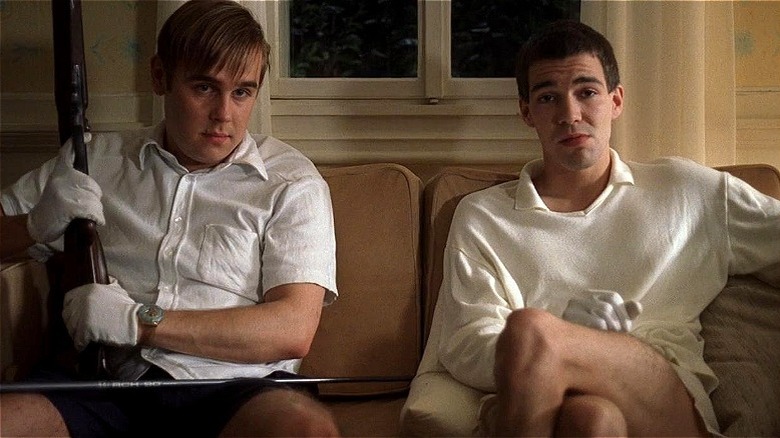
Many horror movies in the 1990s grappled with the effects of the genre on impressionable young minds. Teenagers had spent the '80s being delighted by slasher films, watching bodies brutalized on-screen as entertainment. The Satanic Panic had gripped the country then, too, making people fear that things like rap and heavy metal were brainwashing kids into violence. That's not even mentioning the rise of video games!
A few years before American society confronted these ideas en masse after the Columbine shooting in 1999, German director Michael Haneke made "Funny Games," a home invasion horror movie that hinted that the kids were very much not all right. Arno Frisch and Frank Giering play Paul and Peter, respectively, two young boys who hold a vacationing family hostage. They torture them in a variety of ways, amused all the while by their own cruelty in a way that's deeply disturbing.
"Funny Games" is one of the scariest movies about isolation, trapping the family far away from where society should've been able to help them. It's also a movie that implicates the audience in its cruelty; after all, just like Paul and Peter, we are entertained by watching this family suffer. In one of the most disturbing shots in all of horror cinema, Paul pauses and looks back over his shoulder, smirking and staring right down the camera, as if he sees us watching and is inviting us along.
1. Lost Highway
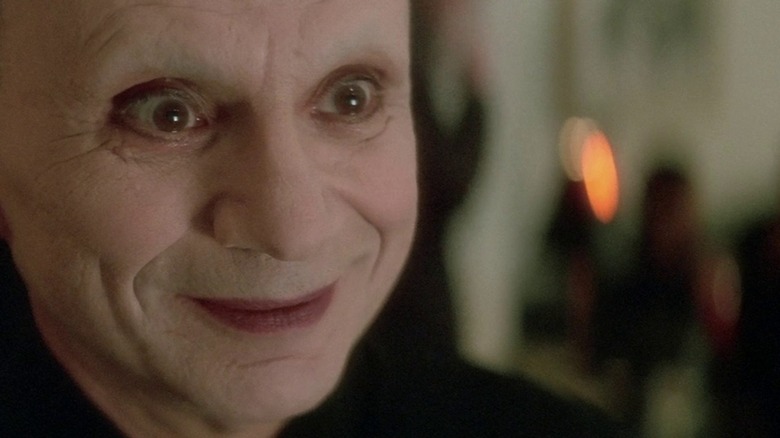
At the dawn of the 1990s, David Lynch turned to television. "Twin Peaks" changed TV, revolutionizing expectations of what respected filmmakers could do with long-form storytelling. It also chilled teenagers everywhere, who were suddenly afraid a long-haired man might appear and climb over their couch.
At the close of the decade, Lynch embarked on what would eventually become a sort of trilogy set in Los Angeles. The first installment, "Lost Highway," is the most disturbing horror movie of '90s. It's difficult to describe because it doesn't follow a plot in the way viewers might be used to. Instead, "Lost Highway" feels like peering in on someone's subconscious as they experience a nightmare. It's like a stew of simmering, surreal images, like someone's stirring the narrative themselves, swirling things together that don't seem to belong in reality.
On a basic level, "Lost Highway" stars Bill Pullman as a saxophone player named Fred. He experiences hallucinations of a mysterious, pale man (Robert Blake) who seems somehow connected to an undercurrent of evil pulsating through the underbelly of Hollywood. As Fred figures out more about what he's experiencing — or just as often, fails to, and is forced to keep experiencing it — it's tough not to find yourself just as freaked out as he is.