

The Weirdest Question About Back To The Future Is Resolved With This Timey-Wimey Fan Theory
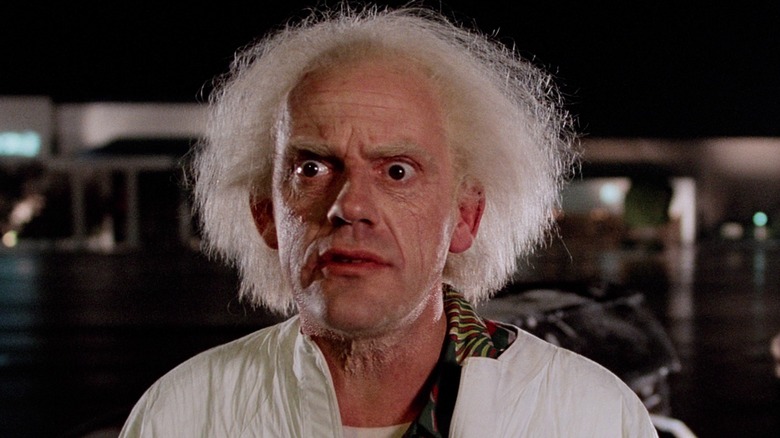
Welcome to "Fanon Fixing Canon," a weekly column where we investigate infamous plot holes or terrible storyline decisions. Through a combo of detective work and meticulous fan theorizing, we fix these problems so they no longer exist — and canon is immaculate once again.
"Back to the Future" is arguably the best time travel movie of all time, and therefore the source of much conversation and speculation. The craziest "Back to the Future" fan theories outline all sorts of strange things about the film and its sequels, analyzing and unpacking the various time paradoxes and inaccuracies within.
However, perhaps the strangest thing about "Back to the Future" isn't actually time travel themed at all. It's the friendship of the two main characters, Emmett "Doc" Brown (Christopher Lloyd) and Marty McFly (Michael J. Fox). Even in the context of a highly rewatchable 1980s sci-fi movie, a friendship between an elderly mad inventor and an unruly high schooler makes zero sense, and is left unaddressed within the confines of the movie itself.
But what if this particular peculiarity of "Back to the Future" actually makes perfect sense? And what if the truth behind it is actually just as time travel themed as several other weird aspects of the film? In this installment of Fanon Fixing Canon, we take a closer look at the two characters' friendship — and why Doc decided to befriend Marty solely because of the fact that he met him in the 1950s and knows that he needs to keep the time loop going.
There's a reason Doc keeps Marty in the loop with the time machine invention
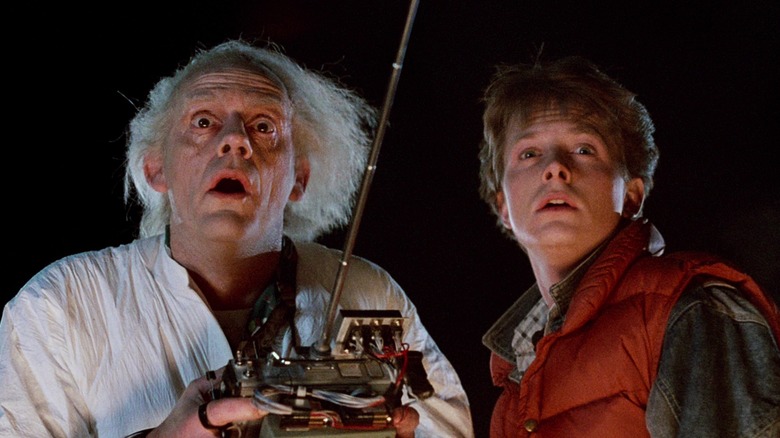
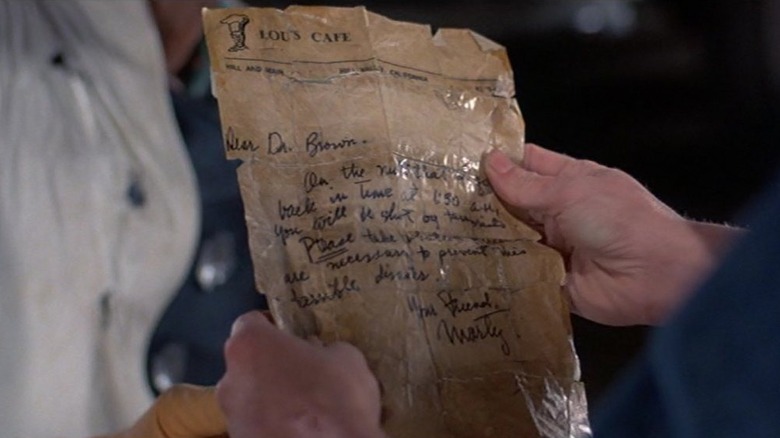
The gist of the theory is that since Marty meets young Doc in the 1950s, Doc grows old knowing what happens in the future. We know this because apart from the pair's interactions in 1955, Marty writes Doc a letter that still exists in 1985. Doc uses its information to save himself from the Libyans with a bulletproof vest — which is apparently sturdy enough to stop machine gun fire from close range, but that's neither here nor there.
The point is that after receiving the letter in 1955, Doc knows exactly when and how he's going to die, how to prevent it, and — most importantly — the precise circumstances that he needs to create in order to make sure that Marty is sent in the past to deliver the letter.
This is why Doc keeps Marty so heavily in the loop about his work to create a time machine, despite the fact that this is a young kid who could potentially babble about Doc's inventions to just about anyone. It's not a case of reckless endangerment of what should be a top secret operation. It's simply Doc operating with the knowledge that he needs to make sure Marty knows how the DeLorean works, and how to operate it himself. The Libyans are coming. The clock is ticking. And Doc needs to make sure that he still knows to wear that bulletproof vest during the next spin in the time loop.
Doc comes to embrace changing the future a bit too much
The Back to the Future franchise famously likes to dabble with the future. Doc saving himself from the terrorists is just the tip of the iceberg. Marty also helps his father (Crispin Glover) turn into a far cooler version of his 1985 self by helping him gain confidence in 1955. This also leads to the humbling of Biff Tannen (Thomas F. Wilson), who goes from George McFly's obnoxious boss and former bully into a subservient figure. This, in turn, has extremely nasty consequences in "Back to the Future Part II," where Biff learns of time travel and uses it for financial gain, turning himself into a powerful and wealthy tycoon.
Literally all of this stems from the 1955 incident, where the time-displaced Marty seeks and receives young Emmett Brown's help. After Marty returns to 1985 and Doc decides to read the faithful letter, the latter has decades to ponder the nature of time travel, time loops, and the consequences of changing the future. The bulletproof vest proves the conclusion that he reached: tampering with the timeline is awesome, as long as it is for personal benefit and hopefully doesn't massively change anything too big. This recklessness leads to some pretty interesting things, such as the futuristic flying locomotive at the end of "Back to the Future Part III."
Still, at the end of the day, Doc's personal intentions for time travel are forced by necessity and he doesn't seem to actively seek out to change things ... right? Wrong. Literally the last thing Doc does at the end of "Back to the Future" is give Marty a new quest — one that seeks to change the future of the McFly kids. In retrospect, it's probably good that the movie series ended after three films. There's no way the characters wouldn't have ended up destroying the world after one well-meaning fluke or another.
Though Doc had an incentive to befriend Marty, he genuinely came to appreciate the kid
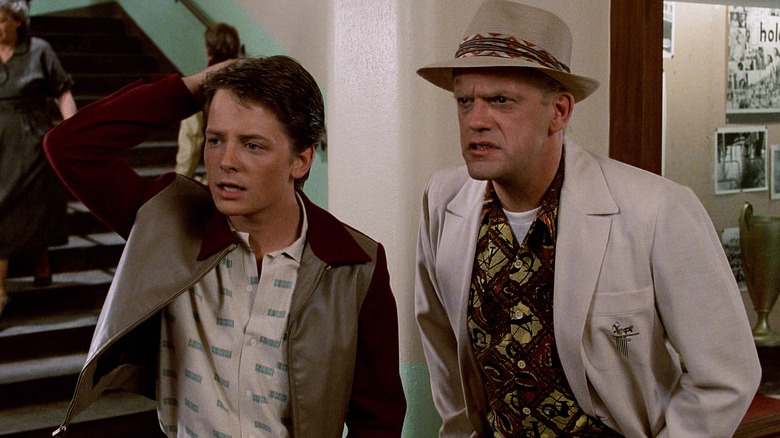
It's worth noting that while Doc had a good motive to befriend Marty and likely kept tabs on the kid and his family for quite a while, he's also genuinely fond of the boy. In fact, there's reason to believe that it was ultimately Marty who made first contact, even though this isn't specifically established in the movie. We know this because "Back to the Future" co-creator Bob Gale has specifically told us so.
"For years, Marty was told that Doc Brown was dangerous, a crackpot, a lunatic. So, being a red-blooded American teenage boy, age 13 or 14, he decided to find out just why this guy was so dangerous," Gale explained to Mental Floss. "Marty snuck into Doc's lab, and was fascinated by all the cool stuff that was there. When Doc found him there, he was delighted to find that Marty thought he was cool and accepted him for what he was. Both of them were the black sheep in their respective environments. Doc gave Marty a part-time job to help with experiments, tend to the lab, tend to the dog, etc."
We can definitely roll with that, since it comes from Gale himself. Still, it doesn't rule out that Doc, who's aware of the letter and Marty's personality, would likely have created and nurtured the circumstances for their meeting at some point, perhaps even deliberately shaping himself into the kind of mad inventor that Marty described to him in 1955 and seems to resonate with. Manipulative as this may be, Doc is acting to save both his and Marty's lives from the Libyans. Besides, Gale's Word of God does say that the pair's friendship is genuine, ulterior motives or not.