

5 Best Time Travel Movies Nobody Talks About Anymore
Movies have the power to make us feel like time travelers, hurtling back and forth through periods we'd otherwise never get to experience for ourselves. Films which explore time travel make that feeling even more literal, designed to make us ask ourselves where we'd visit if we got the chance, whether we could stop disasters or even just change awkward moments from our lives for the better. Rather than coasting by on our nostalgia for bygone days, the best time travel movies look at the ways we've changed with the world around us, asking whether a small tweak to our lives here or there would be worth changing the bigger picture.
With so many masterpieces in this sci-fi subgenre, plenty of worthy movies have fallen through the cracks. We've selected five which deserve more recognition as the best examples of time travel stories, from underappreciated action blockbusters to coming-of-age romances and even mind-melting slasher movies. Our criteria was simple — these are the best movies which don't regularly appear on best time travel movie lists, despite warm critical receptions or high user ratings among the cinephile community on Letterboxd. Those who have seen them have given these movies their seal of approval, but now it's time to properly give them their flowers as some of the best time travel movies out there.
If this makes you hungry for more of the genre and you want to see where your favorites rank, then we've counted down the 54 best time travel movies of all time here. Just don't head over there before finding your new favorite movie here first.
Time After Time
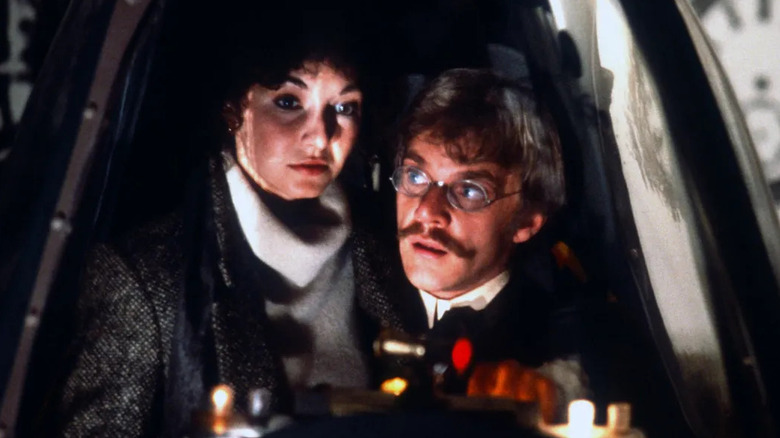
How's this for an elevator pitch: H.G Wells (Malcolm McDowell), author of "The Time Machine," builds a real time machine, only for it to be stolen by Jack the Ripper (David Warner), who escapes to 1970s San Francisco to continue his killing spree after the police finally close in on him. Oh, and did we mention that this story also functions as a fish-out-of-water romantic comedy, as Wells follows the killer to present-day California and falls in love with a bank receptionist (Mary Steenburgen)?
Director Nicholas Meyer had already made a name for himself as the author of the Sherlock Holmes parody novel "The Seven-Per-Cent Solution," and his directorial debut is a similarly affectionate tribute to classic British pop culture. It works just as well as an equally tense race against time thriller as it does an affectionate romance, without either genre detracting from the other.
Opening with a kill from Jack the Ripper's POV that Alfred Hitchcock would be proud of, "Time After Time" never feels inconsistent despite wildly diverging tones from one scene to the next. In the middle of this hunt for a killer, McDowell's bumbling author also experiences his own existential crisis as he learns of the horrors inflicted by mankind during the years he passed through, forcing him to reconsider the inherent humanism that drives his work and political activism; he sees a world shaped by Jack the Rippers, not sensitive idealists. The story may be rooted in the 1970s, but this idea ensures that it continues to resonate to this day.
Deja Vu
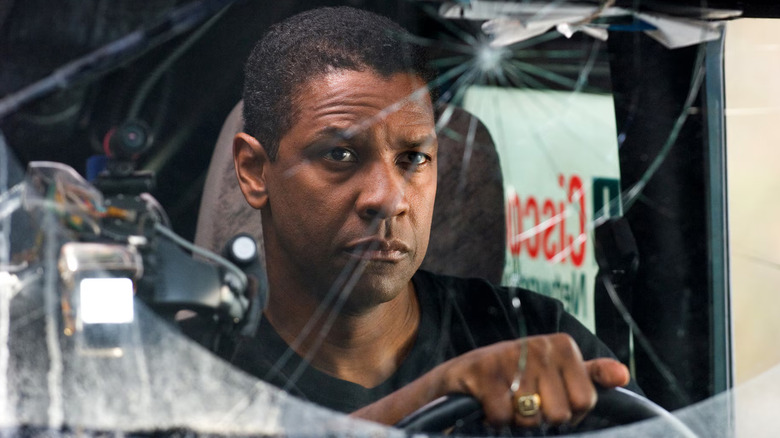
If you loved "Tenet," then it's about time you caught up with the underrated 2006 action blockbuster to which Christopher Nolan's movie acts as almost a spiritual sequel. On the surface, "Deja Vu" appears little different to many Hollywood action movies from the immediate post-9/11 years, as ATF special agent Doug Carlin (Denzel Washington) is hired to help an FBI investigation following a deadly Mardi Gras terrorist attack. However, after Doug is told that the bureau is using a pioneering research tool called Snow White to track down the perpetrator's whereabouts in the days leading up to the attack, it dawns on him that they've created what is effectively a time machine — and he wants to go back a few days to prevent the catastrophe.
Washington described the movie as "science fact" as opposed to science fiction, but there's no dense technical exposition of time travel mechanics or secret governmental operations here, with action maestro Tony Scott understanding that the movie won't work without an emotional connection. Doug believes that the key to cracking the case lies with a victim (Paula Patton) who was found further down the river; as he travels back prior to the attack to become her guardian angel and prevent it from happening, the movie becomes melodramatic and sentimental as their connection develops naturally in the middle of a race against time. In the most complimentary way, it's as unashamedly corny as action movies get, and deserves to be seen as the equal to Nolan's own emotive stories about the passage of time (there are shades of "Interstellar" here too), which followed years later.
The Girl Who Leapt Through Time

Previously declared one of the 50 best anime movies of all time by this very site, this breakout effort from director Mamoru Hosoda saw him get dubbed the next Hayao Miyazaki by many critics — but unfortunately, despite an Oscar nomination for his later movie "Mirai," he's never reached quite the same level of international recognition.
"The Girl Who Leapt Through Time" serves as a sequel to the 1967 novel of the same name by Yasutaka Tsutsui, following the niece of the original protagonist as she discovers she's gained the same skill as her aunt. You don't need prior knowledge of the source material (or its little seen outside of Japan 1983 live-action adaptation) to enjoy this charming coming-of-age story, which keeps its stakes relatively low for a movie dealing with the butterfly effect.
Makoto Konno (voiced by Riisa Naka in the original Japanese dub) uses her powers to fix her everyday problems, making sure she can get to school and finish her homework on time, and gradually tries to solve her friends' problems caused by these timeline changes. It grows ever so slightly more complex with the addition of a second time traveler, who becomes her love interest, but never loses sight of the relatively grounded exploration of how a teenage girl would use these powers if granted them. High-concept anime has rarely felt this down to earth.
Timecrimes
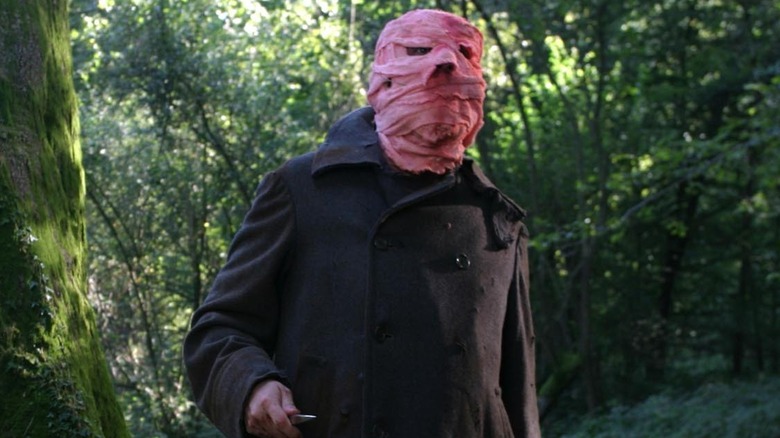
Multiple micro-budget time travel movies become festival darlings in the 2000s, stretching their clear constraints to tell stories of "causal loops," in which a future event causes a past event with the protagonist stuck helplessly in the middle. Arriving a few years after the head-scrambling "Primer" swept Sundance, Spanish director Nacho Vigalondo's twisty time loop tale was far less complicated and more straightforwardly crowd-pleasing, but no less ingenious in the way it explores the chaos that ensues when Héctor (Karra Elejalde) is sent back in time by an hour.
After seeing a mysterious, clearly troubled naked woman (Barbara Goenaga) appear in the woods behind his backyard, Héctor's investigation leads him towards a bandaged killer and a scientist (played by the director himself) as confused by the chain of events as he is. But whereas "Primer" was convoluted and alienating with a similar premise that it refused to explain, "Timecrimes" uses action in place of exposition, transforming the overly complicated nature of a self-sustaining time loop into something closer to a rollercoaster ride. It's not the most conceptually difficult time travel movie to parse, but that's part of the fun; it's designed to make you second guess which parts of the jigsaw fit together, and it's a treat to see how each manic, bloody incident forms a bigger picture.
"Timecrimes" never quite reached the level of cult hit status it deserved, but it's definitely one of the movies you need to watch next if you love "Tenet" and it's one of the better examples of how to pull off dense sci-fi on a shoestring budget. Even with only four characters, limited locations, and a time machine that doesn't go back further than an hour, it feels expansive.
Triangle
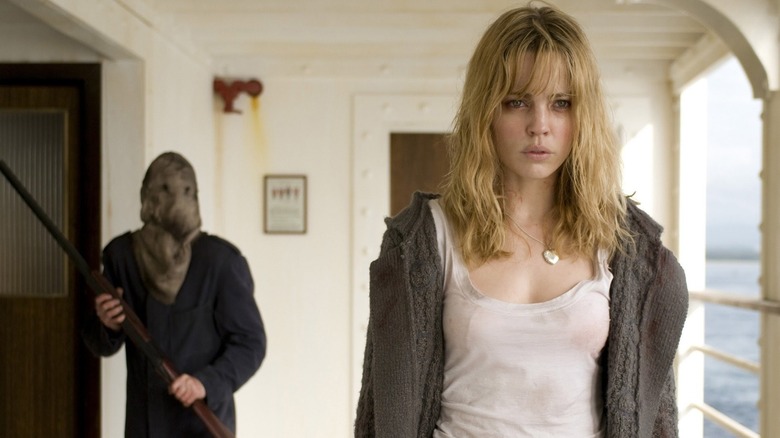
There are many great time travel horror movies, but it's a hard genre hybrid to pull off; by the very nature of time travel, everything we see in the future is inevitable, and there's nothing harder to generate tension from than the inevitable. A time loop horror movie is harder still, because once we know where the scares are, simply repeating them is likely to become more exhausting than thrilling.
Writer-director Christopher Smith uses that disadvantage in his despairing slasher "Triangle," which gradually finds poignancy as it becomes clear that heroine Jess (Melissa George) has few options to escape her perpetual loop and be reunited with her autistic son, suggesting that her fate may even be cosmic punishment for being an impatient mother.
The endless mobius strip of the narrative is less complex than it may seem, following clear emotional logic even as the hard sci-fi it's grounded in becomes increasingly dense. All you need to know going in is that Jess's planned boat ride with friends takes a sour turn after their vessel is capsized in the middle of a storm, forcing the survivors onto an ocean liner where a masked killer is reportedly roaming around. It becomes more inventive as a time travel story than a slasher movie, despite the restrictions of the closed loop, once again proving that mega-budgets and dozens of locations aren't necessary when it comes to making something ingenious and unforgettable within this genre.