

5 Twilight Zone Episodes That Predicted The Future
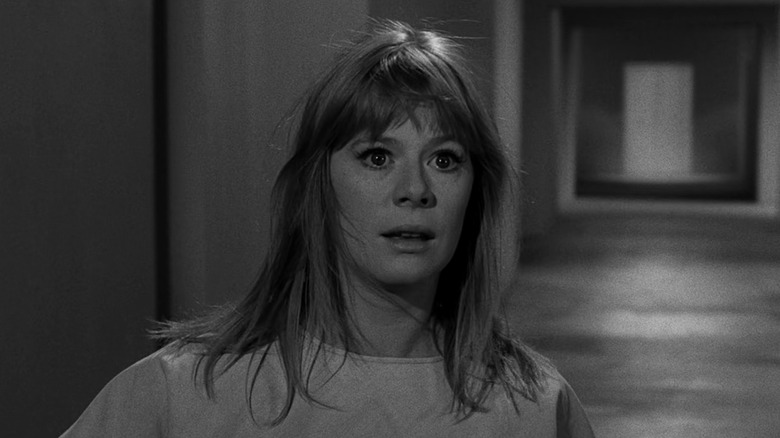
"The Twilight Zone" was nothing if not a series with admirable foresight. The Rod Serling-created CBS anthology classic aired between 1959 and 1964 in its original run (not counting the fact it was remade more than once), yet it managed to touch on social, political, cultural, and existential topics that remain relevant six decades later — if they haven't become even more so.
Serling's own opening and closing narrations put forth the show as a cautionary window into potential futures. The Twilight Zone, a.k.a. the land of imagination, was a place in which strangeness could exist freely, and thereby take viewers to the farthest, most mind-bending reaches of science fiction and fantasy while still remaining scarily tethered to the real world. Tomorrow on "The Twilight Zone" was always uncomfortably close to today, either materially or in spirit — and even today, the series' weekly parallel dimensions could be a mirror to what was happening outside the TV.
Even so, there were some episodes where "The Twilight Zone" managed to be especially prescient. The five episodes listed below are all essential chapters of "The Twilight Zone" that also double as uncanny flash-forwards. They imagine parts of the future, either literal or conceptual, that were still some time away from materializing in the late '50s and '60s — and they do it while largely sticking to the ethos of offering purely speculative fiction, to the point where few viewers at the time might have imagined that those problems would eventually cross over from imagined to real. Here are five "The Twilight Zone" episodes that predicted the future.
The Midnight Sun (Season 3, Episode 10)
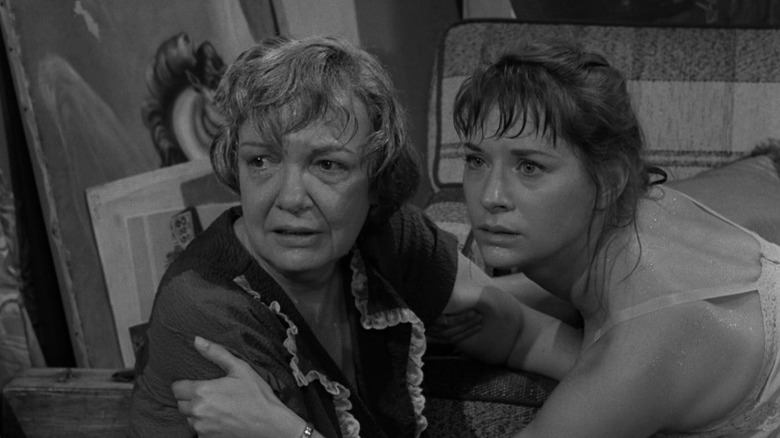
Global warming was beginning to snap into focus in climate and environmental studies prior to the 1980s, but one of the best "The Twilight Zone" episodes nonetheless managed to anticipate the extent to which it would become an omnipresent, anxiety-inducing concern for humanity. Scripted by Rod Serling and directed by Anton Leader, "The Midnight Sun" takes place following a hypothetical astronomical scenario in which the Earth is yanked off its original elliptical orbit, and begins to move closer and closer to the Sun — leading to a gradual but deadly increase in global temperatures.
The episode unfolds from the perspective of Norma (Lois Nettleton), a painter who has become the last remaining resident of her New York City apartment building, along with her landlady Mrs. Bronson (Betty Garde); everyone else has died or run off further north as a result of the sweltering heat. With the sun still burning bright in the night sky and the city reduced to a dystopian wasteland, Norma and Mrs. Bronson endure what is fast becoming the hottest day in history.
Even though the rising heat of "The Midnight Sun" is, unlike ours, not caused by humans, it's still staggering to watch a 65-year-old TV episode so accurately capture a familiar — if fantastically exaggerated — experience of climate stress. Lest we forget, many places in the world right now are already suffering from nigh-intolerable heat spikes brought about by climate change, and the despair, societal mayhem, and high risk for older adults that they bring about is not unlike what we see on the episode.
The Lonely (Season 1, Episode 7)
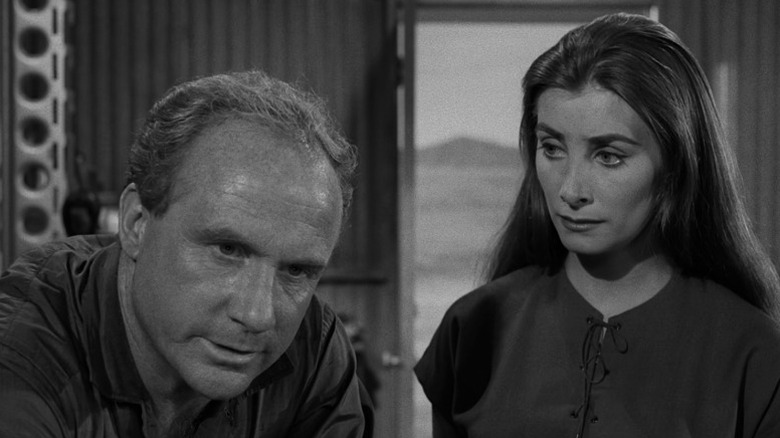
Lots of fiction has been written about the possibility of relationships between human beings and machines, and about the question of artificial emotion more broadly. Yet, somehow, no media has ever been able to anticipate the despair-induced projection of emotion onto robots quite as vividly as one "The Twilight Zone" episode. On "The Lonely," director Jack Smight brings to life a Rod Serling script about Corry (Jack Warden), a man convicted of murder who is currently four years into a sentence of 50-year solitary confinement on a far-away asteroid.
One day, during a delivery of supplies to his prison, Corry receives Alicia (Jean Marsh), an android companion shaped like a human woman. Although he is skeptical at first, Corry slowly begins to take a shine to Alicia upon realizing that she behaves just as a human would when met with pain or emotional distress. Over the following year, bereft of any human company, he falls in love with Alicia, while her personality gradually develops to become a mirror of his.
Although the possible sentience of Alicia is left ambiguous, the episode leaves us with the conclusion that it wasn't really Alicia that Corry got attached to, but an idea of a person created in his head by loneliness. This was projected onto Alicia, with help from the android's own deftness at learning and reproducing desirable behavior. Needless to say, this eerily echoes the current cultural trend of connection-starved humans initiating romances with generative AI chatbots, persuaded by their customized mimicry of humanity and their unfailing affirmation, availability, and devotion.
The Brain Center at Whipple's (Season 5, Episode 33)
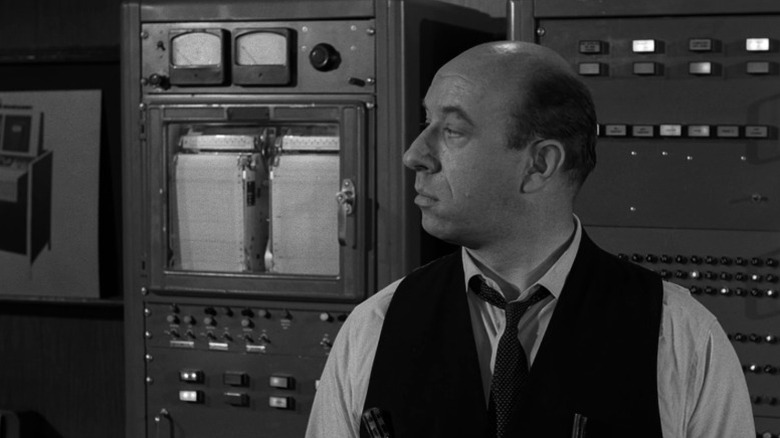
Some "The Twilight Zone" episodes willfully dispensed with subtlety and went all in on getting clear, cogent points across — as was the case of "The Brain Center at Whipple's." Directed by legendary blockbuster filmmaker and TV veteran Richard Donner from a script by Rod Serling, "The Brain Center at Whipple's" centers on Wallace V. Whipple (Richard Deacon), the ruthless owner of a massive manufacturing company in the then-future late '60s. Haunted by his father's "failure" to quadruple the company's production, he acquires state-of-the-art automated assembly machines that allow him to fire tens of thousands of workers.
Spurred on by the cost-cutting success of the automated assembly line, Whipple goes on to replace other workers with machines, the better to stop dealing with their pesky defiances of authority and labor rights; he takes particular glee in firing the secretaries and subbing in dictation robots that won't ask him for maternity leave. He soon replaces everyone in the company, until he's the only human left on the premises.
If that sounds similar to what corporations the world over are trying to do right now with AI, that's scarcely a coincidence — after all, then as now, the imperative of the system has always been to maximize profit and please the board of directors. The only concession to fantasy on "The Brain Center at Whipple's," arguably, is that Whipple eventually has a neurotic crisis of conscience, gets replaced by a robot himself, and learns the error of his ways. In real life, the AI peddlers are unlikely to reach such clarity.
He's Alive (Season 4, Episode 4)
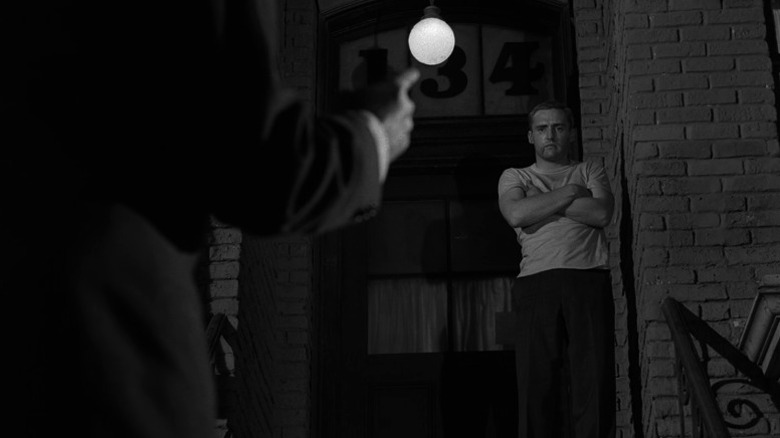
"The Twilight Zone" aired just over a decade after the end of World War II, at a time when the world was still grappling with the horrifying realities of Adolf Hitler's rise to power and subsequent genocidal warmongering. And one "The Twilight Zone" installment allows a real-time glimpse into that processing period. On "He's Alive," written by Rod Serling with direction by Stuart Rosenberg, "Waterworld" star and award-winning actor Dennis Hopper makes a career breakthrough as Peter Vollmer, the leader of a flailing American Neo-Nazi group.
Although Vollmer struggles to be taken seriously, he's eventually visited by a phantasmagoric apparition (Curt Conway) who coaches him in the ways of fascist rallying and political theater, and transforms him into a popular far-right leader. That figure turns out to be none other than Adolf Hitler himself — here, acting as a metaphor for the hate and bigotry ever waiting in the shadows to manifest itself through a new human receptacle.
With the dramatic rise in Neo-Nazi sentiment observed in the United States and numerous other countries over the past decade, "He's Alive" feels less like a speculative warning and more like a wake-up call. What's more, the diagnosis it offers for Vollmer's psychopathic politics remains spot-on: He's a puny, insecure man who uses fascist sloganeering to enact petty revenge on the world, and drinks from the attending cheers as compensation for his absolute mediocrity. And, like so many fascist leaders in the real world, his power only extends as far as his usefulness; eventually, he's discarded, while the hate keeps flowing in search of a new vessel.
Number 12 Looks Just Like You (Season 5, Episode 17)
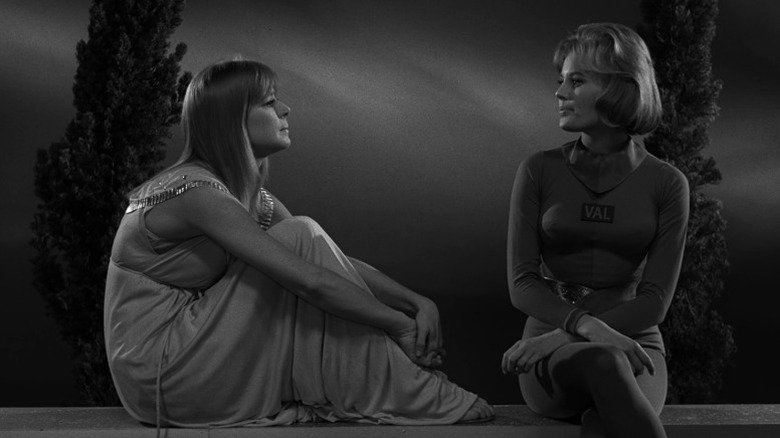
Optional, non-reconstructive cosmetic plastic surgery was still in its infancy in the 1960s, and wouldn't become a widespread practice until many years after the conclusion of "The Twilight Zone." But the show still managed to predict the number it would do on society. Directed by Abner Biberman and adapted by John Tomerlin from the short story "The Beautiful People" by Charles Beaumont, "Number 12 Looks Just Like You" takes place in a world in which plastic surgery is so advanced that all humans are now expected to undergo a "Transformation" into one of a fixed set of possible bodies upon turning 19.
The episode's protagonist, Marilyn Cuberle (Collin Wilcox), is an 18-year-old girl who has decided to skip the Transformation, puzzling her friends and family. In addition to a uniform human appearance, the Transformation also affects the mind, and has ushered in an era of unprecedented peace for humankind. Yet, as Marilyn slowly realizes, the process may be less optional than it's said to be.
The amount of insight that "Number 12 Looks Just Like You" offers about our image-obsessed social media society is vast. In no particular order, it predicts: the spread of plastic surgery among youth; the funneling of "acceptable" physical appearance into a set of algorithm-defined beauty standards; the rejection of subjectivity, empathy, and enjoyed experience as the lodestars of humans' relationship to their bodies; the systemic stifling of solidarity among women who challenge the norm; and the role that an illusory, vertically enforced "consumer choice" plays in all of this. Rod Serling lands his opinions with an immediate poignancy once again, proving that "The Twilight Zone" remains a master at talking about today.