

Every Main Character Death In The Boys Series Finale, Ranked
The following feature contains spoilers for \"The Boys\" Season 5, Episode 8.
Following the death of Frenchie (Tomer Capone) at the end of last week\'s episode, the stage was set for a series finale with a high body count. Fans bracing themselves for epic, tragic deaths should have remembered that this is \"The Boys,\" and things won\'t stay serious for long; Frenchie\'s own self-penned eulogy devolves into him confessing he\'s accidentally seen every team member\'s butt.
That same approach can be found throughout the episode, with the deaths of some characters making you wonder how they were ever considered a threat. It thrives on subverting expectations, right from the moment Sister Sage (Susan Heyward) loses her intellectual powers and is seen for the last time abandoning the final fight to go to Harry Potter World in Orlando. She was the architect of Homelander\'s grand plan for worldwide dominance before becoming a dangerous enemy, and she instantly becomes irrelevant, is given a happy ending, and is forced out of the picture altogether.
Below, we\'re looking at the five major character deaths in the episode, ranked from least-to-most dramatically effective, diving into which bold choices worked, and which felt unsatisfying. Thankfully, the subversive approach to killing off characters mostly worked, depriving fans of intense showdowns in favor of fitting deaths that were either embarrassing or tragic.
5. Oh-Father
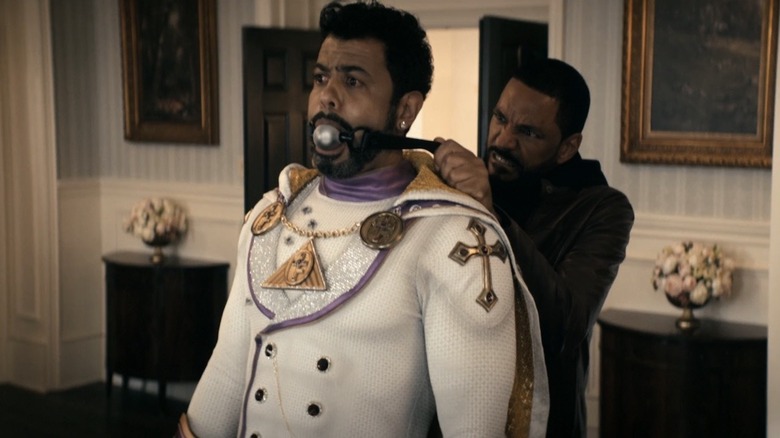
Daveed Diggs\' televangelist preacher was an incredible addition, pushing the show\'s satire of conservative hypocrisy to the ultimate extreme. Oh-Father\'s arc of desperately convincing the public that Homelander is the Second Coming felt a lot less far-fetched than intended too –- the series rollout coincided with the U.S. President posting an AI-generated image depicting himself as Jesus. Oh-Father struggled with his rebrand when very few of Homelander\'s most passionate fans seriously believed he was the Lord incarnate. The civilian body count has been high just from focus groups alone.
The series finale is structured around the speech he penned, with thought police hired to murder any non-believers once Homelander finishes speaking –- it\'s a great satirical touch that the preacher who should be devoted to God is the only person who doesn\'t appear at risk of that fate. Unfortunately, the \"sins\" he commits behind closed doors come back to bite him, and an early throwaway joke involving a titanium ball gag gift turns out to be a Chekhov\'s Gun when Mother\'s Milk (Laz Alonso) and Hughie (Jack Quaid) show up. Sensing that he\'s about to use his power, MM gags Oh-Father with the toy, not realizing that this will cause his head to immediately explode.
It\'s a funny way for the character to bow out, though a little too flippant. The stakes of Homelander\'s grand plan don\'t feel as high when its architect can be dispatched this easily and forgotten.
4. The Deep
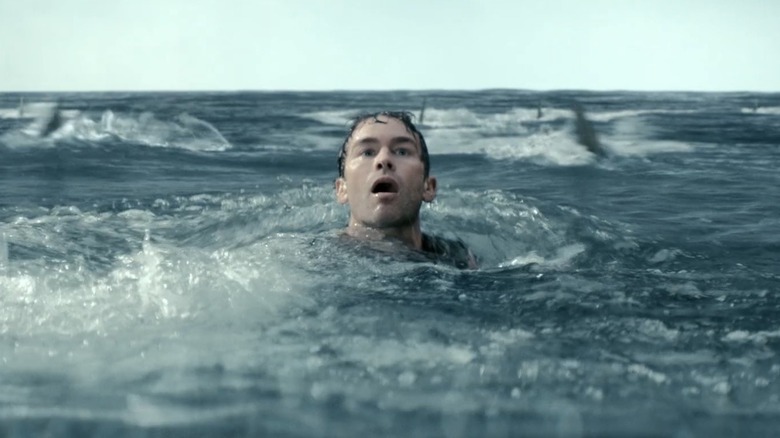
One of the boldest decisions made in the finale is not giving The Seven the cathartic deaths some fans were hoping for. As with Oh-Father, no one mentions The Deep (Chace Crawford) again after he\'s killed, showing just how pathetic he is. There\'s a reason why he\'s at the center of the most topical parodies of right-wing grifter culture; he\'s a serial yes-man who only cares about maintaining his position of power, so will happily parrot whatever he\'s fed on manosphere podcasts or conspiratorial videos.
Those qualities, and reluctantly agreeing to endorse a disastrous oil pipeline project, are what ultimately seal his fate, although the \"previously on\" segment also highlights his his murder of Ambrosius towards the end of Season 4, his octopus lover voiced by a surprise MCU star. As he fights with Annie (Erin Moriarty) and is blast into open waters, mother nature finally holds him accountable for his sins. He\'s torn limb from limb, with an octopus tentacle through the mouth acting as a fitting finishing blow.
This embarrassing, immediately-overshadowed death works far better than Oh-Father\'s because it reflects how much of an afterthought The Deep is. His death at Annie\'s hand is satisfying to see after the sexual assault committed against her in Season 1, but the episode doesn\'t linger on this as an act of retribution -– he\'s too pathetic to even be viewed as a worthy defeat.
3. Homelander
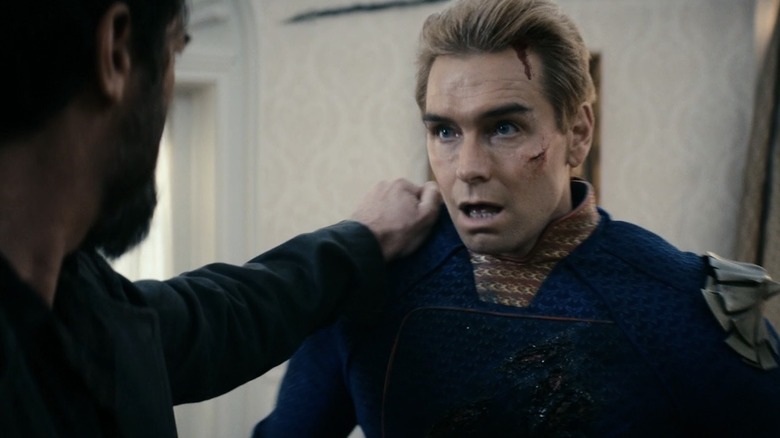
The death fans have been waiting for -– especially considering something has gotten in the way in every prior season finale -– is a very deliberate anticlimax, with an expected final showdown spared in favor of another sequence bringing out the villain\'s pathetic core. Billy Butcher (Karl Urban) and the newly weaponized Kimiko (Karen Fukuhara) fight their way into the Oval Office as Homelander gives his Easter speech announcing himself as the Second Coming, and after a brief brawl, she drains him of his powers.
With cameras still rolling, Homelander gets a fitting comeuppance as his desperation to be viewed as a deity is live streamed worldwide. It\'s sweet revenge for Butcher to see his late-wife Becca\'s (Shantel VanSanten) murderer groveling before him, even copying \"MacGruber\" in suggesting he\'ll do any degrading sex act if it means staying alive. Crosscuting between this and Annie\'s fight with The Deep might be the ultimate embarrassment for Homelander. The man he called the most pathetic he\'d ever met appeared more heroic by comparison; Homelander\'s fans abandon him in droves during his live taping.
The final blow is death by crowbar, a fitting nod to Garth Ennis\' comics where Butcher takes out the man he blames for Becca\'s death in the Oval Office in the same way (only there, it\'s against Homelander\'s clone Black Noir). A high-stakes fight was never going to be a satisfying way to kill off Homelander; it was public humiliation or nothing.
2. Terror
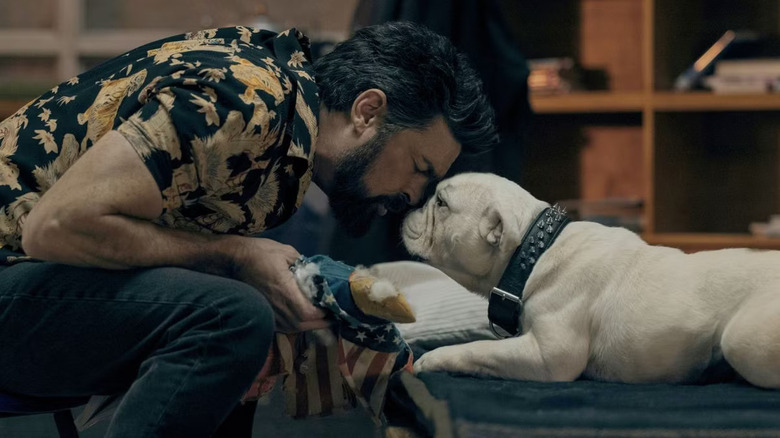
The deaths of the two most prominent villains are given less weight than Butcher\'s beloved bulldog Terror, who passes away peacefully in his sleep –- a stark difference from the comics, where a Homelander clone takes him out. Jokingly trained to hump everything by Butcher, Terror outliving the leader of the Seven by just a few hours is another unintentionally well-orchestrated act of humiliation by The Boys\' leader.
It\'s the quietest and saddest death in the episode, with high dramatic stakes as it reshapes Butcher\'s plan heading into the endgame. Seeing his beloved pet lay on the floor next to a vial of the virus which could wipe out supes for good, his final act of vengeance is as much in honor of Terror as it is Becca. He speeds off to Vought headquarters to embed it in the sprinkler system and spread the disease. That he now feels compelled to take on what would be a suicide mission (given his own mutated powers) is the direct fallout from losing a best friend he assumed would stick around for a little longer.
From the moment he\'s introduced, Butcher has been motivated to carry out a genocide of the Supes, but it\'s the death of Terror that fully unshackles him. Regardless of whether he\'d be successful, the impulsive decision seals his fate.
1. Billy Butcher
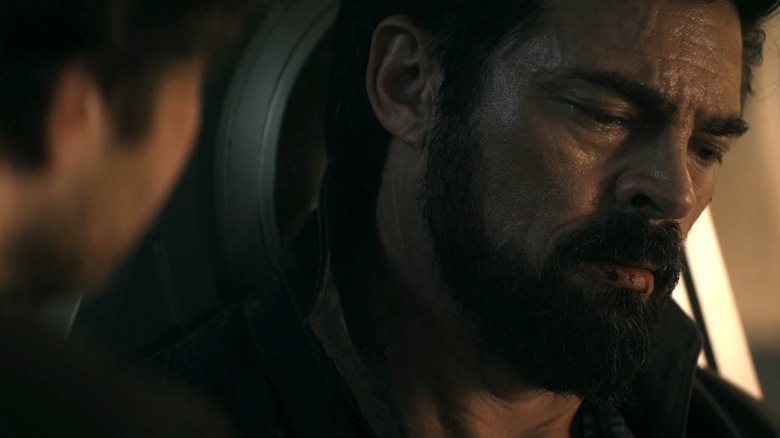
Despite its deviations from the comics, \"The Boys\" doesn\'t change Butcher\'s death taking place after a showdown with Hughie in Vought Towers. The two have been at odds just as often as they\'ve been aligned throughout the series, outlining Hughie\'s growth, who initially joined out of a desire for vengeance. A-Train (Jessie T. Usher) killed his girlfriend in that first episode, but with the deadliest threats elsewhere in Vought dealt with, he\'s had a clearer approach to seeking justice.
Butcher\'s plan to unleash a global Supe pandemic would unknowingly lead to Annie\'s death, bookending Hughie\'s time under the Londoner\'s wing with the tragic deaths of different partners -– and in this case, preventing the birth of their daughter. The cons of this scheme far outweigh that solitary pro, and Hughie shoots Butcher before he has the chance to act. The final moment they share together is one of the episode\'s most touching, offering a fitting end to their relationship and Hughie\'s growth.
The dead villains were seen as pathetic to a world that quickly moved on, which makes Butcher\'s death easily the most tragic. His blind lust for vengeance both saved the day and stopped him from experiencing a world where superheroes no longer had a chokehold on positions of power, a day he dreamed would come for years. It\'s a mournful goodbye to the show\'s most complex character.