

The Star Trek: Enterprise Finale's Worst Problem Is Also The Key To Fixing Its Canon
Welcome to "Fanon Fixing Canon," a weekly column where we investigate infamous plot holes or terrible storyline decisions. Through a combo of detective work and meticulous fan theorizing, we fix these problems so they no longer exist — and canon is immaculate once again.
It's probably not an exaggeration to say that the "Star Trek: Enterprise" series finale "These Are the Voyages..." is the worst Star Trek finale episode, which is saying something. It never made a shred of sense to sideline the main cast of "Enterprise" for the show's swan song, but that's nevertheless what the episode chose to do.
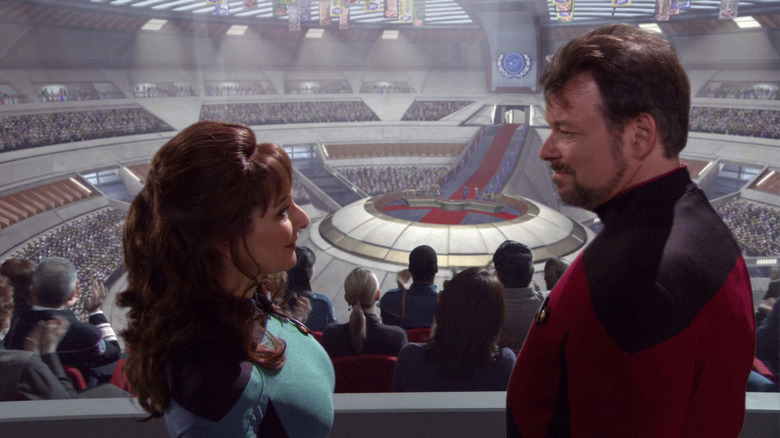
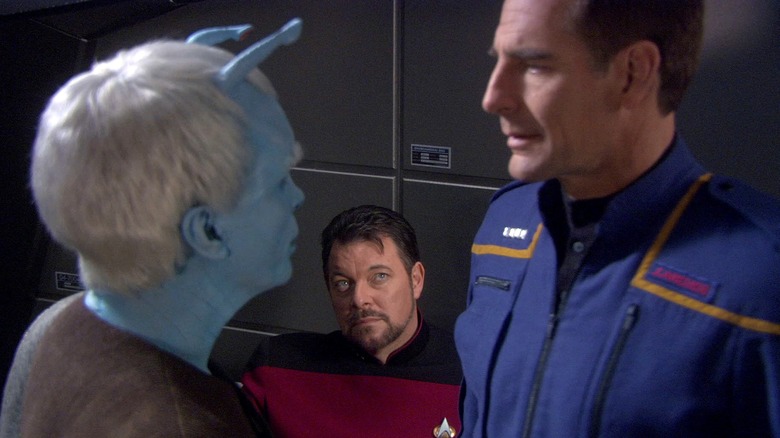
Instead of a proper finale, "These Are the Voyages..." is effectively a not-so-stealthy episode of "Star Trek: The Next Generation." The whole episode is about William Riker (Jonathan Frakes) and Deanna Troi (Marina Sirtis) examining the events of the Enterprise NX-01's final flight before decommission, holodeck style. The end result is effectively all Riker, all the way. He observes the events and interacts with them, while the show's actual cast plays a distant second fiddle. Meanwhile, the audience is treated to moments like the completely unnecessary demise of fan-favorite Trip Tucker (Connor Trinneer) — an event that many fans no doubt rank among the most devastating deaths in the Star Trek franchise.
Fortunately, there is a way to explain all this nonsense in a fashion that makes only the parts of the show featuring Troi and Riker canon: every single thing they see about the Enterprise NX-01 in the episode is simply a flawed latter-day adaptation of the NX-01's last stand. Let Fanon Fixing Canon explain why this hated finale is not nearly as canon as you thought.
The Star Trek: Enterprise finale might not be the whole story, or even the real story
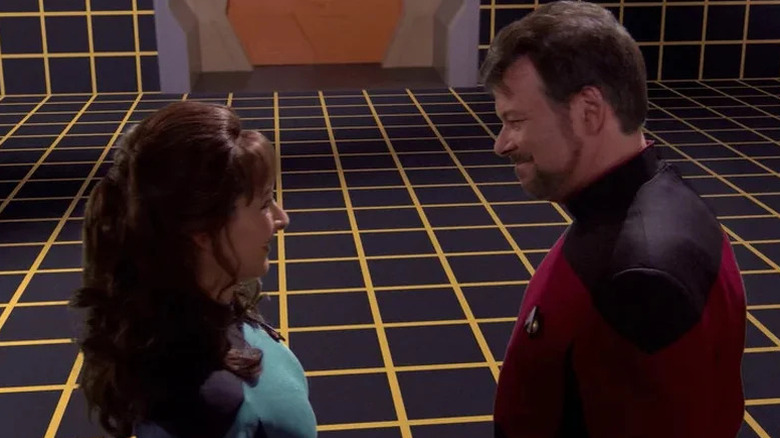
Early in the infamous episode, Troi recommends that Riker runs a holoprogram about the adventures of Jonathan Archer's (Scott Bakula) USS Enterprise NX-01. Why? Because Troi is trying to help Riker come to terms with the events of the "Star Trek: The Next Generation" Season 7 episode "The Pegasus," in which he has to keep secrets of the circumstances surrounding the titular ship during an ostensible rescue mission, and risks losing Captain Picard's (Patrick Stewart) trust in the process.
As we see in both "The Pegasus" and "These Are The Voyages..." these events weigh heavily on Riker, and he uses the NX-01 holoprogram about the ship's final journey to gain some insight. Still, as Riker observes the events, poses as a chef, and converses with the hologram crew, you have to ask — why are we just assuming that the holoprogram is getting any of the details right?
The holoprogram depicts events set in the year 2161. While some alien races already had holodeck technology during the days of "Star Trek: Enterprise," the first Starfleet prototype of a full-on holodeck didn't emerge until the 23rd century. So, whatever records were used to create the NX-01 holoprogram would have been comparatively archaic — or perhaps even partially fictional.
Trip Tucker's death screams dramatic exaggeration
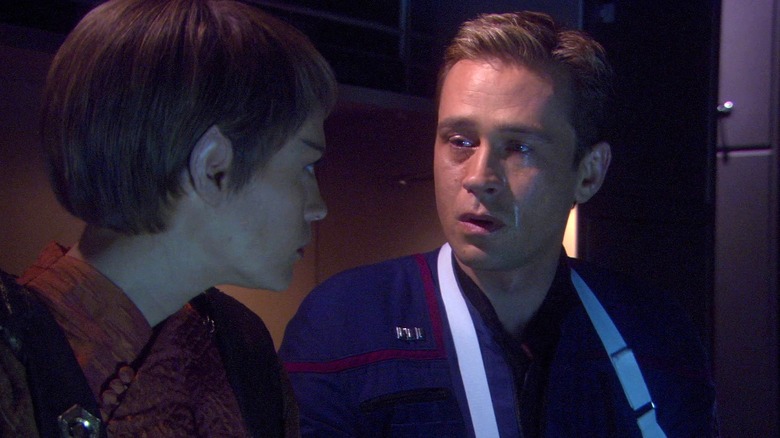
Since the episode implies that Riker has no previous in-depth knowledge of the situation in question, he's going by what he's given — and there's one particular event suggesting that what he's given isn't the full truth: Trip Tucker's infamously pointless death.
Have you ever seen a "based on a true story" tale, biography, or biopic that's completely accurate? Of course not. The world is rife with "true story" movies that lied to you. Things always get exaggerated and changed as part of artistic license — and there's no telling how Troi's holoprogram handles the matter. And so the whole thing with Trip overloading conduits and sacrificing his life to solve a fairly run-of-the-mill Star Trek kidnapper dilemma ... well, it stinks to high heaven of a biographer adding drama to the script for drama's sake. Creative license, if you will.
Note, again, that Riker's going with Troi's recommendation when he views the program. Did she choose a historically accurate scenario, painstakingly converted from logs of the era? Or could she have chosen the holodeck equivalent of a "based on a true story" novelization that just happened to have the exact lesson she suspected Riker would need to learn?
Chef Riker is influencing the simulation in ways that would be impossible if it was a historical recording
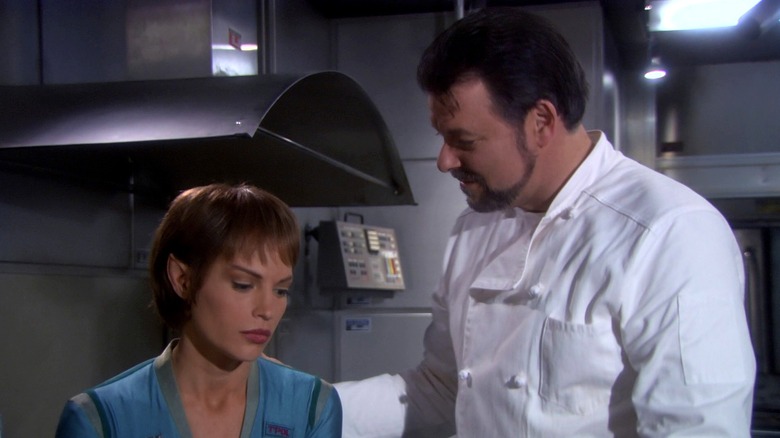
Another reason why the veracity of Riker's holoprogram is highly dubious is the fact that he interacts with his environment in ways that couldn't possibly be a part of the NX-01's real final mission. This should be impossible in a faithful recording, because it's not like he's time traveling. Riker wasn't there, so he should be unable to influence the events in any way.
Notably, Riker uses his chef guise to have a lengthy conversation with T'Pol (Jolene Blalock), who ends up giving him some important insight for his own Pegasus woes. Since it's highly unlikely that T'Pol had this exact conversation with the ship's real chef back in the day, the scene proves that whatever holoprogram Riker is watching deviates pretty heavily from a straightforward historical recording. Instead, what he's playing with seems to be far closer to the kind of approximate period holodeck scenario that "Star Trek: The Next Generation" characters often use for recreation than a wholly accurate reproduction. Effectively, Riker is tinkering with an immersive "Star Trek: Enterprise" game, or perhaps an interactive novel.
Star Trek loves the arts, and has a history of liberally interpreting events in its holo-works
There is actually some precedent for wildly inaccurate holo-works in the Star Trek franchise. Notably, the "Star Trek: Voyager" Season 7 episode "Author, Author" is all about the Doctor's (Robert Picardo) holonovel, "Photons Be Free." It's a massively exaggerated narrative that features very thinly-veiled expys of his crewmates, reimagining them into big ol' meanies who bully the suspiciously Doctor-like medical emergency program. The Federation loves the arts — and as the "Star Trek Starfleet Academy" Season 1 episode "The Life of the Stars" proves, happily incorporates plays and fiction into its lessons in the far future. Since even a holoprogram like the Doctor is easily capable of tinkering with factual representation like that, is there any reason to believe that whatever adaptation of the Enterprise NX-01 story Riker is using would be truthful all the way?
So. We have a culture that thrives on fiction, an event that has been adapted into a holoprogram from an unknown and potentially dubious pre-holodeck source, and major character moments that are suspiciously uncharacteristic and even outright impossible. Do we really want to believe that the events as witnessed by Riker are canon?
If and when we choose to assume that Trip Tucker's death and the T'Pol conversation didn't happen the way Riker's holoprogram depicts, we also have to consider the follow-up question: what can we trust about the "Star Trek: Enterprise" finale, then? The answer is simple. Not a lot, beyond what Riker and Troi do outside the simulation. There you go, Trekkies: consider the finale fixed, and feel free to mentally substitute your own fate for the NX-01 crew in general ... and Trip in particular.