

5 Most Overpowered Weapons In The Marvel Cinematic Universe
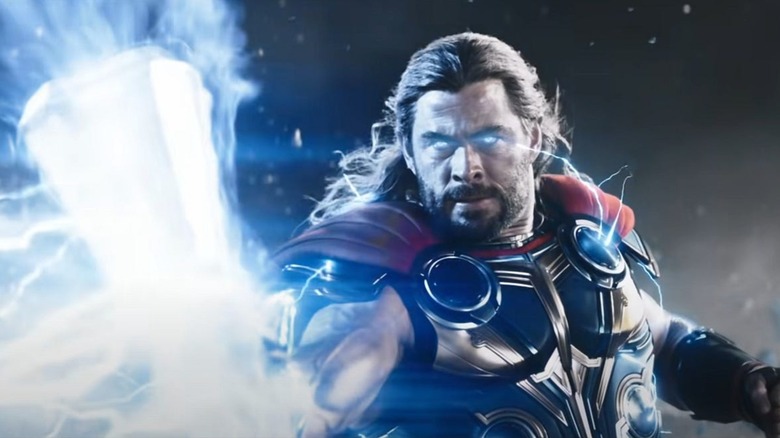
When the Marvel Cinematic Universe (MCU) launched with "Iron Man" in 2008, few could have suspected that it would become the largest and most successful film franchise of all time. Since then, the entire MCU has expanded into a massive timeline that involves dozens of big-name actors playing many of Marvel Comics' biggest and most iconic characters across an infinite multiverse. While each of these heroes and villains is powerful thanks to their abilities, the MCU's weapons are often even more so.
This is a common trope in superhero comics and movies, as all-powerful weapons are often needed to overcome a substantial threat. As every film and television series comes and goes, new weapons are introduced, each one more powerful than the last. That too is a common trope, as it's often necessary to build upon what came before. You rarely see a franchise introduce a weapon that's weaker than whatever preceded it, and the the Marvel Cinematic Universe is no exception. As of writing, the MCU includes dozens of television series and films, and most include some overpowered weapons.
For one of these weapons to be considered overpowered, it needs to be supremely consequential, so none of Iron Man's armor sets, Cap's shield, or Spidey's web-shooters make the cut. Such a weapon has to be capable of something truly extraordinary by MCU standards, and there are several from across the Marvel multiverse that fit. Each of these five MCU weapons is significantly overpowered, possessing the capability of causing widespread destruction and even cosmic levels of change, arranged from least to most potentially destructive.
Ten Rings
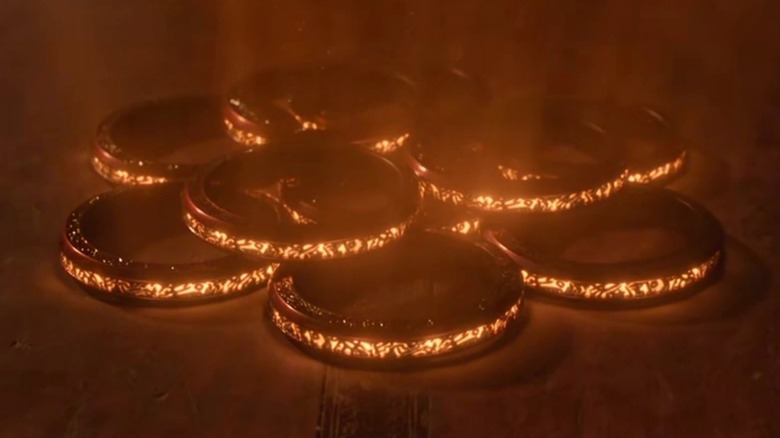
The MCU version of the Ten Rings were introduced in "Shang-Chi and the Legend of the Ten Rings," where they're shown to produce a great deal of destructive power while simultaneously making their bearer immortal. Xu Wenwu (Tony Leung) finds them at some point during the Middle Ages, giving him absolute power while halting his aging. He uses them primarily for their ability to exponentially increase his kinetic strength in dispatching his enemies on the battlefield, transforming entire armies into paper tigers standing before him.
Unfortunately, the mystery surrounding the Ten Rings wasn't fully answered by the film, and there doesn't appear to be a direct corollary between the rings in the MCU and the ones in Marvel Comics. Still, what is known suggests that the Rings are incredibly overpowered because they appear to retain limitless energy. An example of this can be seen in "What If...?," when Shang-Chi (Simu Liu) is infected by the Quantum Virus. He holds off the infection with one of his Rings, meaning they can stop a zombie plague.
The Rings also appear to have some self-awareness that work in conjunction with the wearer, as seen when Shang-Chi takes them from his father. When Wong (Benedict Wong) scans them, the Rings emit a beacon, which only happens after Shang-Chi uses them to kill the Dweller in Darkness. The power required to achieve that kill alone qualifies the Rings as one of the MCU's most overpowered weapons, but it's likely we've only scratched the surface of what they're capable of doing.
Stormbreaker
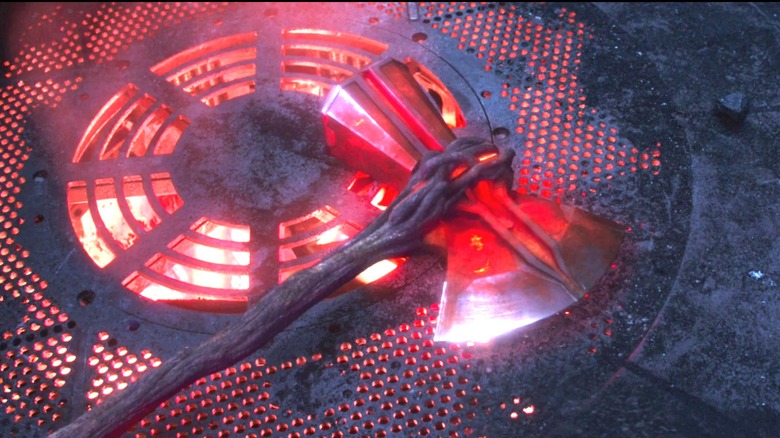
For centuries, Thor (Chris Hemsworth) wielded Mjølnir, which was one of the most powerful weapons in the MCU. In "Thor: Ragnarok," his sister Hela (Cate Blanchett) destroys it, leaving Thor despondent and in need of a replacement. In "Avengers: Infinity War," Thor uses the power of a star to forge a new weapon: Stormbreaker, an enchanted Dwarvian axe made from Uru with a handle provided by Groot (Vin Diesel). While there's no denying the power of Mjølnir, Thor's new weapon, Stormbreaker, is so much more.
On the surface, Stormbreaker is larger and has both an axe and a hammer head, but beyond its physical characteristics lies one incredibly overpowered ability: It can open the Bifrost. First introduced in "Thor" as a rainbow bridge that connects the Nine Realms, the Bifrost allows for instantaneous transportation to anywhere within them. Travel was originally limited to Heimdall (Idris Elba) inserting his sword into a machine to direct its energy, but Stormbreaker has no such requirement.
Instead, Thor can simply point Stormbreaker in whatever direction he likes, open the Bifrost, and travel to wherever he wants to go in an instant. He first uses this to arrive at the Battle of Wakanda in "Avengers: Infinity War," showing off his new weapon's devastating capabilities against the marauding army of Thanos (Josh Brolin). Opening the Bifrost makes Stormbreaker an OP weapon, but there's more: If Thor concentrates that energy, he can use it to destroy entire planets — it's that powerful.
All-Black the Necrosword
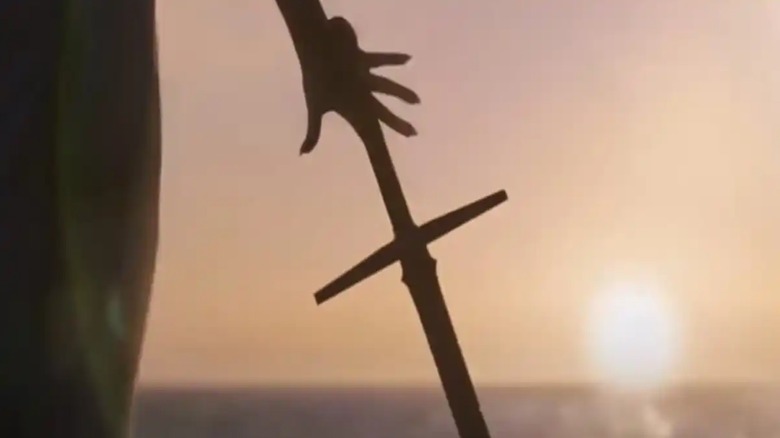
One of the best-named weapons in the MCU is also one of its most dangerous: All-Black the Necrosword. The deadly blade was once wielded by the Dark Shadow Lord, but when it's introduced in "Thor: Love and Thunder," it falls into the hands of Gorr (Christian Bale). At first, he's just Gorr, a grieving man who lost his entire family and prays to his god for help, only to find his deity who laughs at his plight.
Yet once he picks up All-Black the Necrosword, he transforms into Gorr the God Butcher, slaying his god and going on a deity-themed killing spree. Gorr's sword from "Thor: Love and Thunder" is well-known to hardcore Marvel Comics fans, as this overpowered beast comes straight out of the funny pages. The blade was forged at the beginning of time with the power to kill any and all gods, but anyone who wields its dark energy is corrupted by it and is eventually destroyed.
The blade is sentient; it calls out to Gorr, who uses it to slay numerous gods in the hope of finding his way to Eternity so he can kill them all in one final act of vengeance. In terms of the sword's capabilities, it's more than just a blade capable of killing gods — it has the ability to conjure Shadow Monsters, which serve the wielder as their minion army. It can also teleport them to other places and dimensions through shadows.
Darkhold & Book of Vishanti
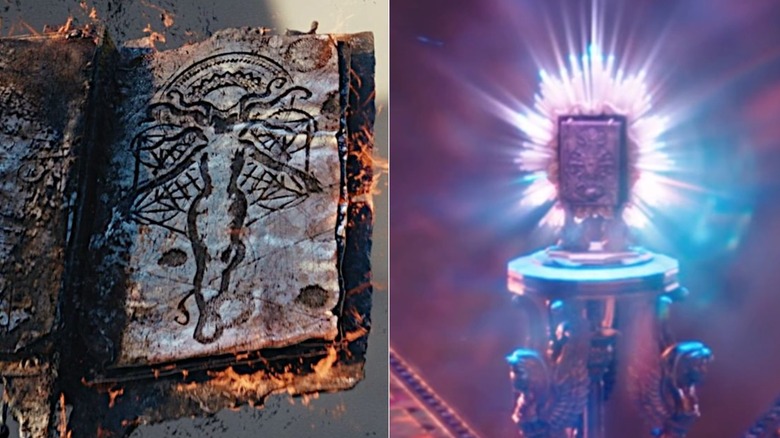
Because they're two sides of the same coin, the Darkhold and the Book of Vishanti take up a single spot. While the Book of Vishanti would make its first appearance in "Doctor Strange in the Multiverse of Madness," The Darkhold was introduced first in the MCU in "WandaVision." An evil book capable of corrupting anyone who uses it as it becomes an obsession of the reader, the Darkhold fully corrupts Wanda Maximoff (Elizabeth Olsen). She uses its powers to peer into other universes, becoming obsessed with finding her children. She then uses her already considerable powers (further enhanced by the Darkhold) to lay siege to Kamar-Taj and defeat almost all of the sorcerers there. She then crosses into another universe and slaughters the Illuminati, which consists of some of the most powerful beings in existence.
Conversely, the Book of Vishanti is the Darkhold's antithesis, which is said to be capable of granting a sorcerer the ability to defeat any enemy. The Book of Vishanti could resist the Darkhold's magic, but not its user. In "Multiverse of Madness," Wanda destroys the Book of Vishanti, burning it to ash. Similarly, the Darkhold is destroyed, but when Wanda does this, it's annihilated in every universe, ending its threat permanently. As far as magical tomes go, both books are incredibly overpowered. In the right (or wrong) hands, they can accomplish great or terrible things, making the Darkhold and Book of Vishanti two of the most powerful weapons in the MCU.
Infinity Gauntlet
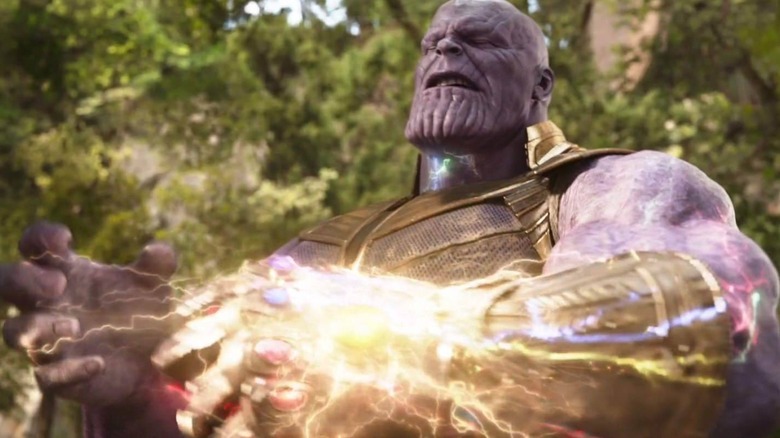
The Infinity Saga built up to "Avengers: Infinity War" and "Endgame," where Thanos finally assembles all six Infinity Stones, completing his lifelong goal: the Infinity Gauntlet. Specially crafted from Uru by the dwarves of Nidavellir, this ensured that its wielder could survive its use, as not even the Mad Titan possessed the power to do so otherwise. Once assembled, it gave Thanos command over space, reality, power, soul, mind, and time. This allows him to snap his fingers at the end of "Infinity War," wiping out half of all life in the universe.
Each Infinity Stone is immensely powerful just on their own, but assembled like that combines them into a wish-granting device. In "Endgame," the Hulk (Mark Ruffalo) is badly injured when he uses the Infinity Gauntlet to undo Thanos' snap. When Tony Stark (Robert Downey Jr.) uses them on his Iron Man suit, it kills him. This demonstrates the energy output of the Stones, which is immense and not something anything less than a Celestial can handle.
In "Loki," the Infinity Stones are used as paperweights, making them seem entirely innocuous, and they are. The scene is played for laughs but it's lore-accurate: these all-powerful stones only work in their respective universe, which is a detail that comes straight out of the comics. Under normal conditions, they're the most powerful items in the MCU, which is demonstrated in the previous films — especially when brought together. It's also shown in "What If...?" when Ultron manages to get his robotic hands on them, becoming an all-powerful multi-dimensional threat capable of perceiving the Watcher (Jeffrey Wright) in his own reality.