

5 Best Movies Like Netflix's Thrash
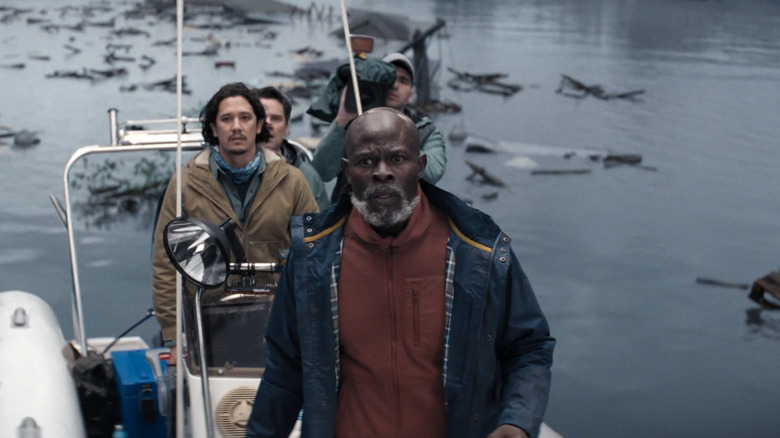
Currently the most watched movie on Netflix, "Thrash" has been thrilling and terrifying subscribers with its story of a town flooded with shark-infested waters from a massive hurricane. Like many of the best shark movies, "Thrash" can definitely be a bit cheesy at times, but it knows how to ratchet up the tension by playing into two of our most commonly-shared fears: Drowning in open water, and shark attacks. Credit where credit is due to Steven Spielberg on that front, as "Jaws" helped to cement a collective terror of sharks and open water for multiple generations.
Speaking of "Jaws," that's the most obvious go to when recommending horror movies based in and around the water, and that involve sharks and other nautical creatures. So much so that it goes without saying when making a list like this. Instead, we've compiled five other films that are similar to "Thrash" — they all feature surviving in dangerous waters as the primary conflict, all of them bring sharks or other similarly dangerous water animals, and a few of them even have a hurricane as the catalyst.
Crawl
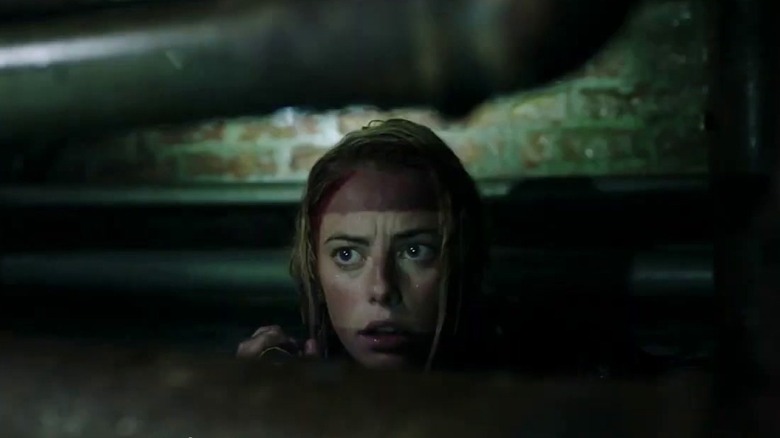
As terrifyingly unsettling as it is to be stuck unprotected in open waters, "Crawl" brings an entirely new angle to water horror. Instead of a lake or ocean, the protagonists of "Crawl" are actually stuck in their own home — the crawlspace under their house, to be specific — as they find themselves trapped after hurricane flood waters rushed in too quickly for them to get away.
Honestly, a movie about trying to navigate and escape a flooded house would've been scary enough. But "Crawl" takes things a step further, and has violent alligators that have also arrived with the flood waters. Father and daughter Dave (Barry Pepper) and Haley (Kaya Scodelario) are immediately put at a disadvantage when Dave is mauled shortly after the gators arrive, and it becomes a matter of not only surviving until help arrives but also keeping Dave from bleeding out along the way.
While "Crawl" is well-made and brings a clever mix of throwback horror and modern self-awareness, it's the performance of Scodelario — one of the best scream queens of the moment — that cements the movie's place in the pantheon of water-based survival horror films.
The Shallows
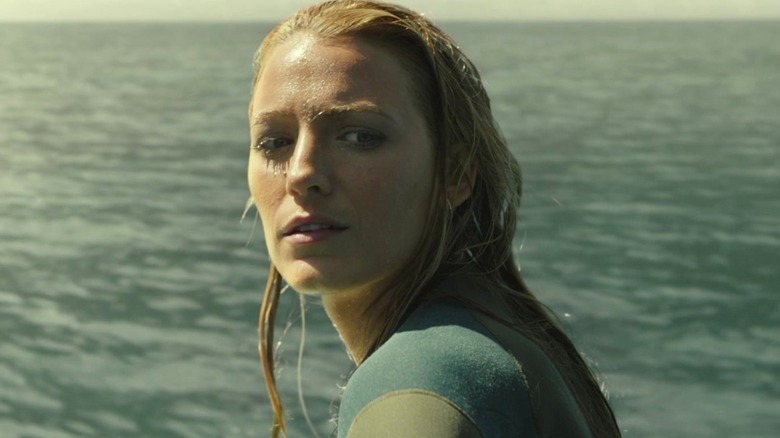
There is always something especially unsettling about horror movies that mostly feature one actor, doubly so when that one actor is playing a character alone in the water. Such is the case with "The Shallows," in which a sequence of events causes a young woman named Nancy (Blake Lively) to become stranded alone on a rock in the middle of shark-infested waters. Making matters worse, the tide is rising, and that rock will soon cease to be a safe haven for Nancy.
Critics were impressed with the film and the way it stands out among a very crowded subgenre. The Rotten Tomatoes critical consensus reads, "Lean and solidly crafted, 'The Shallows' transcends tired shark-attack tropes with nasty thrills and a powerful performance from Blake Lively." Reviewers positively compared "The Shallows" to not only "Jaws" but even non-water horror films like "The Blair Witch Project," and it received nominations from multiple outlets for best thriller of 2016.
47 Meters Down
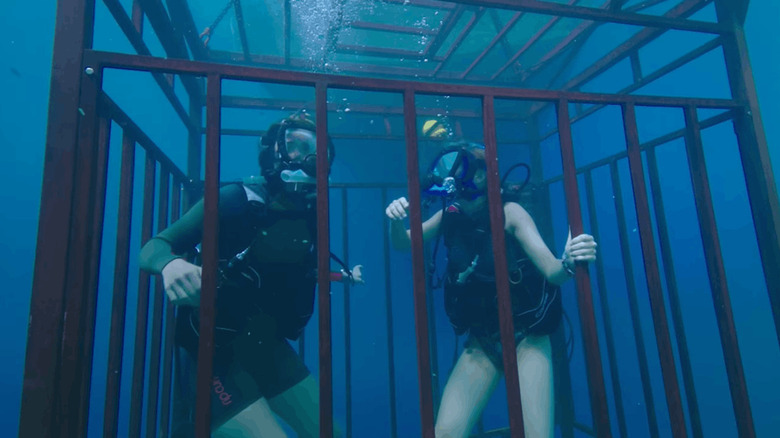
As scary as it is to be on the surface of shark-infested waters, it is even more terrifying to be deep within them. That's the premise of "47 Meters Down," which sees a cage diving excursion go awry as the cage becomes detached from its boat and sends two women to the ocean floor. With sharks circling and their air supply running low, the clock is ticking for these women to somehow free themselves from the cage and swim up to safety without becoming shark food.
"47 Meters Down" certainly found its intended audience, as it spawned not only a sequel but is soon to become a trilogy with a forthcoming third installment. Johannes Roberts, who has also worked on non-aquatic horror films like "The Other Side of the Door" and "Resident Evil: Welcome to Raccoon City," is the co-writer of all three installments, but only directed the first two. "47 Meters Down: Uncaged" is generally considered to be as good as the original, so definitely check it out if you enjoy "47 Meters Down" and look forward to the next one sometime in 2026.
The Reef
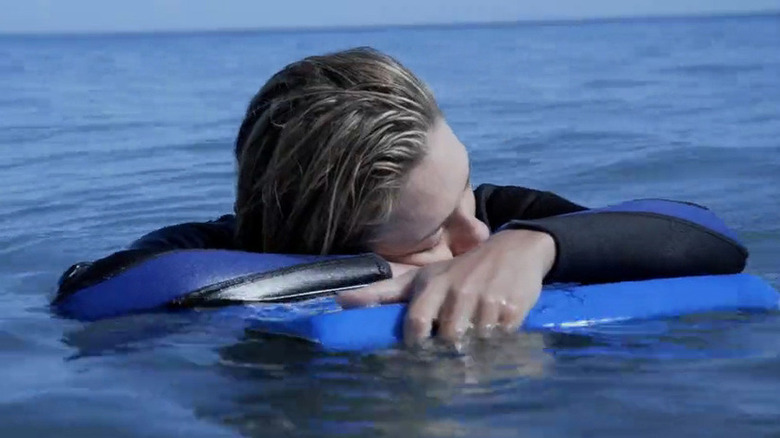
Loosely based on a 1983 incident which saw two people killed by sharks in Australia's coral reef, 2010's "The Reef" follows a group of friends on a yachting trip who strike a reef, capsizing the yacht. Realizing that the vessel's S.O.S. system is too dated to do much good, it is decided that they must brave the shark-infested ocean to swim to the nearest island.
"The Reef" does a great job of bringing the scares, and things don't unfold in the exact sequence of events you expect them to. Unlike "Thrash," it's the kind of movie that isn't wall-to-wall shark attacks or big special effects set pieces, instead mostly content to rely on unsettling tension punctuated by only occasional — but expertly timed — bouts of shark-induced terror.
"The Reef" is another shark movie with a sequel, but it's best to not bother with "The Reef: Stalked." Instead, if you enjoyed "The Reef" and want more, you'd be better off following it up with writer/director Andrew Traucki's excellent "Dark Water" — which takes place in the alligator-infested swamps of Australia.
Open Water
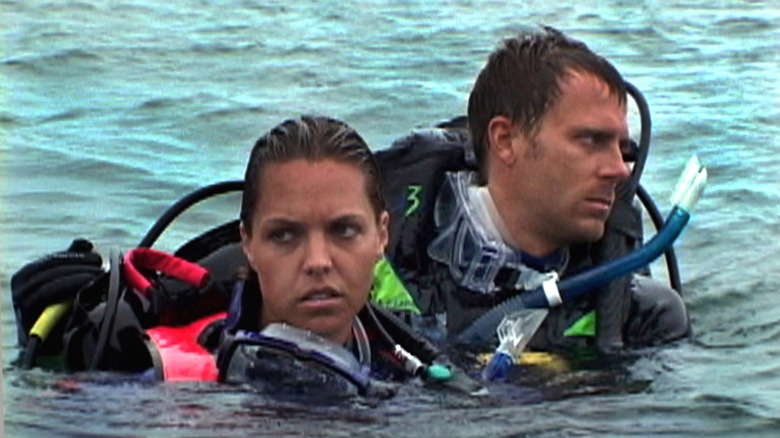
While technically another horror movie about people stranded in shark-infested waters based on real events, "Open Water" is definitely one of those true story movies that lies to you. The movie only draws from the absolute bare minimum of the story that inspired it, just enough to proclaim itself based on a true story.
Married couple Daniel (Daniel Travis) and Susan (Blanchard Ryan) Watkins are on a scuba diving excursion and are accidentally abandoned by the rest of the group, as a logistical error results in the group not even realizing they are gone. So the bulk of the movie is just the two of them, treading water, sharks circling, trying to figure out if they have any options other than to just delay their seemingly inevitable deaths as long as possible.
Putting the deceit of borrowing a real life tragedy to market the movie aside, "Open Water" is one of the best movies of its kind. In fact, legendary film critic Roger Ebert praised the movie specifically for how realistic it felt, writing, "Rarely, but sometimes, a movie can have an actual physical effect on you. It gets under your defenses and sidesteps the 'it's only a movie' reflex and creates a visceral feeling that might as well be real."