

The Twilight Zone Creator Rod Serling Didn't Hold Back On Star Trek
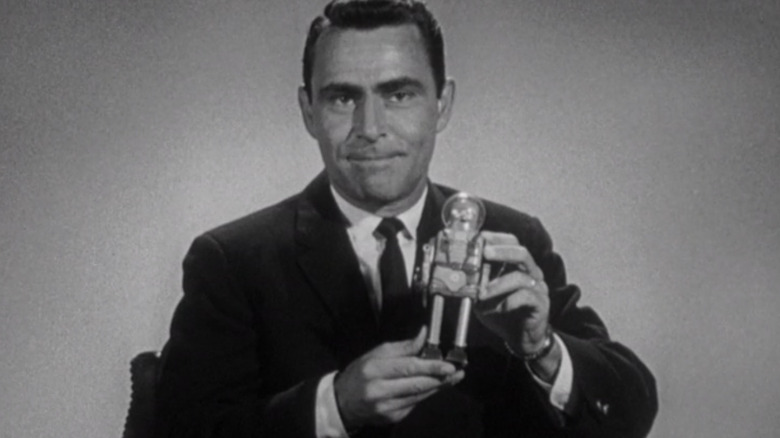
American television was never the same after "The Twilight Zone" and "Star Trek: The Original Series" premiered. Both series worked to remove the stigma from tough topics by presenting them in a way that was both challenging and entertaining. However, "The Twilight Zone" creator, Rod Serling, had a somewhat different perspective of "Star Trek" that pointed out many of its flaws.
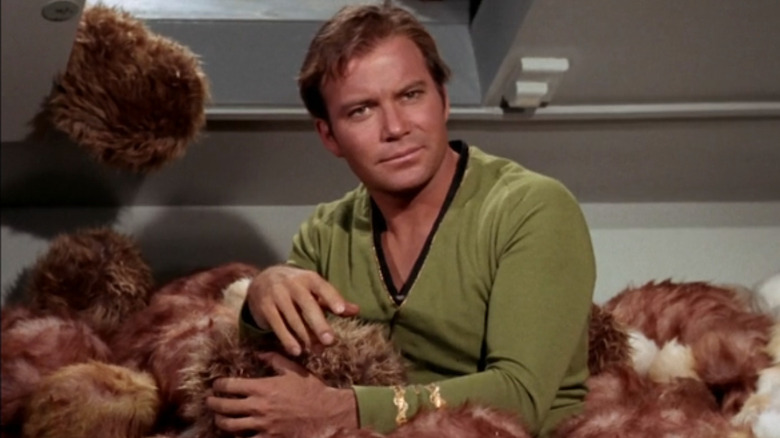
In a 1970 interview, Serling said, "'Star Trek' ... was, again, a very inconsistent show. Which, at times, sparkled with true ingenuity and pure science fiction approaches. At other times, it was more carnival-like, and very much more the creature of television than the creature of a legitimate literary form." He's right about "Star Trek" being the creature of television given its traditional, linear storyline. Such an approach could make the show lackluster, which could be why it tries to loudly stand out with bright colors and absurd villains, like the infamously adorable Tribbles.
While "The Twilight Zone" did have something to prove, it doesn't have the same problems as "Star Trek" because of its anthology approach. This allows the series to fully explore a single subject, eliminating the possibility of inconsistencies and plot holes that plague stories focusing on multiple characters and storylines. This is just part of the reason why many of "The Twilight Zone" episodes still hit just as hard today. It's clear that Serling believed in making decisions due to substance rather than pure entertainment, but Roddenberry once said that his choices were made for a very good reason.
Why the entertainment factor was crucial to Star Trek
Some of "Star Trek's" ideas are steeped in fantasy. There was even an experiment with Greek mythology that brought us one of "Star Trek's" worst villains. As Serling stated, these storylines shouldn't make sense in outer space, but Roddenberry's approach may have been caused by certain pressures.
"Star Trek: The Illustrated Oral History" (via StarTrek.com) includes an interview with Roddenberry, who explained that the writers tried to hang onto their main objective while focusing on the show's survival. "Although 'Star Trek' had to entertain or go off the air, we believe our format was unique enough to allow us to challenge and stimulate the audience," he said. Going where no man has gone before gave them the opportunity to do just that, and sometimes they stretched their limits. However, the series still became legendary because of standout episodes that struck the perfect balance between being informative and entertaining in order to give us groundbreaking science-fiction tales.
Roddenberry told The Humanist in 1991 (via Humanist Trek) that he had reached a point where the idea of "Star Trek" was totally accepted by the studio. He recalled putting a stop to studio notes during the first of "Star Trek: The Next Generation," and that led him to compare his decision-making power to Serling's. "Rod Serling may have come close at one point with his 'The Twilight Zone,' but I don't think as close as I've come," he said, proving that both men were unafraid to share their professional takes on each other.