

The First Horror Movie To Win An Oscar Is Streaming On HBO Max
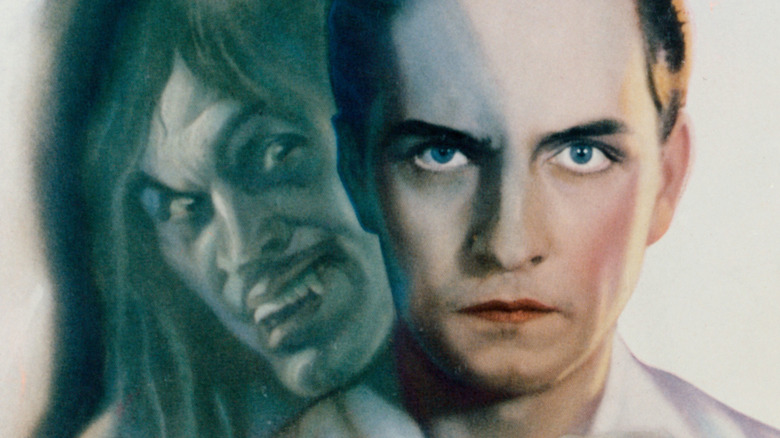
Ryan Coogler's "Sinners" will go down in the record books for being the most-nominated film in Oscar history with 16 nominations, with the kicker being that it's also the most-nominated horror film, too. The Academy has given out its share of awards to films like "The Exorcist," "Silence of the Lambs," and "Get Out," but, for the most part, the odds of horror movies winning Oscars are slim. That's especially strange considering the first genre movie to receive any attention at the Academy Awards was almost a century ago: 1931's "Dr. Jekyll and Mr. Hyde."
This adaptation of Robert Louis Stevenson's gothic horror novella about an English doctor in Victorian London was not only nominated for best adapted screenplay (then known as adaptation writing) and best cinematography, but it nabbed a best actor Oscar for Fredric March in a rare tie outcome with Wallace Beery for "The Champ." You can see the record-breaking performance for yourself now that "Dr. Jekyll and Mr. Hyde" is streaming on HBO Max.
Dr. Henry Jekyll (March) has everything a man in his position could ask for. He's respected by his peers, he has a beautiful home, and a fiancée (Rose Hobart) who adores him. But he's determined to prove that everyone has good and evil inside of them, which compels him to concoct a formula that would prove his theory. Jekyll transforms into Edward Hyde (also March), a beast of a man who revels in his dark desires. He's able to switch between the two identities, but before long he realizes that he's losing control of his transformations.
Fredric March's dual performance is mesmerizing
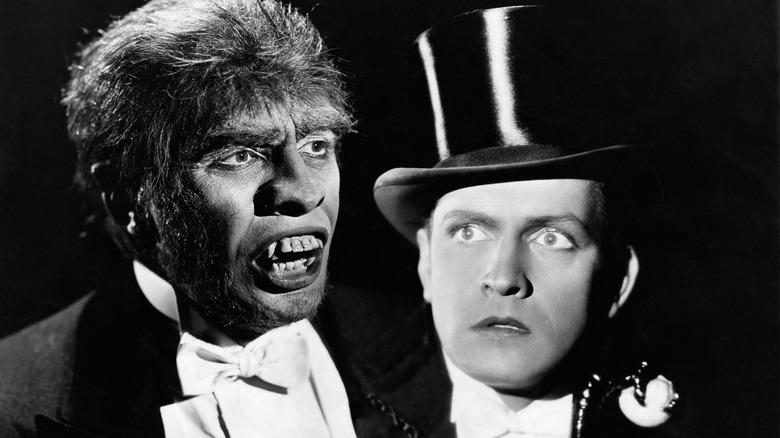
Fredric March's Oscar win was very much deserved, and his performance hasn't lost an ounce of potency in the decades since. Jekyll and Hyde are two aesthetically different characters, with the former resembling the "respectable" upper class gentleman and the latter taking the form of a snarling, primitive beast. It's a testament to March that he's able to convey shades of Hyde inside of Jekyll before the iconic transformation. Director Rouben Mamoulian's depiction of the doctor's bad side is a deviation from Robert Louis Stevenson's text, in which Hyde's ugly appearance comes down to how he's perceived by others. But Wally Westmore's ape-like makeup created a disturbing transformation that's a lot more visual, and it remains iconic to this day. Jekyll's metamorphosis is still a jaw-dropping special effect that makes you feel as if you're witnessing cinema itself pulling one heck of a magic trick.
Cinematographer Karl Struss achieved the in-camera effect by swapping between different colored filters while shooting on black and white film stock. It ensures that the makeup that was already caked on March's face seamlessly appears as if it was actually changing him from within rather than achieving the effect through separate cuts. Struss lures the viewer in right off the bat with a spectacularly impressive opening shot that puts you inside Jekyll's POV. It achieves the mirror effect by having March in another room before implementing a hidden cut to make it feel natural and smooth. The clever filmmaking techniques on display in "Dr. Jekyll and Mr. Hyde" were groundbreaking — remember, the "talkies" were only a few years old at this point in time. Watching the film today leaves you in awe of how creative it is.
Dr. Jekyll and Mr. Hyde is still a frightening film
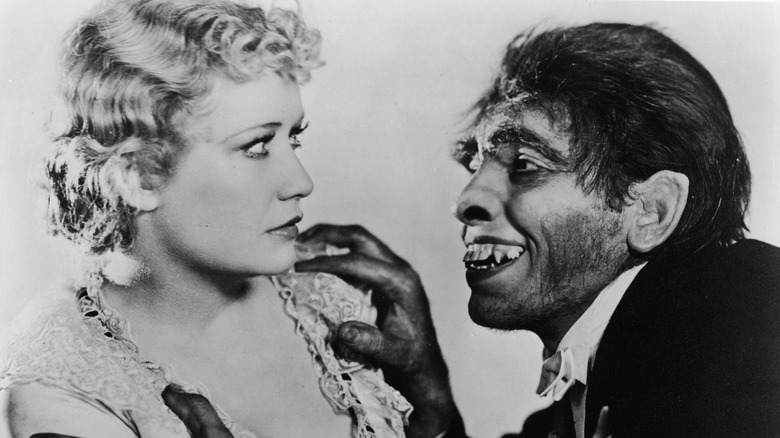
"Dr. Jekyll and Mr. Hyde" still feels edgy and frightening today, partly because it was made in the pre-Hays code era, when there was a more lax attitude towards depictions of violence and sex. This allowed Rouben Mamoulian to explore the darker aspects of the story relatively unshackled, such as Hyde's abusive relationship with singer Ivy Pierson (Miriam Hopkins), illustrating the depths of the terror he inflicts on her. It's still upsetting to watch him break her down by using her promiscuous side against her. There's no score beyond Bach's "Toccata and Fugue in D minor, BWV 565" in the opening credits, which makes the long stretches of silence amid Hyde's evil deeds that much more sinister.
Horror fans should consider themselves lucky that 1931's "Dr. Jekyll and Mr. Hyde" is accessible today considering MGM purchased the prints of both the 1920 and 1931 adaptations with the intent of locking them away so its inferior 1941 remake starring Spencer Tracy would thrive, paying a whopping $125,000 for them. It wasn't nearly as successful despite landing three Oscar nominations of its own. There's also a hilarious irony considering March and Tracy would later go face to face in a Jekyll and Hyde-esque showdown in Stanley Kramer's stirring 1960 courtroom drama "Inherit the Wind," one of the best lawyer movies of all time. Thankfully, a print of the 1931 film was unearthed in the mid '60s. It would have been a real travesty had this wonderful movie been locked away and forgotten.