

10 Best Cosmic Horror Movies Of All Time, Ranked
Who doesn't love a good horror movie? The best of this genre demonstrates tremendously fulfilling artistry, and there are countless strains of horror cinema to fit one's mood on any given day. Among these variations is the world of cosmic horror, a type of storytelling made famous by author H.P. Lovecraft.
Cosmic horror, as its name implies, is typically sci-fi-based, often tapping into humanity's fear of being dwarfed by larger forces and worlds. It's soothing to imagine that nothing will upend the status quo, but cosmic horror reinforces our vulnerability, forcing viewers to confront their true, minuscule place in existence. These daunting, often visually surreal projects are incredibly evocative, not to mention deeply frightening on an existential level.
These ten cosmic horror movies (here ranked from "least best" to greatest ever) are lofty testaments to the thrills and chills this subgenre can provide. All these projects are wildly different and go far beyond Lovecraft's vision of cosmic horror. They all, however, reinforce what a special cinematic space this is.
10. Color Out of Space

Even with all the problems that plagued Guillermo del Toro's unmade Tom Cruise-starring Lovecraftian horror movie,"At the Mountains of Madness," H.P. Lovecraft movie adaptations haven't been totally absent. Case in point: 2019's "Color Out of Space," a take on Lovecraft's 1927 short story "The Colour Out of Space." This feature from writer/director Richard Stanley sees Nathan Gardner (Nicolas Cage) contend with the vibrantly colored madness that consumes his farm after a meteorite crash.
Though not perfect, Stanley's commitment to surreal storytelling, the deluge of uncomfortable imagery, and Cage's naturally bravura performance excel at capturing the madness of Lovecraft's prose. This author's work, which defines the entire realm of cosmic horror, can sometimes be tough to translate to the silver screen, especially for films trying to maintain a traditional narrative structure. "Color Out of Space" wisely eschews realism or logic, especially in its memorably unhinged finale.
Descents into madness defined so many of Lovecraft's works and this film mimics that phenomenon effectively. Better yet, the feature looks utterly gorgeous, whether it's in the cinematography emphasizing bright colors or the impressive practical effects. As a cherry on top, Cage operates in many different modes reflecting Gardner's slippery psyche, and each of his personalities is a riot to absorb. Cosmic horror's architect got a rock-solid modern movie with "Color Out of Space."
9. Hellraiser

In "Hellraiser," the scares do not come from a masked killer lurking behind a house or a threat hiding in plain sight. Instead, the frights are intertwined with forces mankind can barely comprehend. Pinhead (Doug Bradley) and the other Cenobites are striking-looking creations that promise "sights" and twisted versions of "pleasures" incoherent to Earthbound minds. These are the sensations that bedrock the story of the depraved and deceased Frank Cotton (Sean Chapman) carrying on an affair with Julia Cotton (Clare Higgins) and murdering random men to get his body back.
All the while, the Lament Configuration summoning Pinhead and his cohorts beckons. The threat of this puzzle box being reopened and Frank's carnage escalating loom over this seemingly normal suburban house. So vividly juxtaposing ordinary reality with mystifying, otherworldly forces is just one of many ways "Hellraiser" excels as a cosmic horror. Writer/director Clive Barker's flippant treatment of human beings, who remain consistently powerless against these threats, is also a chilling recontextualization of this genre motif. Even Frank is not immune to the towering authority of the Cenobites and their chaotic domain.
Humans spend so much of their lives convinced they're on top of the food chain and that everything is in their control. "Hellraiser," meanwhile, chillingly upends that reality. Enhancing it all is Barker's heightened imagery that could only work in the realm of cosmic horror. All hail the frights and "sights" of "Hellraiser."
8. Annihilation

Rarely has a terrifying dystopia been as beautiful as the tableaus littering Alex Garland's "Annihilation." The 2018 film sees Lena (Natalie Portman) and a handful of other women go on a mission to a forbidden Earthbound zone known as The Shimmer. This territory was forever altered after a meteor landed, with beautiful green foliage, luscious colored fungus, and weird animal hybrids littering the land. Even The Shimmer's entrance is a beautiful array of dripping hues looking more like a watercolor creation than the barrier between the normal world and madness.
Garland's efforts in making "Annihilation's" cosmic horrors so gorgeous makes for a fascinating and transfixing visual scheme. In this context, the ominous is so pretty you can't help but want to reach out and touch it. This approach also makes unnerving flourishes, like human-shaped trees, extra impactful. Even when they're sublime to look at, these elements remind viewers they're trapped in a disorienting, albeit gorgeous, nightmare.
The voyage undertaken by the lead characters is rife with the kind of inspired visuals and unpredictability defining the best cosmic horror movies. Garland's execution, though, leans heavily on the enchanting to differentiate it from its peers. Gaze into The Shimmer's wonders and you'll be as awestruck as you are chilled to the bone.
7. Altered States
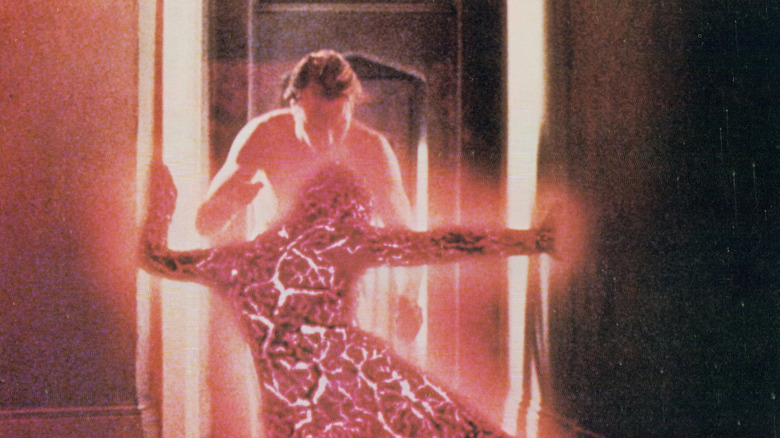
Director Ken Russell was a wizard at leaving it all on the floor. His movies like "The Devils" ran rampant with unhinged insanity that left viewers baffled. That made him an ideal creative voice to shepherd a cosmic horror like "Altered States," which focused on Edward Jessup (William Hurt) using sensory deprivation tanks to discover new levels of human consciousness. Specifically, these experiences help Jessup unlock and experience past memories.
Like so many cosmic horror movies, "Altered States" is a frightening yarn about human beings tapping into greater forces they can never hope to control. Screenwriter Paddy Chayefsky (adapting his 1978 novel of the same name under a pseudonym) uses the concept of blurring the lines between the past and present to deliver surrealist explorations of identity and religion. There's also extended sequences involving a proto-man running loose that seem like the outcome of somebody asking what would happen if "Shakma" took place outside.
Jostling between such opposing modes effectively heightens the way Jessup is pulled between modern reality and the deprivation tanks. It's all unnervingly mind-bending, a quality amplified by deeply committed performances and Russell's assured handling of the offbeat material. "Altered States" leaves your brain feeling like goo, a testament to Russell's filmmaking mastery.
6. Under the Skin
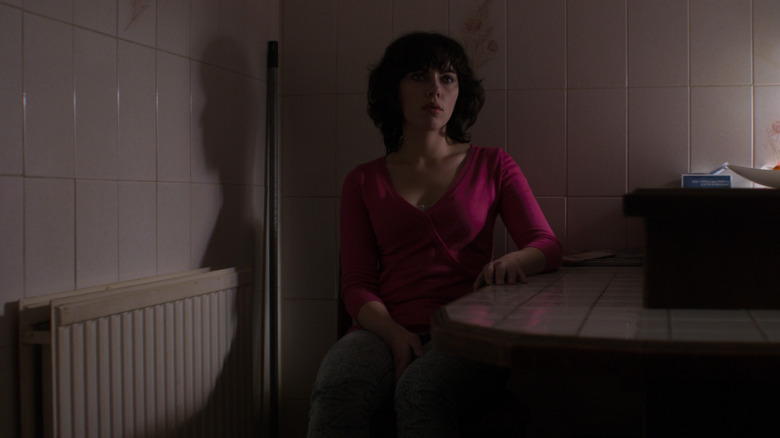
The quietest material can sometimes be the most terrifying. Director Jonathan Glazer epitomized that reality with his 2023 masterpiece "The Zone of Interest," which depicted the "tranquil" domestic life of SS officer Rudolf Höss and his family living right next to Auschwitz. Nearly a decade earlier, Glazer utilized silence to similarly masterful results in "Under the Skin."
When The Female (Scarlett Johansson), an alien posing as a human woman, brings men back to a black, liquidy void, they either submerge or become only empty skin. There are no screams as they succumb to their fate, nor are there grandiose sound cues or dialogue beats explaining what's happening. It's largely silent carnage taking place in an endless realm divorced from anything resembling reality. The stillness and predominately empty sonic landscape allows the viewer to instill their fear and uncertainty into what's happening.
Glazer forces viewers to confront the indescribable in these and other "Under the Skin" sequences, while also demonstrating how malleable human identity is. There are few movies, cosmic horror or otherwise, quite like "Under the Skin." Rarely do films this well-crafted come along, especially ones exemplifying the importance of silence in creating quiet yet impactful terror.
5. The Lighthouse

Good luck classifying "The Lighthouse" into one genre. Sometimes, it operates like a cosmic horror movie. Other times, it's a grounded character-based drama about men going mad. And then, it's a dark comedy full of gruff depictions of classical masculinity crumbling into insecurity at the slightest insult. Uniting these aesthetics is writer/director Robert Eggers, who, like on "The VVitch," demonstrates impressive visual precision and dedication to getting every period detail just right.
This oddball concoction registered as one of the most baffling movies of 2019 for many. However, "The Lighthouse" is also a masterpiece, exemplifying the psychological terrors and slippery definitions of reality that define great cosmic horror. This cinematic dish is loaded with delectable bouts of madness that are impossible not to devour. To boot, it's led by two tremendous performances courtesy of Robert Pattinson and Willem Dafoe.
With "The Lighthouse" boiling down to just two men trapped in one location, this entire film rests on their shoulders. They're more than up for that task, with Dafoe especially having the time of his life playing the crustiest sea dog that's ever strode onto the silver screen. Still the creative pinnacle of Robert Eggers directorial efforts, "The Lighthouse's" one-of-a-kind aesthetic shows just how flexible the world of cosmic horror cinema can be.
4. Nope

Jordan Peele's filmmaking career has been exciting on countless levels, but it's been especially enthralling because of how many different corners of horror cinema he's explored. "Get Out" was a more down-to-Earth, psychological horror experience. "Us" had slasher film energy for days. "Nope," meanwhile, leaned on cosmic horror and the follies of humanity controlling nature. Whether it's a chimpanzee on a sitcom set or a gigantic UFO, "Nope's" characters, just like actual human beings, are tragically drawn to taming the untamable.
These thematic cornerstones of the cosmic horror space are combined in "Nope" with all kinds of trippy imagery that only this genre could produce. The gigantic otherworldly creation descending upon the central "Nope" characters eventually contorts into a towering, indescribable figure channeling the inexplicable appearances of so many cosmic horror creations. Excitingly, though, "Nope" delivers extra doses of levity compared to most cosmic horror films. Peele masterfully imbues bursts of comedy throughout "Nope" without ever diluting the tension or momentousness of this premise.
Typically, cosmic horror features and stories are incredibly morose affairs that maintain strictly grim atmospheres. "Nope," meanwhile, balances out cosmic horror ominousness with incredibly amusing Keke Palmer line deliveries and Brandon Perea as a plucky, inquisitive Fry's employee. Additionally, the incorporation of Western visual and thematic motifs further differentiates "Nope" from so many of its cosmic horror brethren. There's just so many unique achievements here, all amplifying a glorious cosmic horror aesthetic. Leave it to Jordan Peele to make that artistic accomplishment look so effortless.
3. Mandy
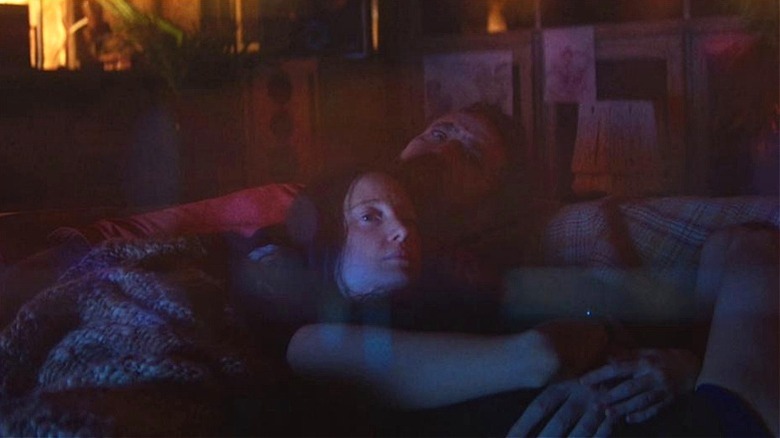
Many cosmic horror movies depict people crumbling in the face of incomprehensible alien threats. "Mandy," meanwhile, carries over those impulses to tell the story of a lumberjack enduring immense anguish in the face of grief. Red Miller (Nicolas Cage) is a man whose girlfriend, Mandy Bloom (Andrea Riseborough), is murdered by Jeremiah Sand (Linus Roache) and his freaky followers.
Much like how gazing upon a beast drives normal people mad in classic Lovecraft novels, watching the woman he cherishes perish snaps Miller's psyche in two. Writer/director Panos Cosmatos (who penned the script with Aaron Stewart-Ahn) depicts this internal agony in raw fashion in a sequence where a pantsless Miller, clutching a whiskey bottle in one hand, sits on a toilet and wails to the heavens. Cage's performance is uncomfortably human, and capturing this messy emotional display in one unbroken image accentuates his pain.
One of the best Nicolas Cage movies, "Mandy" is full of memorable sequences, eventually descending into bloody, brightly-colorful chaos as Miller exacts revenge against Sand and his devotees, complete with cocaine and chainsaw fights. "Mandy" is an exceptional work, but also an achingly painful one conscious of how tremendously torturous it is to navigate grief. Sometimes, the tenets of cosmic horror materialize from more intimate, internalized means, like in "Mandy."
2. Alien (1979)
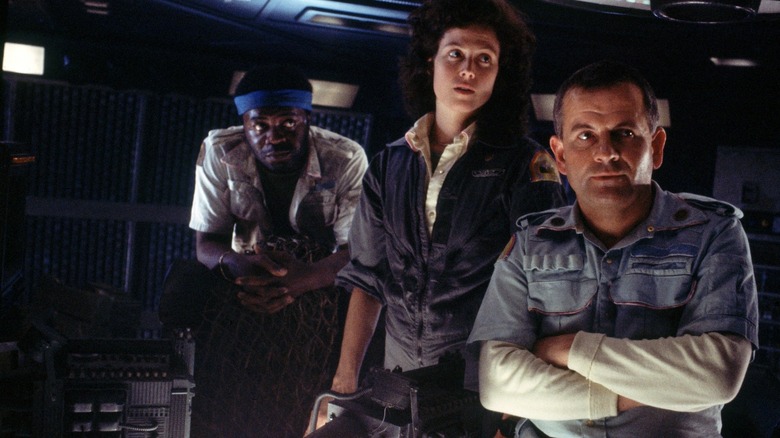
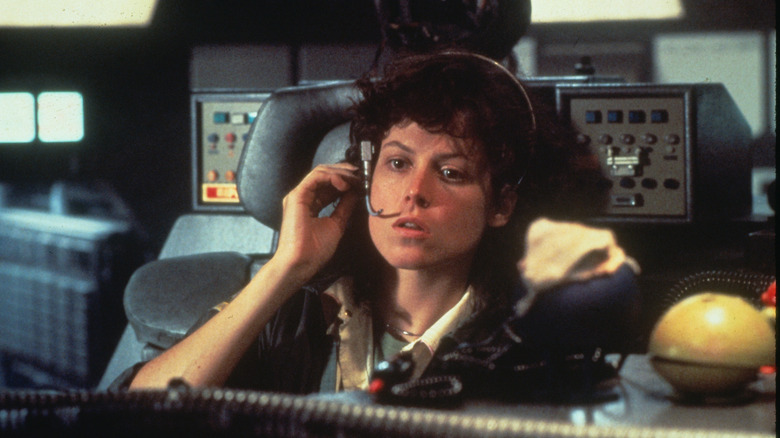
The entire "Alien" story now spans multiple movies, a Noah Hawley-created FX show, and crossovers with the "Predator" saga. Before the days of "Prometheus" and Timothy Olyphant encountering Xenomorphs, there was 1979's "Alien," the film that started all this outer space carnage. Subsequent installments would ratchet up the action and include cathartic callbacks to earlier movies. Ridley Scott's inaugural "Alien," though, was simply focused on providing something purely terrifying that made audiences tensely question what was going bump in the night.
There is no method to the Xenomorph's rampage in "Alien" as she picks off the various humans one by one. Like so many threats in cosmic horror, logic and reasoning do not enter this organism's mind. Instead, the Xenomorph is focused on attacking and reproducing with nary a hint of concern for the humans caught in the crossfire. The Space Race of the 1960s suggested that humanity had "conquered" outer space. "Alien," meanwhile, showed human beings succumbing to monstrous entities in the farthest corners of the cosmos. We hadn't conquered anything.
Still a terrifying ride like no other, "Alien's" practical effects work and masterful suspense, as well as Sigourney Weaver's fantastic lead performance, remain remarkable. The larger "Alien" franchise can make it easy to forget that this saga's roots come from one of the most spine-tingling cosmic horror movies out there.
1. The Thing (1982)
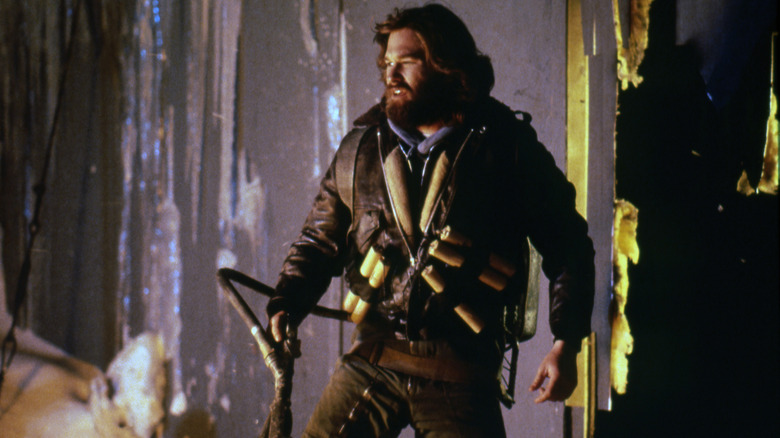
Cosmic horror's extensive history within the realm of cinema reached its artistic zenith with 1982's "The Thing." Though initially a box office and critical bomb, John Carpenter's remake has garnered a far better reputation in the modern world and for good reason. This ballad of men stuck at an isolated Antarctic research base encountering a shape-shifting alien who can turn into recognizable, everyday people is a tremendously tense enterprise, and Carpenter wrings all possible suspense out of this rich concept.
A barrage of memorable actors crush it in their roles, including leading man Kurt Russell and supporting players Keith David, Wilford Brimley, and Donald Moffat. The real star, though, is the assortment of groundbreaking practical effects used to realize the titular creature's various forms. Decades after "The Thing" first hit theaters, the warped designs and staggeringly tactile makeup and puppet work still astonishes.
Best of all, "The Thing" fits right in with the world of cosmic horror, and not just because its chilly setting harkens back to H.P. Lovecraft's "At the Mountains of Madness." This title's bleak atmosphere (including the gut-punch ending), paranoia-infused uncertainty, and depiction of humanity being firmly dwarfed by cosmic forces are vivid portrayals of core cosmic horror tenets. A tour de force excelling on all fronts, it's no wonder "The Thing" is widely considered the best sci-fi horror movie of all time.