

12 Biggest Box Office Bombs Of The 2000s

The 2000s. Nickelback, Daniel Powter, and Flo Rida dominated the Billboard charts. Reality television established a foothold in the cultural zeitgeist. And then there were the movies. Looking at the global film scene across the 2000s, it's immediately apparent many all-time masterpieces debuted across this era, with the best movies of the decade vividly reflecting that sentiment.
However, it wasn't all sunshine and rainbows for the movies. A variety of features — some artistic gems, others total creative disasters — tanked at the box office in the 2000s. These projects attracted tons of toxic publicity and quickly became more known for their lack of revenue than anything else. Despite getting released in the same decade, the biggest box office bombs of the 2000s each suffered from unique circumstances informing their financial despair.
From terrible marketing to atmospheres audiences just weren't digging, among other quandaries, there's no end to the factors that inspired the box office woes of these 2000s motion pictures. No decade's cinema scene is devoid of financial hardship, and these 12 movies exemplify that the 2000s were no exception.
Battlefield Earth

"Do you WANT lunch???" "We've decided to keep you here for another 50 cycles! With endless options for renewal!" "I am going to make you as happy as a baby Psychlo on a straight diet of kerbango." These and other "brilliant" lines of dialogue are the greatest legacy of the widely derided sci-fi film "Battlefield Earth." Universally regarded as the nadir of 21st century cosmic adventures, this adaptation of an L. Ron Hubbard text was envisioned to be the next "Star Wars." Instead, it became the "Cutthroat Island" of sci-fi tentpoles.
While today "Battlefield Earth" is strictly associated with the word "dismal," there was a point where it might've seemed like a recipe for making money. After his career rebirth in "Pulp Fiction," John Travolta continued to headline hits like "Get Shorty," "Phenomenon," and "Face/Off." As late as 1999, "The General's Daughter" grossed $102.7 million domestically. It's easy to imagine financiers at the time imagining that putting this face in a sci-fi action blockbuster would inevitably lead to profitability.
As the world knows all too well, though, that never happened. This $80 million budgeted project only grossed $21.47 million domestically and $8.25 million abroad for a $29.72 million worldwide cume. This was a fittingly terrible box office run for a film that's garnered a level of infamy few others have ever achieved.
Titan A.E.
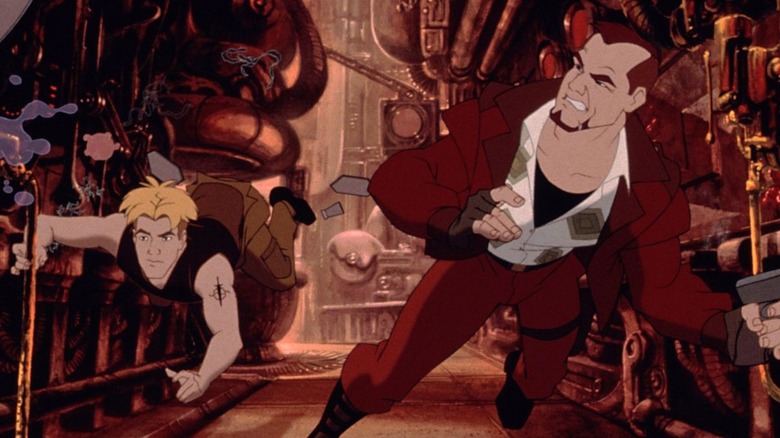
Back in the mid-'80s, director Don Bluth, who infamously walked away from Disney's animation department in the late '70s, helmed animated features that gave the Mouse House a run for its money at the box office. 1986's "An American Tail" was, at the time, the biggest non-Disney animated title ever in North America. Two years later, Bluth's "The Land Before Time" outgrossed "Oliver & Company" during their head-to-head opening weekend, and only made a few million dollars less than the Disney production over the course of its original theatrical release.
Unfortunately, few of his subsequent efforts even passed $12 million domestically, let alone broke even. His filmmaking career reached a frustratingly unlucrative end in 2000 with his first big foray into action cinema, "Titan A.E." The first of many action-centric animated PG movies that dominated American theaters between 2000 and 2003, "Titan A.E." had a $75 million budget and high hopes of becoming a summertime moneymaker.
Sadly, the movie only made $36.75 million worldwide, $22.75 million of which came from the domestic market. The fallout was so immense for the historic bomb that it bankrupted its studio (in this case, 20th Century Fox Animation). Former 20th Century Fox Animation head Chris Meledandri later recalled that "Titan A.E." lost $100 million, a far cry from the immense profits earlier Bluth films made with ease.
Town & Country
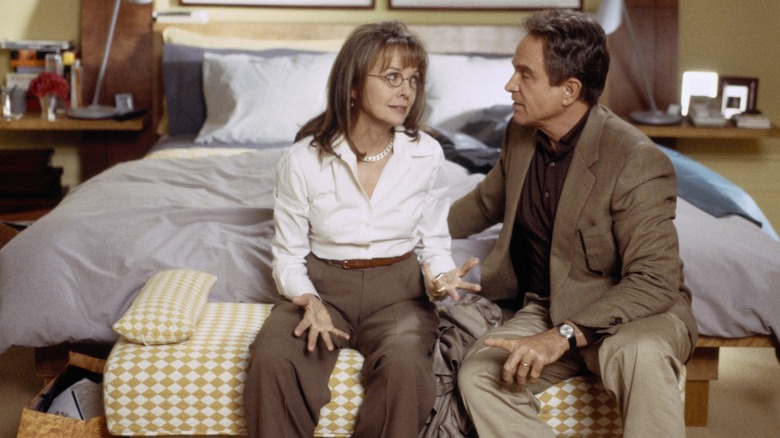
Circa. 2001, one would think that the only buzz surrounding a new Warren Beatty and Diane Keaton movie would've been its cast. Instead, Peter Chesholm's "Town & Country" arrived into multiplexes a creatively beleaguered project. Principal photography was constantly delayed due to difficulties coordinating the schedules of its big-name cast members and multiple rewrites.
There didn't seem to be a concrete creative vision behind this enterprise, making getting it into releasable shape a Herculean task. The budget had spiraled so far out of control for a grounded romantic comedy, with its $105 million price tag being even more than that of the first "X-Men" (which had a $75 million budget). Making a profit on those kinds of numbers was not going to be possible.
Inevitably, "Town & Country" crashed and burned financially, though nobody could've ever anticipated it doing this poorly. Only amassing $6.71 million domestically and $10.36 million worldwide, "Town & Country" was Beatty's lowest grossing film in North America in decades, making less than half of "Ishtar." Overshadowed by "Bridget Jones's Diary" (which opened two weeks prior), "Town & Country" was a flop of the highest order. None of those extensive reshoots and rewrites could turn this boondoggle into a moneymaker.
The Adventures of Pluto Nash
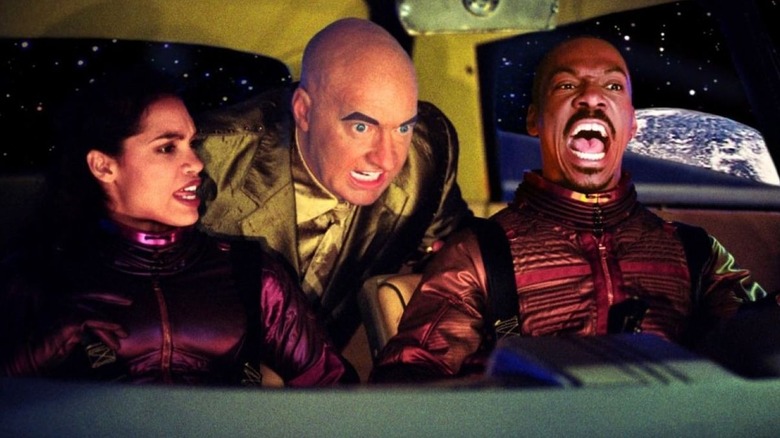
Much like "Town & Country," "The Adventures of Pluto Nash" was a costly and star-studded comedy that experienced tremendous problems during production. Release delays and reshoots led to the Eddie Murphy star vehicle eventually dropping in mid-August 2002. A few years later, mid-August became a great launchpad for yukfests like "Superbad," "Tropic Thunder," and "We're the Millers." Back in 2002, though, it signified distributor Warner Bros. Pictures had given up on "Pluto Nash" before it even hit theaters.
As any actor who headlines new movies annually is bound to experience, Murphy had his share of flops before "Pluto Nash." However, misfires like "Holy Man" and "Best Defense" at least got to $10+ million domestically. Not so with "Pluto Nash." This project immediately capsized on opening weekend, and eventually only grossed $4.4 million domestically (its worldwide cume topped out at $7.09 million).
"Pluto Nash's" anemic haul signified outright disdain from general moviegoers. The film's elaborate sets, visual effects, and endless production difficulties resulted in a $100 million budget, which meant tremendous losses on the project. The biggest Eddie Murphy movies of all time show that few have had this man's appeal on the big screen. Unfortunately, "Pluto Nash's" towering failure proved that not even Axel Foley was immune to delivering historically catastrophic box office duds.
Sinbad: Legend of the Seven Seas

In an interview with the Look Back Machine podcast, "Sinbad: Legend of the Seven Seas" director Tim Johnson recalled how both the film and its marketing campaign had trouble trying to please everyone. In particular, Johnson felt that the advertising threw so much at audiences (Action! Romance! A funny dog!), that they never got a firm grasp of what "Sinbad" actually was. Its promotional campaign didn't radiate confidence or specificity, but rather an eagerness to please whoever's eyeballs it had caught.
Those marketing woes would help explain why "Sinbad: Legend of the Seven Seas" was such an enormous box office disaster. Costing $60 million to make, "Sinbad: Legend of the Seven Seas" only made $26.48 million domestically despite a prime 4th of July release date and launching in 3,086 North American theaters. With a worldwide gross of $80.76 million, DreamWorks co-founder Jeffrey Katzenberg used "Sinbad" as proof that hand-drawn animated movies were no longer viable.
Years after its debut, DreamWorks co-founder David Geffen divulged that "Sinbad" lost $125 million. While an industry titan like Disney could easily absorb such a money-loser, the significantly smaller DreamWorks (which was founded less than a decade before "Sinbad's" release) nearly went bankrupt because of all this spilled red ink. The fallout from "Sinbad: Legend of the Seven Seas" was massive. Clearly, more than insecure marketing was responsible for its turmoil.
The Alamo
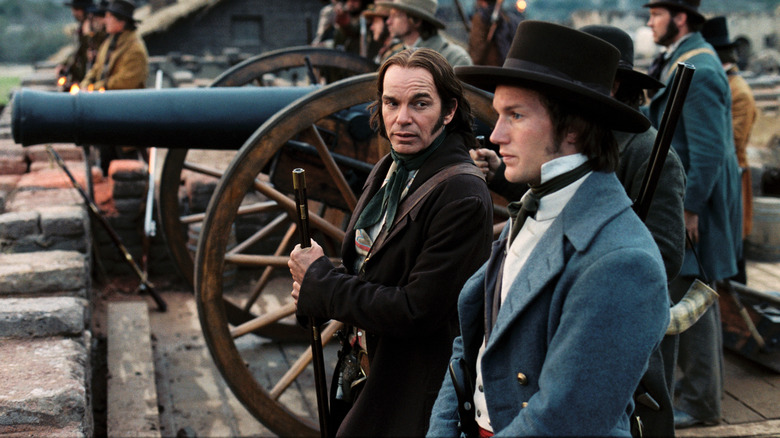
In the late 90s, Disney's adult-skewing movie division, Touchstone Pictures, began a quest to pull off a big-budget vision of the Battle of the Alamo. Getting this enterprise moving was a taxing endeavor, with Ron Howard leaving during pre-production. Initial visions of a glossy historical epic helmed by the recent Oscar-winner behind "A Beautiful Mind" quickly got dragged down to Earth. Instead, journeyman screenwriter John Lee Hancock, with only two directorial credits under his belt, sat behind the camera after helming the 2002 Disney sleeper hit "The Rookie."
The cast, meanwhile, was not populated with fresh, hyped-up faces that could resonate with younger audiences. Instead, Dennis Quaid, Jason Patric, Billy Bob Thornton, and Patrick Wilson were the big names above the poster. Despite the lack of major names involved, "The Alamo" still secured a mighty $92 million budget from Disney/Touchstone Pictures.
Inevitably, the production went south fast. In North America, "The Alamo" only made $22.4 million, while international audiences showed even less interest in a story about Texas history, with only $1.5 million overseas. Among 2004 Disney movies, "The Alamo" made less than significantly cheaper titles like "Confessions of A Teenage Drama Queen" and "Raising Helen." This dour and poorly reviewed affair had nothing appealing to offer prospective moviegoers. Perhaps Disney should've just rolled the dice on whatever Ron Howard's initial vision was.
Treasure Planet

"Treasure Planet" was a hopeful glimpse into the future of American animation that never came to be. Director Ron Clements and John Musker realized their long-gestating passion project with a striking mixture of hand-drawn and CG animation that allowed the best of both worlds to flourish. Artists like Glen Keane (head animator on "Treasure Planet" character Long John Silver) flexed their artistic muscles with pencil and paper, while CG augmentations lent new depth to the futuristic characters and cosmic backdrops.
In an era where these two mediums were pitted against each other, "Treasure Planet" proposed they could fuse together to make something unique. Unfortunately, "Treasure Planet's" immense box office failure meant Hollywood never emulated this title's bravura imagery. Bringing in only $38.12 million domestically and $91.8 million worldwide on a $140 million budget,"Treasure Planet" saw Disney Animation Studios suffer a box office misfire like never before.
Just weeks into its theatrical run, Disney took a $74 million write-down on the film, giving up on the project before its big screen voyage was finished. For years, theories and speculation have abounded on what led to "Treasure Planet" flopping. Intense competition for family audiences in November 2002 couldn't have helped, but history suggests that action-packed sci-fi animation from Disney just isn't something the general public wants. Thus, "Treasure Planet's" vision of animation unity sank at the box office.
Sahara

Hollywood runs on the idea that what worked in the past will inevitably work again. Beloved adventure flicks, such as "Raiders of the Lost Ark" and "The Mummy," signified to Tinseltown that moviegoers would never tire of retro adventure yarns full of ancient artifacts and wisecracking protagonists. One has to imagine that this is how 2005's "Sahara" came to be given how much this adaptation of Clive Cussler's 1992 novel was clearly channeling Indiana Jones in its marketing and general aesthetic.
If all had gone well with "Sahara," Matthew McConaughey's Dirk Pitt would've headlined countless further globe-trotting adventures, each more exciting than the last. However, during shooting "Sahara's" budget just kept going up and up. Eventually, the movie that originally cost $80 million wound up with a gargantuan $160 million price tag. For comparison's sake, "National Treasure" had cost $100 million to make.
"Sahara" would've needed to decimate box office records to break even in theaters. That never happened, only taking in $121.64 million globally. It was eventually revealed that this enterprise lost $78.3 million for all its financiers, a disastrous outcome immediately killing off franchise potential. "Sahara's" generic premise and vision of spectacle didn't grab audiences like the best adventure movies had, leaving this as a one-and-done affair.
Stealth

Man-made technology or scientific feats betraying humanity is an ancient storytelling template. Rarely, though, has that logline been filtered through as tedious of a vision as 2005's "Stealth." This project concerned a military jet fueled by A.I. going rogue, taking innocent lives, and beginning a domino effect that could result in the end of humanity. Only three normal human pilots (Josh Lucas, Jessica Biel, Jamie Foxx) stand between the world and jet-informed Armageddon.
To say audiences rejected "Stealth" is a drastic understatement. Despite a massive $138 million budget, a cushy late July 2005 release date, and a launch in 3,495 theaters, "Stealth" only made $32.11 million domestically and $76.41 million worldwide. "Stealth" later emerged as the poster child for larger box office woes Sony/Columbia Pictures, and the industry as a whole, was experiencing in 2005.
"Stealth's" failure became downright infamous, while the film itself hasn't even obtained an "ironic" cult following since its release. After all, with so many vastly superior "machines gone haywire" movies out there, it's hard to remember anything about this forgettable fluke.
Flushed Away
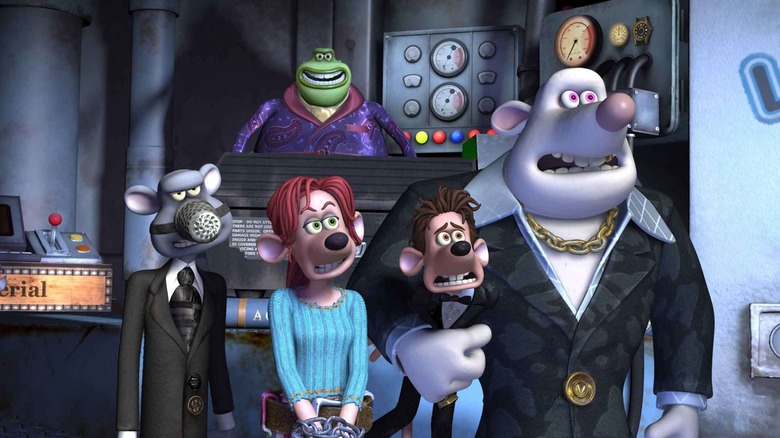
There's endless reasons why certain DreamWorks Animation movies flopped. Some got hurt by bad release dates, while others weren't in touch with what people wanted at the time. 2006's "Flushed Away" had a weird issue, meanwhile, where its budget didn't make any sense given the box office trajectory of DreamWorks' past collaborations with Aardman Animations. "Chicken Run" and "Wallace & Gromit: The Curse of the Were-Rabbit" had each grossed roughly $200 million worldwide on budgets in the $30-40 million range. There was clearly a ceiling for the endeavors produced by this distinctly British label.
"Flushed Away," meanwhile, was a CG-animated title that cost $149 million to produce. That ludicrous sum meant that this project would've had to significantly outgross the likes of "Chicken Run" to even begin reaching profitability. Of course, that never happened. "Flushed Away" was all washed up with just $179.35 million worldwide. That dreadful sum resulted in DreamWorks reporting a $109 million loss on the project. "Flushed Away's" massive budget made such a write-down an unfortunate inevitability.
Speed Racer

Warner Bros. initially saw "Speed Racer" as the next big Wachowski Sister blockbuster following the duo's work on the "Matrix" trilogy. The studio even once planted "Speed Racer" in 2008's Memorial Day weekend slot, though that later changed to a May 9 launchpad. Unfortunately, "Speed Racer" was out of step with 2008 sensibilities. This adaptation of the '60s anime preceded mainstream acceptance of the Japanese art form, while its colorful, heightened aesthetic was at odds with the grim and gritty imagery dominating the late 2000s.
Tragically, "Speed Racer" only grossed $93.39 million worldwide, with only $43.94 million made domestically. Costing $120 million to produce, Warner Bros. and other financiers lost a boatload of cash on this vibrant and hopeful experience. At the time, box office analysts chalked up its failure to, among other problems, "Speed Racer's" difficulty in securing passion from either families or adult action fans.
A gigantic financial loss in 2008, "Speed Racer" has kept its engine revving for nearly two decades and become a modern cult classic. Today, unlike many of the other entries on this list, the film is a beloved work known far more for its bold visual instincts and sincere pathos than any of its initial box office challenges.
A Christmas Carol

In the first half of the 2000s, Jim Carrey and director Robert Zemeckis found tremendous success with separate Christmas films. Carrey's "How The Grinch Stole Christmas" practically printed money, while Zemeckis uncovered a lucrative enterprise with his film adaptation of "The Polar Express." To close out the decade, the pair united to deliver another Christmas feature. This time, they drew from one of the original Yuletide texts, the Charles Dickens work "A Christmas Carol," while embracing the distinctly modern sensation of motion capture animation.
One problem that the 2009 Disney flick had in comparison to Carrey and Zemeckis' earlier efforts was that 2000's "Grinch" was the first big screen adaptation of that story. Ditto 2004's "The Polar Express." This "Christmas Carol" production didn't have the same novelty, as countless iterations already existed. These problems came back to haunt the $190 million budgeted effort, which only grossed $315.7 million worldwide.
Though ironically one of the highest grossing Christmas movies of all time, that massive budget made "Carol" a major money loser. What was supposed to be the lavish kick-off to Disney's motion-capture unit ImageMovers Digital was instead a financial lump of coal in the Mouse House's stocking. Carrey and Zemeckis just couldn't make Christmas box office magic strike again.