

'80s Teen Movies That Everyone Needs To Watch At Least Once
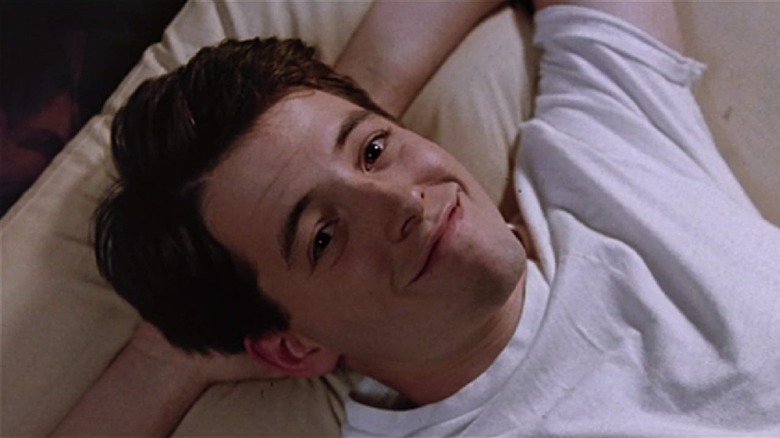
When looking at the best teen movies of all time, the 1980s loom large. There were definitely movies about and for teenagers released before and since that decade, but the '80s very much felt like a golden era for coming-of-age films. Perhaps it was because it was such a transitional period for both pop culture and just humanity in general, one where those who were in middle school, high school, and the first years of college at the time seemed to be taking control of the consumption of art in a more deliberate way than had happened in the past.
To that end, filmmakers of the '80s knew that they needed to make movies for this hungry new market of young people. And the result were a number of films that did a better job than teen movies of eras past of capturing the teenage experience in more realistic, frank — and of course, funny — ways. In many cases, parents and other adult authority figures were seen largely as easily surmountable options to youthful freedom in films of the day, if adults even had a presence in the movies at all.
While this list can easily be considered to represent five of the best '80s teen movies, that isn't entirely the point here. What we're presenting are the most essential entries, the ones that were must-watch movies for teenagers at the time and are unmissable for students of the history of youth-oriented art now.
Fast Times at Ridgemont High
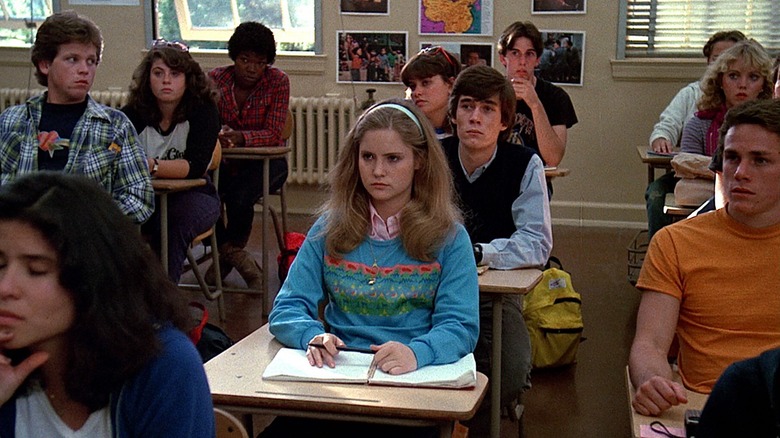
There were a few filmmakers who seemed to be especially adept at — and interested in — bringing the teen experience to the big screen in the '80s. And one of them, arguably the one who would lay the foundation for the entire subgenre of '80s teen movies, was Cameron Crowe. Though he created a timeless image of teenage romance with the iconic boombox scene from "Say Anything," it was his screenwriting debut that really lit a fire under the zeitgeist that decade.
That movie, "Fast Times at Ridgemont High," was one of the first teen movies of any era to feature such an intense focus on sex in 1982. Not even just the act itself — though that was definitely depicted with an uncomfortable level of awkward realism — but the discussions of it, the evangelizing of it, and yes, the often disappointing reality of it. Showcasing an ensemble that featured a brilliant mix of already known young actors with multiple future Oscar winners, "Fast Times" was ambitious in how many characters it featured, how many subplots it balanced, and how many different social strata it included — and somehow pulled it off within a tight 90 minutes.
Yes, a lot of what is depicted in "Fast Times" is a bit exaggerated. Above all else, the movie is still primarily a comedy. And there is a certain sense of it being how adults thought teenagers were talking and acting vs. how they maybe actually were. But "Fast Times" still mostly gets it right, and would spend decades being often imitated but never surpassed.
Ferris Bueller's Day Off
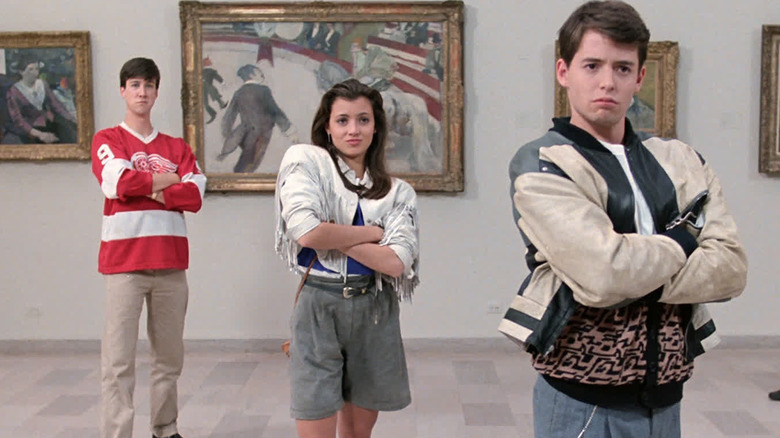
Nobody loomed larger over the teen movie genre in the '80s than John Hughes. When he wasn't making movies about people taking ill-fated road trips, Hughes was firing off movies about being a teenager on the verge of adulthood. It would've been easy to have this entire list just be movies he wrote and/or directed, and it still fulfills its main thesis. But we wanted to limit it to one movie per filmmaker to keep things varied and interesting. And with that in mind, we landed on "Ferris Bueller's Day Off" to represent Hughes in this discussion.
What makes "Ferris Bueller" not only stand out from Hughes's other movies, but '80s teen movies in general, is just in the way it so perfectly captures a teenager's ideal of reckless abandon. Nobody is really trying to learn any major lessons; there isn't a love story that needs to be resolved, and there isn't a huge cast of side characters that must be addressed. It's all about the titular character, his girlfriend, and his best friend, having the ultimate last day of truly carefree teenage freedom before such a thing is no longer feasible.
Most of it isn't even particularly tied to the '80s specifically, and has seen several subsequent generation of teens watch the movie and also see it as their idea of what a perfect day of playing hooky might look like. What grounds "Ferris Bueller" in its era is the lack of cell phones, making it not only easy to roam the city without their parents tracking them, but allowing them to just let the adventure guide them and not constantly be looking up what to do next or how to get there.
Fame
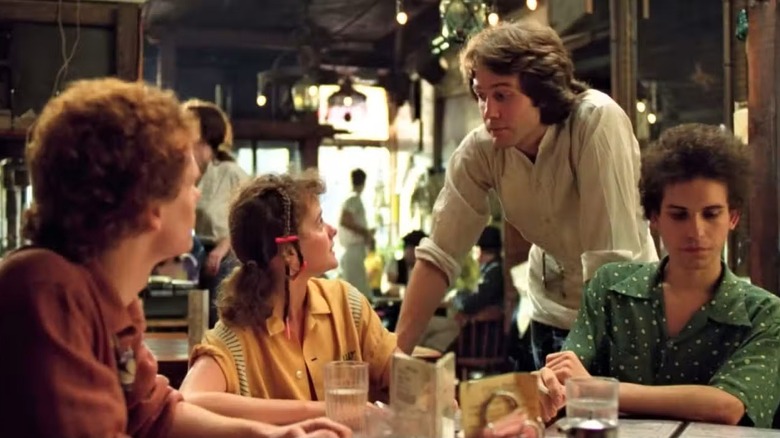
Not to turn this into an excuse for intergenerational warfare, but one key difference between Gen X and Gen Z can be illustrated by each one's respective high school-based musical. Gen Z had, well, "High School Musical," where the stakes were low and the bubblegum pop factor was high. On the other hand, Gen X had "Fame," which dealt with such heady topics as queer struggles, gender identity, the sexual predation of minors by adults in positions of authority, and mental illness. Its title tune also scored an Oscar win for best original song and received multiple Grammy nominations — neither of which any songs from "High School Musical" can claim.
But enough picking on a perfectly harmless Disney musical. What is relevant here is that "Fame" is an essential '80s teen movie — musical or otherwise — because it showcased a different side of being a teen, and different types of teens altogether, than most of its peers. Performing arts kids are rarely depicted on film, and when they are, it's typically to either make fun of them or to show them as all singing, dancing, and smiling. "Fame" did none of those things, instead depicting their struggles to not only make a name for themselves in the arts but to just gain acceptance from their friends and family.
Admittedly, "Fame" coming out in 1980 means that it was actually a '70s production. Still, those who came to identify with it were '80s kids, and that's who the movie ultimately belongs to and is a celebration of.
Stand by Me
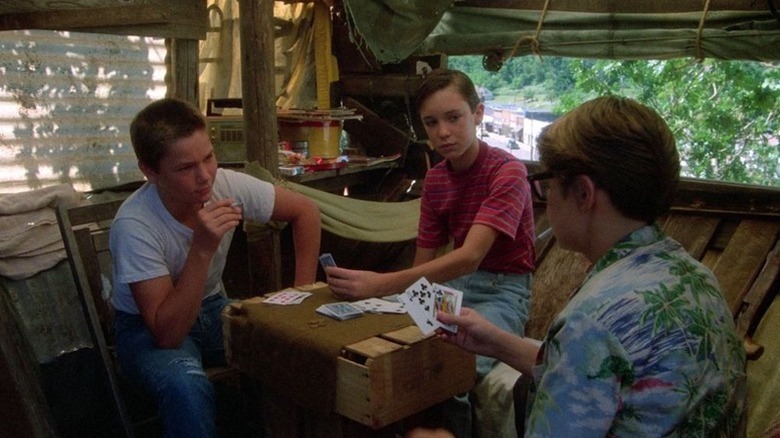
A lot of Baby Boomer filmmakers and producers in the '70s and '80s were starting to feel nostalgic for their childhoods, and with that came a flood of movies and TV shows that looked back on the '50s and '60s. We didn't want such movies to dominate this list, as the point was that these are '80s teen movies. But we are often defined in large part by our parents' nostalgia, and for '80s kids in particular, there was no escaping art that mythologized the time when their parents were kids themselves. And the best of the movies that did that was "Stand by Me."
Part of the reason "Stand by Me" resonated with kids then, and continues to resonate today, is that its core concept is a fairly timeless one. Four kids take an adventure over the river and through the woods. Though they have a specific goal in mind — seeing a dead body they had heard about — the destination isn't the point. What "Stand by Me" is ultimately about is those summers that seemed to last forever, one day blurring into the next as you and your closest pals just ... hung out. Sometimes things happened, sometimes they didn't. But it was transformative either way, and you not only learned a lot about your friends, but about yourself as well.
There's a case to be made that "Stand by Me" is the best movie based on a Stephen King story. It was also one of the first movies named in many of the obituaries for its director, Rob Reiner, after his sudden passing in December 2025. All these years later, it remains one of, if not the, best thing that pretty much everyone involved in it has ever made.
Heathers
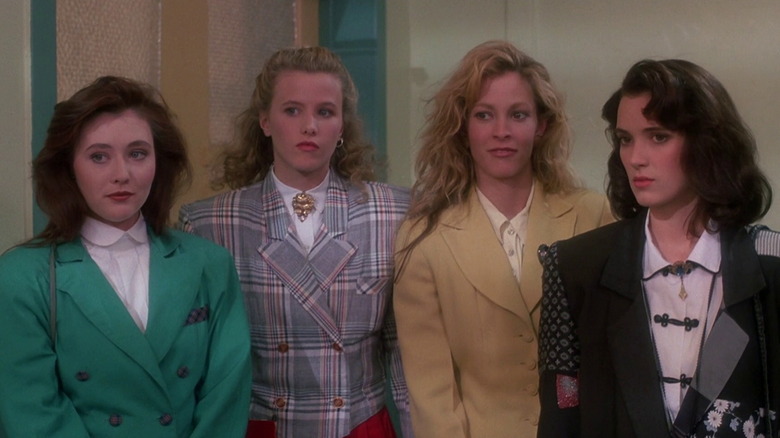
It would be disingenuous to talk about the teenage experience, especially the Gen X teenage experience, without addressing the edginess that is inherent in those years of one's life. Being a teenager is when you push boundaries, test limits, laugh at things you shouldn't laugh at, and try things you later can't believe you tried. In other words, a list of the most important '80s teen movies needs at least one super dark, super black comedy. And with that, one name immediately comes to mind: "Heathers."
If you were a teenager in the '80s, you knew at least one or two girls named Heather — assuming you weren't also named Heather yourself. And "Heathers" leans into that by having three of its four main female characters all share that name. The four of them end up getting charmed by a bad boy into helping him with his plot to murder popular students at their school. That would already be a dark premise for a so-called comedy, but part of the plan is that the murders are staged to make it look like the students took their own lives.
Shockingly, an untold truth about "Heathers" is that its original ending was even darker than it already is. We won't spoil either one in case you haven't seen it, and you should, just with the caveat that there are numerous potential triggers here — especially in light of the many high-profile school shootings that have happened in the decades since. But if you can look beyond that, what "Heathers" says about conformity, teenage angst, and rebelling against the narrow boxes society often tries to force girls into remains just as potent today as it was in 1988.