

Robert Downey Jr.'s Star-Studded 2005 Historical Drama Got A Perfect Score From Roger Ebert
"Good night, and good luck." Those five words were veteran news reporter Edward R. Murrow's signature sign-off at the end of every CBS newscast. 50 years later, George Clooney used them as the title for his historical drama that dramatized Murrow's (David Strathairn) quest to expose U.S. Senator Joseph McCarthy's demagoguery to the American public.
"Good Night, and Good Luck" also features Clooney, Robert Downey Jr., Patricia Clarkson, Jeff Daniels, and Frank Langella in the ensemble, but they're not why famed critic Roger Ebert gave it a perfect score. In his review, Ebert singled out how "the movie is entirely, almost claustrophobically, about politics and the news business," and "the process by which Murrow and his team eventually brought about [McCarthy's] downfall."
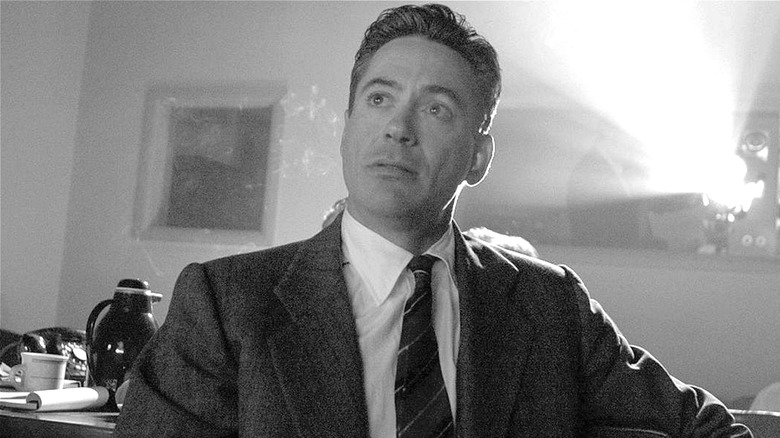
In this era of U.S. history, McCarthy weaponized his perch from the House Un-American Activities Committee, using the shield of anti-communist persecution to attack his political opponents, which comes to include Murrow and his CBS team. Robert Downey Jr. plays Joseph Wershba, a CBS correspondent who finds himself in the crosshairs when his secret relationship with his wife Shirley (Patricia Clarkson), runs afoul of CBS's policy forbidding the employment of married couples.
Like most critics at the time, Ebert singled out Strathairn's commanding and evocative performance. "Good Night, and Good Luck" put a spotlight on Strathairn's acting prowess, netting him his first (and so-far only) Academy Award nomination, while the film itself commonly ranks among one of the best movies of 2005.
Ebert felt one creative decision elevated Good Night, and Good Luck to master status
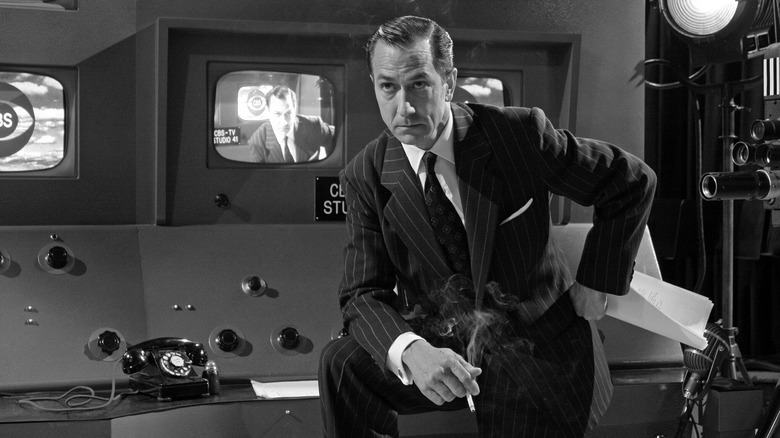
To evoke the feeling of a 1950's newsroom, George Clooney shot "Good Night, and Good Luck" in black and white, which Ebert highlighted brought to it "an echo of 'Citizen Kane.'" But the Chicago critic singled out one directorial decision that elevated the film.
Rather than cast an actor to play McCarthy, the senator is instead represented using actual news footage, allowing audiences to see the politician's dangerous rhetoric for themselves. "It is frightening to see him in full rant," Ebert says. "And pathetic to see him near meltdown during the Army-McCarthy hearings, when the Army counsel Joseph Welch famously asked him, 'Have you no decency?'"
While decidedly a period piece, Ebert recognized how it spoke as much to America's present and future as much as it did its past, at one point describing the movie as "a morality play, from which we learn how journalists should behave." This unflinching depiction is why, even 20 years later, "Good Night, and Good Luck" stands alongside heavy hitters like "All the President's Men" and "Spotlight" as one of the best films about journalism.