

This 2003 Ben Affleck Sci-Fi Movie Was Based On Philip K. Dick's Best Short Story
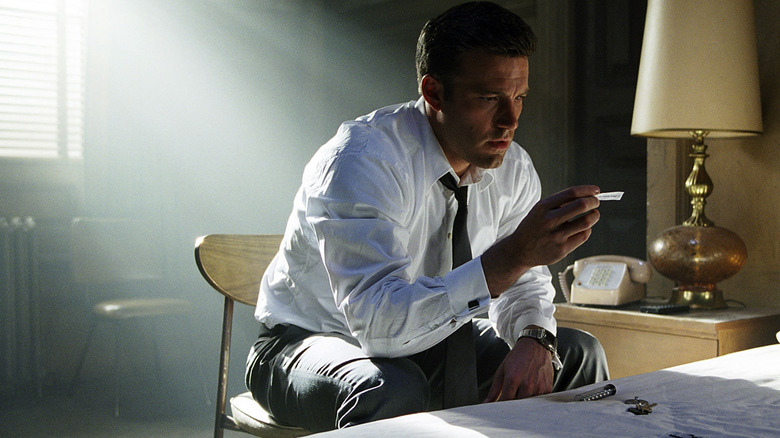
Ben Affleck has had many ups and downs over the course of his career since he won the Oscar for Best Original Screenplay for "Good Will Hunting" with his bestie, Matt Damon, in 1998. The years since found Affleck trying to establish himself as a leading man, but he hit choppy water with "Daredevil," an early and awkward Marvel Comics adaptation, and "Gigli," one of the most notorious box office bombs of all time — and a film that nearly ended his acting career entirely. His next film, "Paycheck," as the latest in a string of Philip K. Dick adaptations, should have turned his fortunes around.
With a grand premise about induced amnesia, corporate espionage, and government surveillance, Affleck and the team had hoped to create a film that could follow in the paranoid footsteps of other loose Dick adaptations like "Blade Runner" and especially "Minority Report," which released to critical acclaim and tremendous box office results the year before. With action maestro John Woo, the man responsible for some of the the most epic gunfights of all time, at the helm, "Paycheck" should have been a hit. It wasn't.
Paycheck" would double its budget with a $117 million worldwide haul, but it didn't succeed in turning around Affleck's luck. With a 27% Rotten Tomatoes score, the film only succeeded in winning Affleck a third Razzie win for worst actor.
Dick's short story is about how something worthless could become priceless
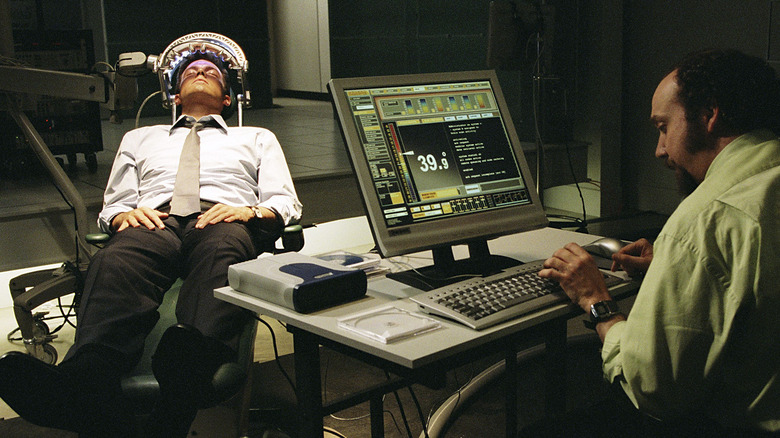
Philip K. Dick was no ordinary science fiction author. HIs stories pushed the boundaries of character perspective and narrative storytelling. Adapting them into a big-budget feature film requires a deft hand, and "Paycheck" was no exception.
The original story follows Jennings, an electronic engineer, who accepts a secretive job for Rethrick Construction that requires him to have his memory wiped upon completion of the work. That's not unlike the premise of "Severance." But when Jennings wakes up two years later, he discovers that he's given up his paycheck in favor of an envelope filled with seven seemingly ordinary items. Even worse, America has devolved into a dystopian police state, and the Security Police are after him in connection to the job that he has no memory of.
His only means of escape are those innocuous objects that Jennings left for himself pre-amnesia (in lieu of hard cash), and Jennings uncovers the truth that Rethrick hired him to create a device that can see the future. Armed with the gift of foresight, Rethrick is building an army to fight back against the government, and the story ends with Jennings joining forces with them to destroy the police state that has taken over America.
Dick's intention was to explore how, given the right circumstances, a seemingly worthless or random item — like a bus token — could make the difference between life and death. It's a potent idea and easy to see why Paramount Pictures and Dreamworks thought this would be a worthy follow up to "Minority Report."
Paycheck lost the plot of Dick's story to disastrous results
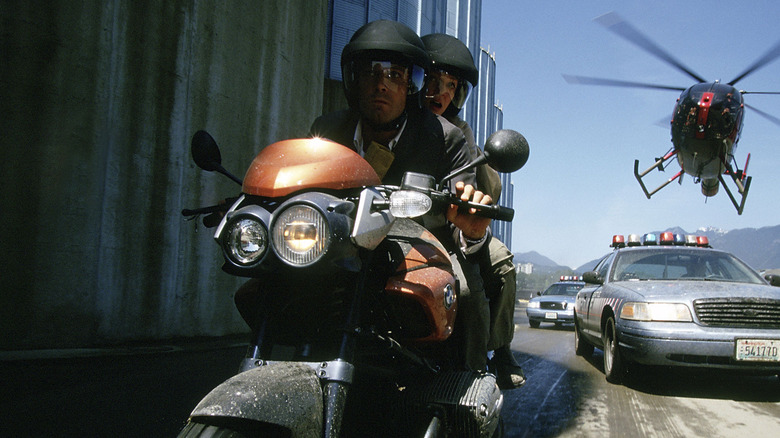
The film flips Philip K. Dick's premise, turning Rethrick Construction into the villainous tech company Allcom, which is using the future-seeing machine for its own ulterior motives. Jennings (Ben Affleck) is now tasked with unraveling the conspiracy with the help of his love interest, Rachel Porter (Uma Thurman), and sidekick Shorty (Paul Giamatti). Rather than use the leap forward to highlight how much society can change in a short period of time, the film is only interested in the premise as an excuse to manufacture a series of action set pieces. Dick's larger themes go ignored.
This was not the first time John Woo had been tasked with making a good movie out of a dumb premise, with "Face/Off" finding new ways to wring tension and humor out of its ludicrous core. But the changes to "Paycheck" flatten everything that was interesting and provocative about the source material, which even Woo's signature flair couldn't save.
Looking back on the film only a few years later, Woo told Entertainment Weekly that he "had intended to make an Alfred Hitchcock-style movie out of it, something more about suspense and thrills than guns and shooting, but unfortunately the script wasn't written that way. But at least it was nice working with Ben Affleck."