

10 Stephen King Adaptations That Changed The Book's Original Ending
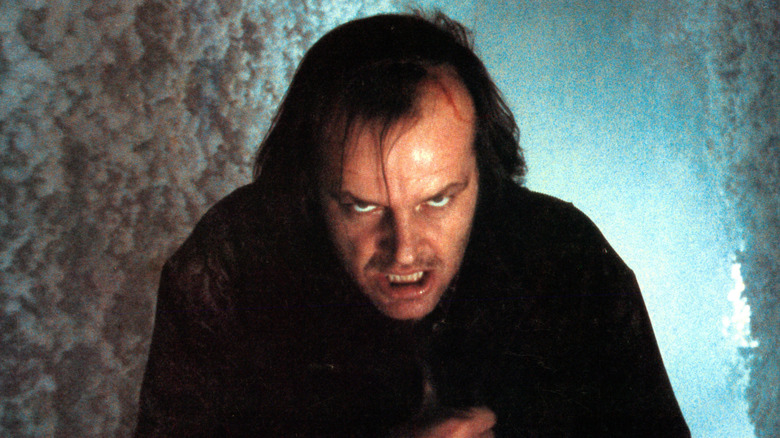
Stephen King may be one of the most influential horror writers of all time, but that hasn't kept producers and screenwriters from changing his novels to suit their aims. Sometimes King has been very loud about his displeasure regarding these choices — the world might consider the 1980 version of "The Shining" a masterpiece, but he hated the changes Stanley Kubrick made to the text so much he eventually threw his support behind ABC's television miniseries take, which is more faithful to the novel's origins. He even co-produced and self-adapted it.
However, "The Shining" wasn't the first and it won't be the last time King's text has been changed. Whether a story is transformed to give Carrie White an iconic exit, or book characters are saved from fates far worse than death in the big screen versions, you won't find any of these endings in the novels that Stephen King wrote. Here are 10 movie adaptation endings that are completely different from the conclusions present in Stephen King's novels — for better or for worse.
Carrie (1976)

While "Carrie" boasts one of the most iconic horror movie endings of all time, you won't find it in Stephen King's novel. The book's conclusion sees the titular heroine rampage through Chamberlain, Maine after being bullied by her classmates. She kills hundreds of people, including most of her graduating schoolmates. Carrie goes home to confront her mother, Margaret, who she hopes to murder — but Margaret has the same plan. Margaret fatally wounds her daughter, but Carrie kills her mother by stopping her heart with her powers. Carrie crawls off alone into the woods to die, but Sue Snell follows and finds her. They share a final psychic bonding moment, and Carrie dies in Sue's company.
In the 1976 version of the story, Carrie (Sissy Spacek) comes home, shell-shocked from the bloody prom, and is attacked by Margaret (Piper Laurie). Carrie uses her powers to stab her mother to death, though Margaret fatally stabs her first. Then, their house collapses in on itself, sucking them both into the earth. The movie ends with Sue Snell (Amy Irving) dreaming of visiting Carrie's makeshift and vandalized grave, leaving her flowers — only to have her hand grabbed by a bloody fist emerging from the dark pit, and she wakes up screaming. While other adaptations have been more faithful to King's book, Brian DePalma's version of the story remains an indelible part of the horror world.
The Mist (2007)
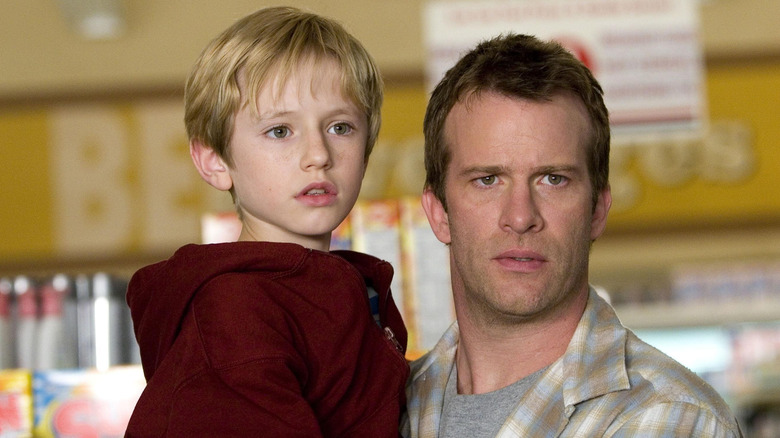
"The Mist" is an open-ended novella of Stephen King's, unlike its film adaptation. It's yet another piece set in Maine — this time, in the microscopic hamlet of Bridgton. David Drayton, his son Billy, and neighbor Brent find themselves trapped together in a grocery store after a mysterious mist descends after a thunderstorm. An earthquake follows, which deposits various bloodthirsty creatures in their midst. The store's employees and customers soon find themselves fighting for their lives.
The novel ends with a note of hope; David and Billy, while traversing a devastated New England, pick up signs of life in Hartford, Connecticut. Frank Darabont's 2007 film version of "The Mist," however, ends without further reassurances. While the short story leaves the fate of Stephanie (Kelly Collins Lintz) — David's (Thomas Jane) wife and Billy's (Nathan Gamble) mother — somewhat ambiguous, the movie blatantly deems her dead. Believing the situation to be inescapable, David ends up killing the last four survivors who escape the store with him, including his son, in a gesture of mercy. He then leaves his car and asks the monsters to kill him. In a bitter twist of irony, the mist soon lifts and soldiers arrive to clean up the mess. David collapses in horror at what he's wrought. A very different, and very daring, idea — one that won the movie critical acclaim and audience plaudits.
The Shining (1980)
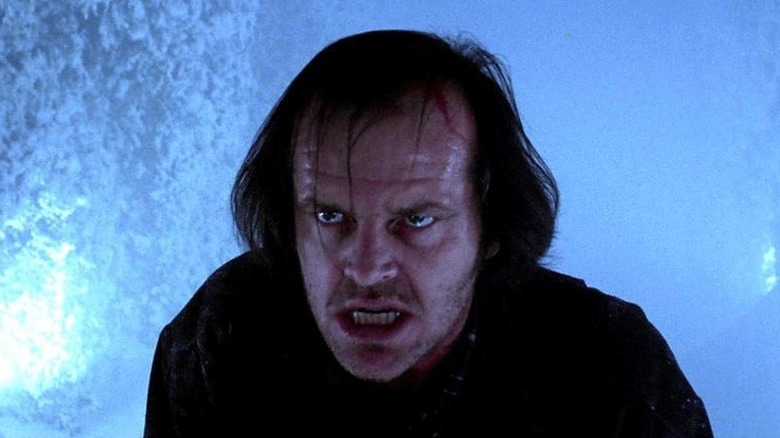
Stephen King wasn't wild about the way Kubrick's version of "The Shining" changed up his novel. In the book, Jack Torrance is unquestionably under the influence of the Overlook Hotel and its many horrific ghosts. This is double-underlined in the narrative, as other characters — including Dick Hallorann — are possessed by the hotel's malevolence during the book. Though he goes on a similar rampage, Jack regains control of his body at the end of the novel and manages to save his son, Danny, and wife, Wendy — shoving them out of the way after the hotel's boiler room explodes, killing him and destroying the Overlook. Dick Hallorann guides them to safety and becomes a protective figure to them both afterwards.
Kubrick refuses to play straight with King's narrative, changing Jack's (Jack Nicholson) personality, motivation, and eventually, the movie's ending. In the film, it's impossible to tell if Jack is truly going mad or if the ghosts are trying to urge him to join them. Jack never has his redemptive moment, and ends up murdering Hallorann (Scatman Crothers). Danny (Danny Lloyd) and Wendy (Shelley Duvall) are on their own. A clever Danny leads his father into a maze and traps him there. Jack freezes to death while Wendy and Danny escape, and it's implied that Jack's spirit finally joins the ghosts of the Overlook.
Doctor Sleep (2013)
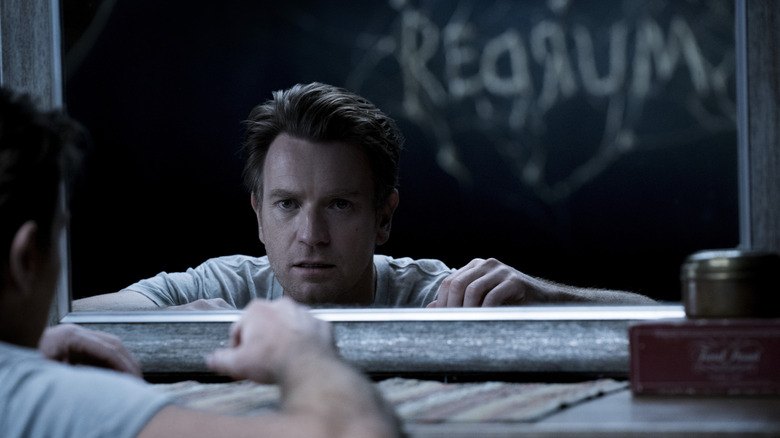
It was inevitable that any sequel to "The Shining" would be caught between being faithful to its literary roots or the legendary 1980 film. Stephen King's "Doctor Sleep" book mainly follows the events of the novel. Dick Hallorann is still alive and acts as Dan Torrance's mentor, teaching him how to trap malevolent spirits in mental lockboxes using his shining. Dan grows up to be an alcoholic, but later embraces sobriety and becomes an orderly at a hospice center, using his gifts to help ease the suffering of others. He develops a psychic connection with a little girl named Abra, whose shining is even stronger than his. This makes her a target for The True Knot, a group of psychic vampires who consume steam. Steam is only produced by those who possess the shining, specifically if they die in pain, which means The True Knot have killed a whole lot of people like Dan. At the end of the book, Danny survives, the ghost of Jack Torrance finds peace, and Dan — having discovered Abra is his half-sister — has made a friend for life.
The 2013 film changes the plot so that it correlates with the 1980's "The Shining"; the entire ending is different. Since the Overlook Hotel wasn't destroyed at that version of "The Shining," it comes into play as a dilapidated structure in the final act. Rose the Hat (Rebecca Ferguson), the leader of the True Knot, is killed by the Overlook Hotel's ghosts instead of being shoved over a platform by Dan (Ewan McGreggor) and Abra (Kyliegh Curran); and Dan is confronted by the malevolent spirit of his father and resists the temptation to return to drinking. Dan dies in a fire at the Overlook, but continues to appear to Abra in spirit form.
It: Chapter 2 (2019)
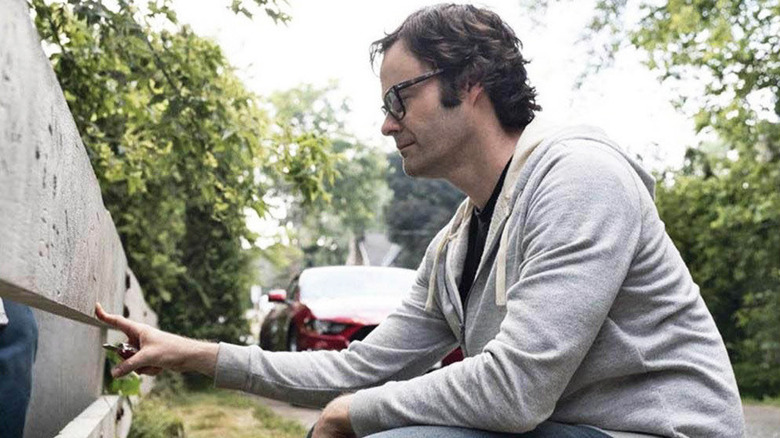
Stephen King's "It" has been adapted twice — once for a 1990 miniseries, and once for a two-part film event. Plenty of changes were enacted for each release. In the novel, the surviving members of the Loser's Club violently kill Pennywise in the sewers. Their hometown of Derry, Maine is subsequently destroyed in a catastrophic storm. They return to their individual lives, separating permanently, their endless night watch of Derry and Pennywise over, and their memories of one another and what they went through fading away.
In 2019's "It: Chapter 2," the group's victory over Pennywise (Bill Skarsgård) is more cerebral; they psychologically taunt the creature until they can get its hands on and crush its heart. Instead of forgetting each other, the group emerges from the cave underneath the Neibolt House with a new determination to stick together. While they all finally leave Derry, the town is not destroyed, and their memories of one another do not fade away. The movie ends with an excerpt from Stan Uris' (Andy Bean) suicide letter, which he sends to each member of the club. It concludes with the statement "we're Losers, and always will be," which is quite the opposite sentiment from the one expressed in the book.
Cujo (1983)
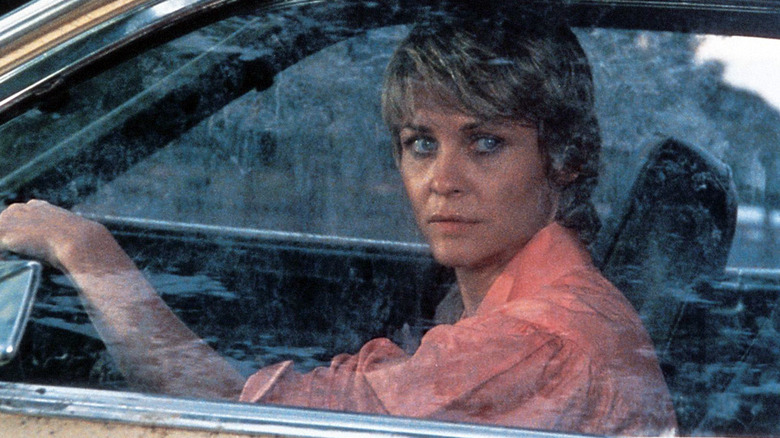
"Cujo" is scary and depressing enough without throwing a dead child into the mix, but that's exactly what Stephen King did in his novel. Young Tad actually dies of heat stroke during the finale, leaving behind Donna, his bereft and rabies-stricken mom, as well as Vic, his frustrated careerman dad. The two manage to bond in the aftermath of Donna's encounter with Cujo, salvaging their troubled marriage, but their lives are forever altered.
In the movie, though Tad (Danny Pintauro) develops dehydration after being stuck in the family car with Donna (Dee Wallace) on a hot summer day thanks to Cujo, he survives. Donna determinedly tries to get him water, ultimately killing off the infected pooch in the progress, and saves her son from further harm. The incident helps reunite Donna and Vic (Daniel Hugh-Kelly), in spite of her extramarital affair and their once-uncertain future as a family. They move on together as one, without Donna having to endure rabies shots.
Children of the Corn (1984)
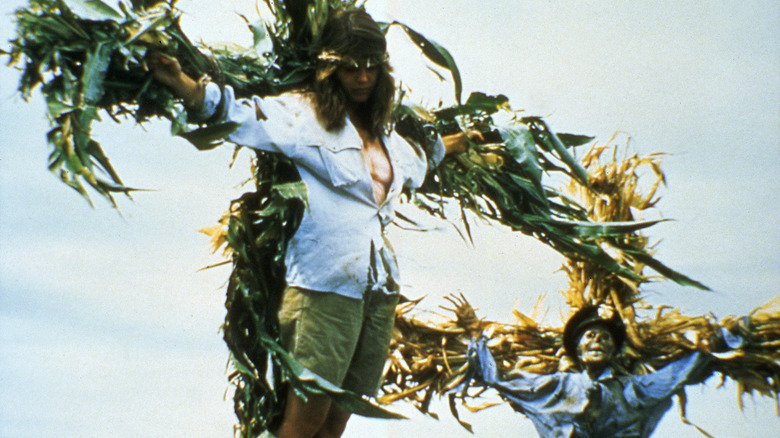
"Children of the Corn" is a far more brutal in story form than it is as a movie. In Stephen King's short story, Vicky and Burt are an on-the-rocks couple who find themselves stranded in Gatlin, Kansas. There, they learn the children have killed all of the adults in their town, and sacrifice their fellow children when they turn 19. Vicky ends up killed and strapped to a cross, her orifices stuffed with corn-related ephemera. On the other hand, Burt is claimed by He Who Walks Behind the Rows, the unseen supernatural entity that governs the children's actions. Annoyed that the children failed to capture Burt themselves, He Who Walks Behind the Rows demands the kids lower the sacrificial age to 18 — and it is pleased when this yields new victims.
In the 1984 film, Vicky (Linda Hamilton) and Burt (Peter Horton) both survive their ordeal. They also end up fostering Sarah (Anne Marie McEvoy) and Job (Robby Kiger), two children who disagree with their fellows and wish to escape Gatlin. Burt figures out that to destroy He Who Walks Behind The Rows, they need to set the cornfield alight, and they do so — killing the wicked Isaac (John Franklin) in the process. That's an undeniable bonus, since sacrificing the adults to the demon is his idea.
Misery (1990)
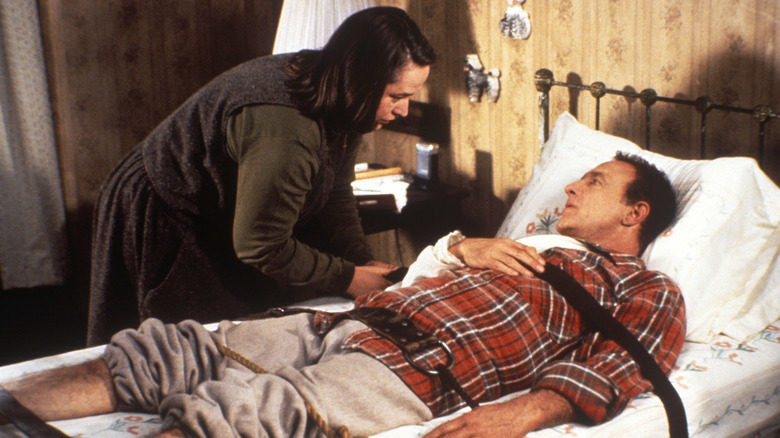
"Misery" is one of the most decorated adaptations of King's work, and it has been called one of the best Stephen King movies of all time for a reason. But it also bears a completely different ending from the novel. In the book, Paul Sheldon actually allows "Misery's Return," the book he wrote to trick Annie Wilkes into releasing him, to be published. Suffering from PTSD and coping with a painkiller dependency, he becomes an alcoholic and develops writer's block. His downward trajectory is halted by a supportive comment given by an enjoyer of his work, which encourages him to begin writing again.
Paul's (James Caan) life in the film is a little more sunny. The novel he wrote in the hope of breaking away from his "Misery" books is projected to be a major hit. While he walks with a cane, he's clearly healing from everything he went through with Annie (Kathy Bates). He briefly hallucinates seeing her in the form of a waitress, who calls herself his number one fan — much as Annie always used to. Paul accepts the compliment with a wince and a polite smile.
The Shawshank Redemption (1994)

"The Shawshank Redemption" is one of Stephen King's more sedate dramas — there's not a demon or an axe to be found – but it still had a few twists removed on its way to Oscar glory, making it quite different from the book "Rita Hayworth and Shawshank Redemption." In that story, Andy escapes from prison just as he does in the film. He establishes the false identity "Peter Stevens" and buys a hotel in Zihuatanejo, Mexico with assets he's socked away. After Red's paroled, Andy sends him $1,000 and the invitation to join him in Mexico. While Red accepts, the reader never finds out if he makes it over the boarder and finds Andy.
In the ending of "The Shawshank Redemption," Andy poses as Randall Stevens and launders money to establish a new life in Zihuatanejo. Red ends up making parole and does follow him to Mexico. But instead of leaving their reunion ambiguous, the twosome meet and embrace onscreen, reaffirming their connection for fans. Back at Shawshank, instead of simply resigning as he does in the novel, warden Samuel Norton (Bob Gunton) hangs himself. His inability to accept defeat and resign from his position in the wake of Andy's escape double underlines his stubbornness.
The Green Mile (1999)
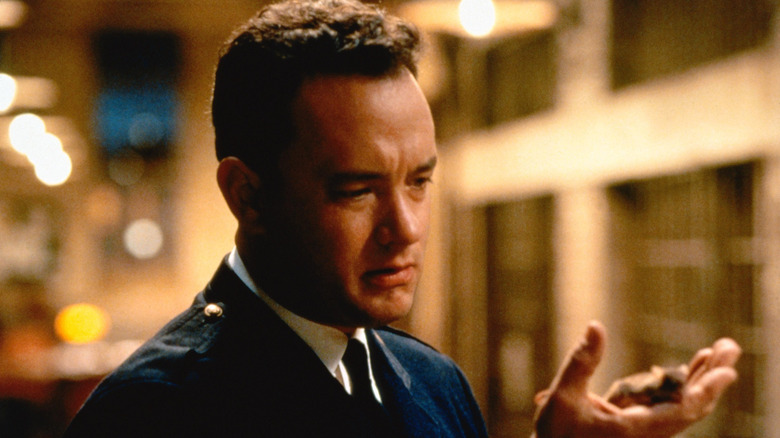
"The Green Mile" is another expostulatory novel that was adapted into a linear storyline for the movies. Paul Edgecombe is writing his memoir in the book, but the movie mainly takes place contemporaneously with his time working as a prison guard serving in Louisiana in the 1930s. The novel ends with a surprise death — that of Mr. Jingles, John Coffey's mouse, whom Paul has been taking care of for decades. They, and anyone else who had been healed by John, have been granted lifespans that stretch on as long as the Green Mile itself. Paul continues to live on and on, missing his late wife, Janet, who dies in a bus crash.
At the ending of the film version of "The Green Mile," Paul's (Tom Hanks) wife (Bonnie Hunt) does not die violently, and neither does Mr. Jingles. But he does continue to live endlessly, confiding his frustrations to his friend, Elaine (Eve Brent). Though Paul unburdens himself to Elaine, she dies as well, leaving Paul even more alone. He considers it a fair punishment for not saving Coffey, but in the novel audiences are left to question the justice of this twist of fate.