

Marlon Brando's '60s Revenge Western Is Also The Only Movie He Ever Directed

Though it doesn't always get brought up when discussing Marlon Brando's best movies, the 1961 Western "One-Eyed Jacks" certainly falls under that umbrella. It follows a man named Rio (Brando) who is double-crossed by his former outlaw partner Dad Longworth (Karl Malden). Brando also directed the film, his first and only time stepping behind the camera. In fact, it's one of only a select few non-acting screen credits Brando ever had — he's also got one producer and one cinematography credit each, both for documentary projects.
"One-Eyed Jacks" got a fairly lukewarm reception upon release, but its esteem has only grown over time. In 2018, it was added to the Library of Congress's National Film Registry as part of a stacked class of inductees that also included "Jurassic Park," "The Shining," and "My Fair Lady."
It might lean a bit more cult classic than all-time great, but there are plenty of lengthy write-ups that extol the virtues of Brando's Western. Criterion proclaims, "'One-Eyed Jacks' stands as one of Brando's great achievements" and said of Brando's performance, "Rio is the last and perhaps the most tender of the iconic outsiders that the great actor imbued with such intensity throughout his career."
Brando was third in line to direct after Stanley Kubrick and Karl Malden
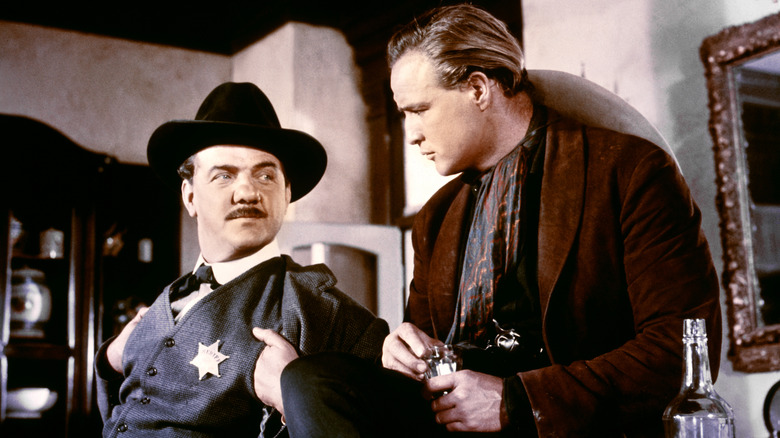
Given that "One-Eyed Jacks" would be the sole motion picture he directed, Marlon Brando is technically included among those filmmakers who only made one movie. And given how the production went, it's probably for the best. Brando didn't make things easy for his crew, bringing the kind of perfectionist touch that might get results but doesn't tend to endear a director to the folks working for him — or the ones paying for the production. In his defense, however, "One-Eyed Jacks" was a production that was already fraught with problems long before he took the directorial reins.
The original plan was for Stanley Kubrick to direct "One-Eyed Jacks" — speaking of directors that actors hated working with — but that didn't pan out. The reasons behind his departure are somewhat contentious, but creative differences with Brando seem to be at the heart of his exit. Next, Brando's co-star, Karl Malden, was offered the director's chair, but he declined. It was at this point that Brando realized he was the only man for the job, and he got behind the camera for the first and last time to become the director of "One-Eyed Jacks."