

10 Best Time Travel Episodes In Star Trek, Ranked

Star Trek has always been about exploring the unknown, or to quote many a captain, "To seek out new life and new civilizations. To boldly go where no one has gone before." To that end, most Star Trek series are deeply rooted in space exploration, but they don't only explore the final frontier. Time travel has also been a cornerstone of the franchise since the beginning; it's been a major focus of the movies as well as whole seasons of "Star Trek: Picard" and "Star Trek: Discovery."
There are numerous standalone Star Trek episodes from various series involving time travel and the effects of time dilation, many of which are highly rated among fans. When travelers from the 22nd century and beyond go back in time, they typically arrive on Earth around the same period in which the shows are filmed, tying elements of science fiction into the real world.
This has given the fandom plenty of great scenes and interesting interactions, including a Russian man asking San Francisco police about nuclear vessels during the Cold War. As the franchise endures, it's likely that time travel will remain a core element, as it's become a well from which many good stories are drawn. Of all the time travel episodes spread throughout the franchise, these 10 are the best. They're rated based on fan reaction, their IMDb scores, and their impact on the franchise. While there are multipart episodes on this list, the Star Trek movies and season-long story arcs are excluded.
10. Star Trek: Voyager - Timeless
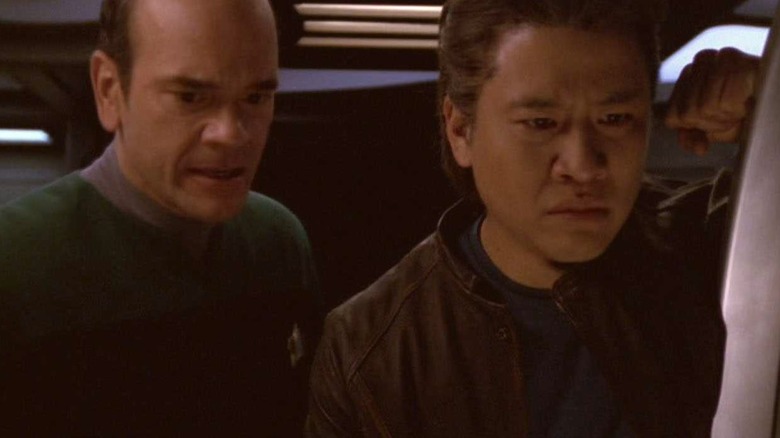
"Star Trek: Voyager" is all about returning the titular starship to its preferred corner of the galaxy, so most of its episodes focus on cutting the travel time from the Delta to the Alpha Quadrant. In "Timeless," the cold open takes place 15 years in the future, when the wreckage of Voyager is discovered buried beneath a thick layer of ice and everyone onboard is long dead. It's later shown that an attempt at using slipstream technology brought Harry Kim (Garrett Wang) and Commander Chakotay (Robert Beltran) home, but Voyager was lost.
Kim blames himself for the mishap, pointing to a miscalculation he made during the attempt. He and Chakotay, now on the Delta Flyer, set out to make things right. They find Voyager and recover The Doctor (Robert Picardo), using his capabilities along with parts scavenged from Seven of Nine's (Jeri Ryan) corpse to hatch a plan. Using a stolen Borg temporal transmitter, they hope to send Seven a message through time to correct Kim's mistake, but they run afoul of Starfleet's Temporal Prime Directive, as their plan would alter history.
As they're pursued by the USS Challenger, whose captain, Geordi La Forge (LeVar Burton), is sympathetic, Kim fails to fix his mistake. He tries again, and moments before the Delta Flyer's warp core breaches, Kim succeeds. The episode ends back in the present aboard Voyager, where Seven updates the calculations, ending the slipstream experiment. As a "What If" episode, this is one of "Voyager's" best time travel adventures.
9. Star Trek: The Next Generation - Tapestry

There are numerous time travel episodes in "Star Trek: The Next Generation," but "Tapestry" is unusual as it involves Q (John de Lancie). It begins with Captain Picard (Patrick Stewart) being horribly wounded on a mission. Instead of awakening in sickbay, Picard finds himself in a shapeless white void, where he's greeted by Q, who explains that he died after his artificial heart was destroyed in the attack. Picard had received the implant after his heart was pierced in a bar fight decades earlier.
When he reflects on the fight with regret, Q sends him back through time to the day before the bar fight. This gives Picard the opportunity to live out his life differently, so he decides to avoid fighting the Nausicaan who gravely injured him in his youth. After doing so, Q returns Picard to the present, where he's lived an unremarkable career as a junior science officer.
Picard confronts Q after realizing that his near-fatal bar fight is what made him the man he is, telling him he'd rather die as captain than live a life of mundanity. Q sends him back, and Picard gets into the fight, laughing after he's stabbed through the back, collapsing. He awakens in sickbay as captain, wondering if it was all a dream or something real that Q put him through. What makes "Tapestry" such an enduring episode is how it explores the relationship between Picard and Q, which would be revisited numerous times.
8. Star Trek: Strange New Worlds - Those Old Scientists
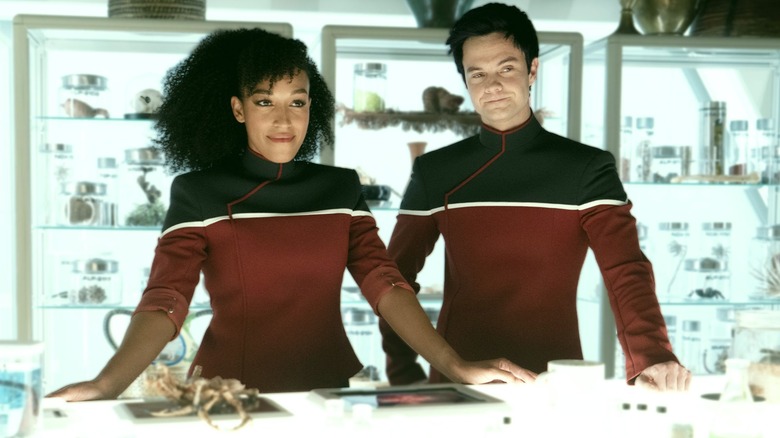
"Star Trek: Lower Decks" is all about what makes "Star Trek" great, and it's filled with references to just about everything the franchise has covered. The series is animated, so it never seemed possible that it would crossover with something like "Star Trek: Strange New Worlds," but the episode "Those Old Scientists" came along and did it anyway. "Strange New Worlds" also included a K-pop-style Klingon number, so an animation crossover isn't that out of the ordinary.
Brad Boimler (Jack Quaid) is transported through a portal back to the 23rd century. When he arrives, Boimler shows his love of the Enterprise and its crew, gushing over his heroes as they put up with his adoration while trying to find a way to send him home. As they manage to power the portal to send him back, things go a bit wonky when Beckett Mariner (Tawny Newsome) stumbles through, putting her into live-action alongside Boimler.
There are plenty of shenanigans that take place as they work to send the pair to the future, and they manage it in the end. The episode is as fun as it sounds, having pulled off the most unlikely crossover in franchise history. One reason it works so well is that Boimler and Mariner look a lot like their voice acting counterparts, which isn't common in animation. Not only is it one of the more entertaining "Strange New World" episodes, but it's one of the enjoyable in "Trek" history.
7. Star Trek: The Next Generation - Cause and Effect

There are all kinds of time travel in the science fiction world, and one fan favorite involves time loops. This is explored in the episode "Cause and Effect" from "The Next Generation," which begins with the senior officers playing poker. The day continues until the Enterprise-D encounters a spatial anomaly, and as it's being studied, a Federation starship emerges on a collision course. Data (Brent Spiner) advises using the tractor beam to push the other ship away.
Picard orders his plan, resulting in the Enterprise's destruction. Time resets to earlier in the duty day, though several crew members begin to notice strange voices and instances of déjà vu, leading to the discovery that they're in what is called a "temporal causality loop." Even by discovering this and its cause, they're unsure as to how it can be stopped, leading Data to suggest using his positronic brain to cross through the time loop and send himself a message.
The loop resets and the number three appears repeatedly, indicating William Riker's (Jonathan Frakes) rank pips. Data surmises that Picard must go with Riker's suggestion over his own, which ultimately saves the day. With the loop broken, the USS Bozeman safely emerges, having been missing for 90 years, solving the mystery of what happened to the vessel and its crew, which is captained by Morgan Bateson (Kelsey Grammer, pictured). While not the only time loop episode, "Cause and Effect" is a favorite among fans, earning its place here.
6. Star Trek: Voyager - Blink of an Eye
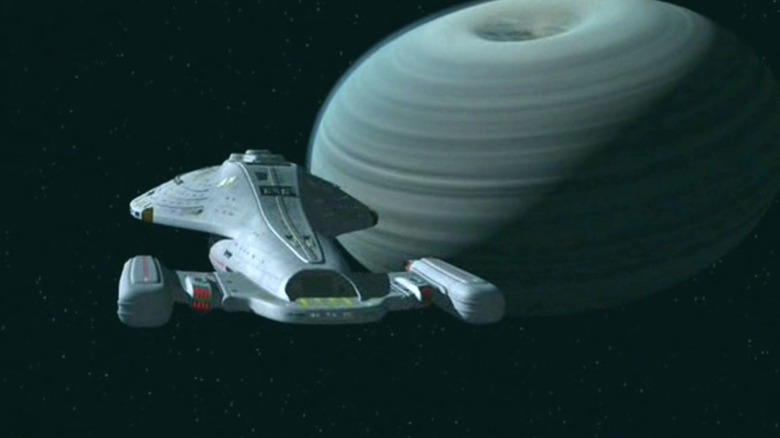
While most time travel episodes involve going to the past or future, "Voyager's" "Blink of an Eye" is different. It centers around a unique planet, where its natural spin causes time to pass exponentially faster on the surface than in the surrounding universe. When Voyager approaches the planet, the ship becomes mired in a time distortion field, appearing in the sky as a new star. The pre-industrial civilization sees Voyager as a new god called the Ground Shaker, as its presence causes quakes.
This action inadvertently violates the Prime Directive, as Voyager's presence ends up reshaping the planet's culture. As the world progresses through centuries of its own time, hours pass on Voyager as the crew labors to free the ship. Once the planet's society evolves into a spacefaring one, an expedition is sent to the Ground Shaker to investigate, leading an astronaut to come into contact with Voyager and its crew. Decades pass before he returns home, and by that time, the world is militarily aligned to destroy the threat.
This leads to violent attacks from the ground, which are carried out in desperation. Fortunately, the astronaut is able to work with the government while Voyager takes the necessary steps to leave orbit as they're towed by two ships' tractor beams. When the episode concludes, the astronaut is an old man, while everyone aboard Voyager has experienced only hours. It's a brilliant demonstration of how time dilation can be an effective storytelling device.
5. Star Trek: Deep Space Nine - The Visitor

A pivotal relationship in "Star Trek: Deep Space Nine" is between Benjamin Sisko (Avery Brooks) and his son, Jake (Cirroc Lofton). This is explored in "The Visitor," which begins with an elderly Jake (Tony Todd) being visited by an aspiring writer. She hopes to learn from him, so he tells her his story of how, when he was 18, his father took him aboard the USS Defiant to observe an inversion at the Bajoran Wormhole. The episode shifts back to this moment, when a malfunction results in Ben vanishing into subspace.
This leads Jake to spend his life attempting to recover Ben, though everyone else believes he's dead. A year after the accident, Ben appears briefly before Jake, as he's become unstuck in time. Jake meets his father again numerous times throughout his career as he marries and becomes an author. He abandons his life to study subspace mechanics in the hope of reversing what happened to his dad decades earlier.
During another inversion, Jake recreates the accident and fails, leading the briefly returned Ben to ask him to stop trying. Knowing Ben will reappear on the same night the writer visits, Jake injects himself with a lethal dose of medicine, believing his death during a visit from Ben will upset the cycle. Jake dies in his father's arms, and time resets to the original accident on the Defiant, where Ben saves himself at the last moment in what is one of the series's most touching time travel episodes.
4. Star Trek: The Next Generation - All Good Things...
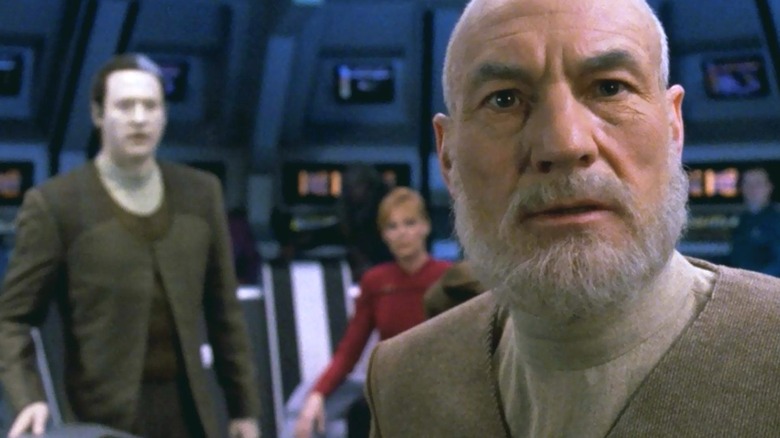
The series finale of "The Next Generation," "All Good Things..." is a callback to the very first episode, and presents time through three moments simultaneously. Picard jumps from the present to the past, when he took command of the Enterprise-D, and to a point 25 years in the future. This leaves Picard and the people around him confused, as he's disconnected from his past and future selves. Meanwhile, a spatial anomaly in the Romulan Neutral Zone piques his interest, leading him to travel to that point in all three time periods.
Picard is then cast back into Q's courtroom, first depicted in the pilot, where the godlike being informs him that his trial of humanity had never ended. What's happening is humanity's last chance to prove itself to the Q Continuum, and Q is the cause of the time jumping. He tells Picard to solve the mystery or humanity will be destroyed, so Picard works to do just that.
He coordinates his actions across all three time periods, causing all three ships to suffer serious damage. Q appears once more, telling Picard, "All good things must come to an end," and the Enterprise explodes. Picard is again inside Q's courtroom, where Q congratulates him on solving the puzzle and admits to being responsible for helping him via the time jumps. The episode is one of "Next Generation's" best explorations of time, while capping off the series with a satisfactory conclusion.
3. Star Trek - The City on the Edge of Forever
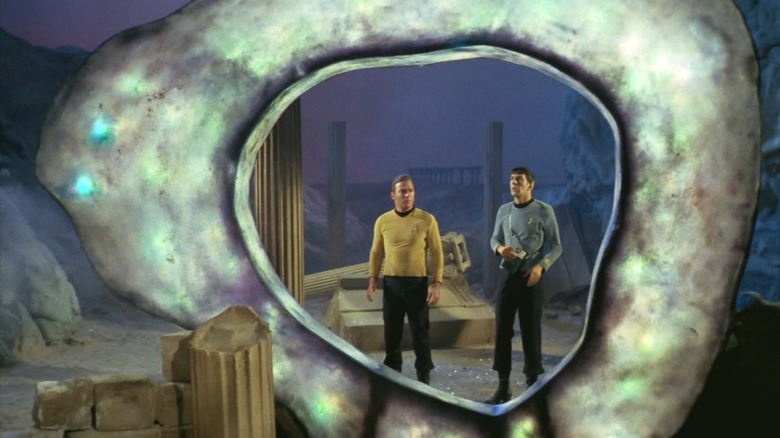
Time travel episodes began in the original "Star Trek," which features one of the franchise's best episodes, "The City on the Edge of Forever." It begins with the USS Enterprise orbiting a strange planet that causes time distortions. After Dr. Leonard McCoy (DeForest Kelley) accidentally injects himself with a massive dose of cordrazine, he loses his mind and beams down to the planet. He's followed by Captain James T. Kirk (William Shatner) and several officers who find a sentient portal called the Guardian of Forever.
McCoy runs from his hiding place and travels back to the 20th century, completely mucking up history and reshaping reality. The others follow McCoy to repair the past and arrive in New York City during the Great Depression. They settle into 1930s America as best they can while looking for the doctor, and Kirk falls in love with Edith Keeler (Joan Collins), whom Spock (Leonard Nimoy) realizes was supposed to die in a traffic accident. When this doesn't happen, it impacts all of history.
Eventually, they find McCoy, and after crossing the street, Keeler is about to get hit by a truck. Spock stops Kirk from saving her, which restores reality, putting things back to the way they were. The away team returns through the Guardian and back to their own time. It's a fantastic episode that's a fan-favorite from the original series, which isn't surprising, seeing as famed sci-fi scribe, Harlan Ellison, wrote the script.
2. Star Trek: The Next Generation - Yesterday's Enterprise

"The Next Generation" explores alternate realities via time travel in "Yesterday's Enterprise," which opens with the Enterprise-D encountering a rift in spacetime that spits out the long-lost Enterprise-C. The ship was destroyed two decades earlier, and when it reappears, all of reality undergoes an instant change. The Enterprise is now a warship designed to fight in the Federation's conflict against the Klingon Empire. Tasha Yar (Denise Crosby), who died in an earlier episode, is back, but Worf (Michael Dorn) is missing.
There are numerous alterations, the least of which is Yar's presence, and only Guinan (Whoopi Goldberg) knows that anything is amiss. She informs Captain Picard, and it's decided that returning the Enterprise-C to the past is the only way to set things right. Picard is initially apprehensive, but ultimately agrees with the plan, which is upset when the vessels are attacked by a Klingon Bird of Prey. Things ultimately work out, and Yar asks to be reassigned to the older ship, understanding she's supposed to be dead.
When three Klingon battlecruisers attack and the rift becomes unstable, the Enterprise-C is just barely able to make it through, causing time to return to normal. Only Guinan remembers the events that happened, though she's only marginally aware of them, so she asks Data to tell her about Yar. "Yesterday's Enterprise" is more than a mechanic to return Yar to the series, as it explores a potential timeline completely unfamiliar to the franchise.
1. Star Trek: Deep Space Nine - Trials And Tribble-ations

"The Trouble with Tribbles" is one of "Star Trek's" most feel-good episodes, and it's revisited in "Deep Space Nine's" "Trials and Tribble-ations. The episode begins with the USS Defiant accidentally traveling more than a century into the past and hundreds of light-years from its location. It's near Deep Space Station K-7, where the USS Enterprise and a Klingon vessel are docked. They were brought there by a former Klingon agent disguised as a human, whom Captain Kirk caught poisoning a grain shipment.
The "Deep Space Nine" senior officers dress for the occasion and insert themselves into the events of "The Trouble with Tribbles," hoping to stop time from being disrupted. This results in numerous scenes of 24th-century characters interacting with those from the original "Star Trek" episode. Several characters from the Defiant take the places of background Enterprise crewmembers, and it's all blended seamlessly as if it were originally filmed that way.
The crew works to find a bomb as the tribble infestation intensifies. They succeed, and the Defiant transports the bomb into space, saving the Enterprise, and the "Deep Space Nine" crew manages to return to their own time. Before they do, Captain Benjamin Sisko takes a moment to meet with Captain Kirk, and they have a scene together. The episode is a fun return to the franchise's roots and a great exploration of time travel as a means of averting disaster, making it the best example of time travel in a "Star Trek" series.