

Why Gandalf Was Forbidden From Using His Full Power In Lord Of The Rings
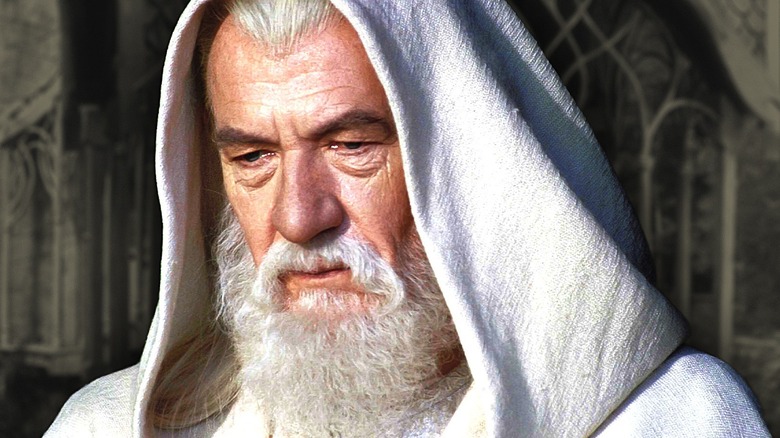
Throughout "The Lord of the Rings" and "The Hobbit" stories, it's abundantly clear that Gandalf is a powerful force to be reckoned with. But there are also moments when it's clear that he's holding back. Why the restraint? Because the Wizard has been forbidden from using his full power in Middle-earth.
The book "Unfinished Tales" helps explain why in a passage that talks about how the Creator of the world, Eru, allows the Valar (angelic guardians) to send a few select members of their spiritual order to Middle-earth. The book says that these five "Istari" or Wizards are incarnate emissaries "in bodies as of Men" with a critical caveat: they "were forbidden to reveal themselves in forms of majesty, or to seek to rule the wills of Men or Elves by open display of power." The book adds, "but coming in shapes weak and humble [the Istari] were bidden to advise and persuade Men and Elves to good, and to seek to unite in love and understanding all those whom Sauron ... would endeavor to dominate and corrupt."
So, asking why Gandalf doesn't just blast all of the baddies with his power is fundamentally misunderstanding his role in Middle-earth history. Gandalf is an immortal spirit bundled into in an old-man body specifically to limit his power. In fact, it resets his entire life experience. "Unfinished Tales" explains, "Being embodied the Istari had need to learn much anew by slow experience ... thus by enduring of free will the pangs of exile and the deceits of Sauron they might redress the evils of that time."
In a letter written in 1954, Tolkien offers another, more spiritual version of why Gandalf's powers were put in check, saying, "Why [the Istari] should take such a form is bound up with the 'mythology' of the 'angelic' Powers of the world of this fable ... the purpose was precisely to limit and hinder their exhibition of 'power' on the physical plane."
There are obvious reasons Wizard powers are restricted
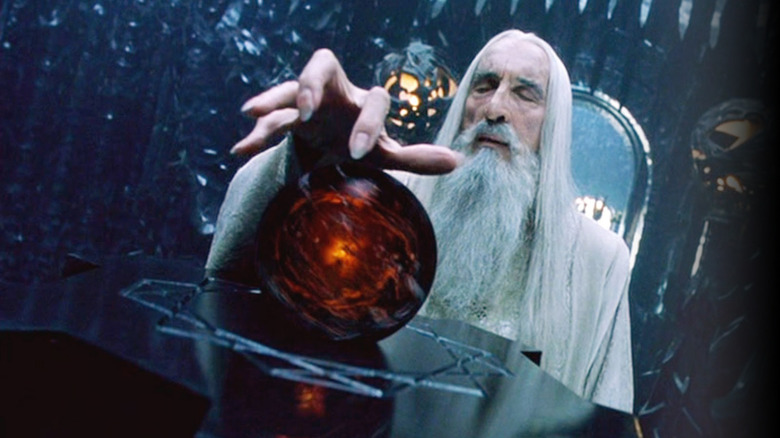
The letter Tolkien wrote in 1954 goes on to detail why the Wizards' powers were restricted within their incarnate bodies. It says that this was "so that they should do what they were primarily sent for: train, advise, instruct, arouse the hearts and minds of those threatened by Sauron to a resistance with their own strengths; and not just to do the job for them. They thus appeared as 'old' sage figures..."
Along with encouraging and guiding others, Wizard power restrictions in Middle-earth are partly to keep the power-wielders themselves in check. It turns out their incarnate bodies actually makes life harder and open up the door for an easier slide into evil. In Tolkien's 1954 letter, he elaborates that the Wizards "being incarnate were more likely to stray, or err."
"Unfinished Tales" also says they were "clad in bodies as of Men, real and not feigned, but subject to the fears and pains and weariness of earth, able to hunger and thirst and be slain." A bit later it adds, "the Istari, being clad in bodies of Middle-earth, might even as Men and Elves fall away from their purposes, and do evil, forgetting the good in the search for power to effect it."
So, while the Istari are very powerful, the limitations of their power come from two main objectives. One is to support the will of the Free Peoples of Middle-earth to resist Sauron, not do the resisting for them. The other is to prevent the Wizards from going rogue with unlimited power. The wisdom of this move is proven more than once. Saruman is limited in his power when he betrays his friends. While less is known about the mysterious Blue Wizards, if they did break bad as Tolkien hinted, they would have naturally been less effective in their restrained incarnate state, as well.
Gandalf is still really powerful
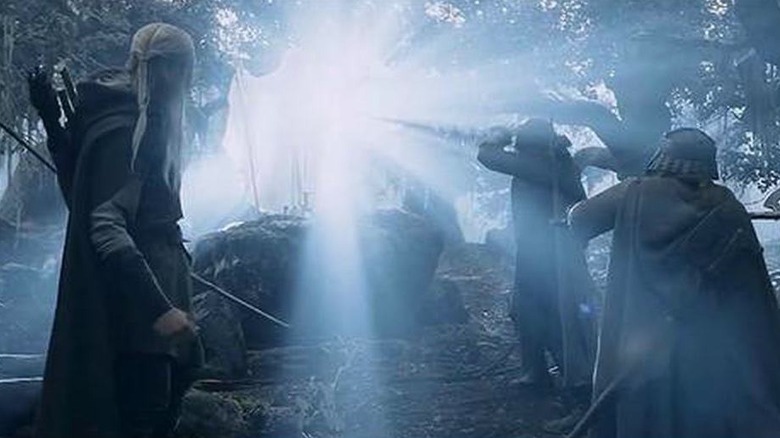
The key thing to remember here is that Gandalf's power is limited, not non-existent. Think of a Wizard like a can of spray paint. The painting power is there all along, but it's siphoned through a single, limited expression. As they learn and adjust to their new old-man bodies, Wizards can still wield power, just in more limited ways — and we see Gandalf do that over and over again across Tolkien's books.
In "The Hobbit," he uses his magic to control smoke rings and set pinecones alight with a fire that won't go out. In "The Fellowship of the Ring," he fights the Balrog (who is one of the most powerful creatures in "The Lord of the Rings"). In the confrontation, he even hints at his own inner power when he refers to being a "servant of the Secret Fire." In both stories, he talks about knowing spells and secret passwords for magic doors. He also uses his staff to create light and fire and even fashions supernatural fireworks for entertainment.
On top of that, Gandalf has one of the Three Elven Rings of Power. The Elven lord Círdan gives this to Gandalf when he arrives in Middle-earth, saying, "Great labours and perils lie before you, and lest your task prove too great and wearisome, take this Ring for your aid and comfort." So, while Gandalf's personal power is limited, he actually has a Ring of Power to give him an extra boost. But he's smart enough to stop with an Elven Ring and not, like Saruman, try to use the One Ring to rule them all — even though Frodo does offer it to him. In the book "The Fellowship of the Ring," Gandalf rejects the offer, saying, "With that power I should have power too great and terrible." A wise statement from a power-restrained Wizard who understands his task and his role in the larger story.