

Toy Story 5 Proves One MPA Rating Is Dead
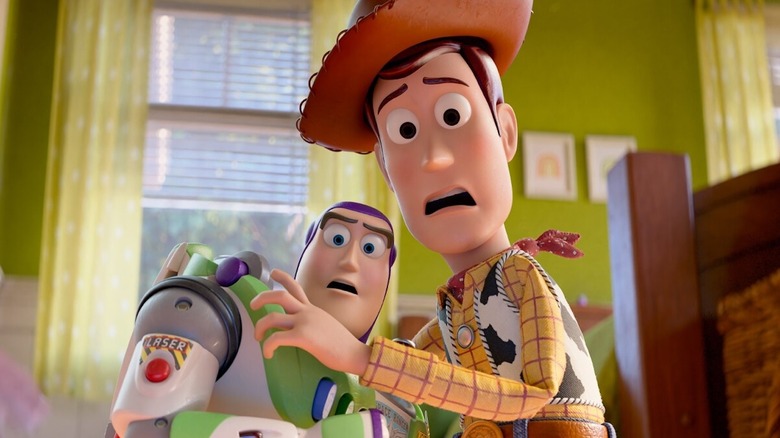
"Toy Story 5," coming to theaters on June 19, is now the first "Toy Story" movie (not counting the very different "Lightyear" spinoff) to be rated PG by the Motion Picture Association. While the previous four films received the G rating, this one gets its higher classification "for some thematic elements and rude humor."
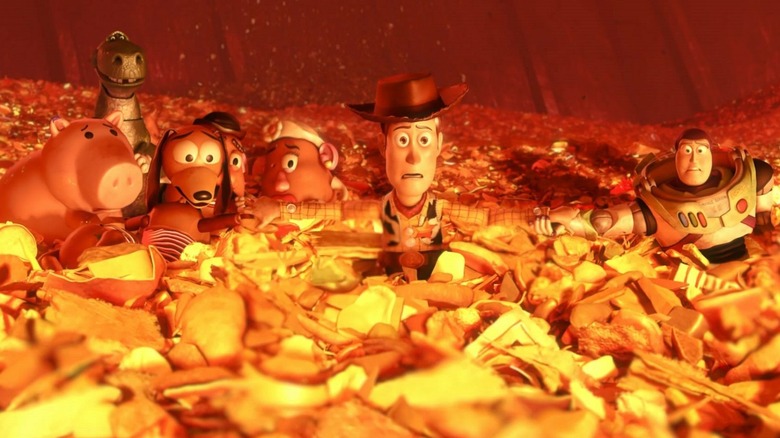
Without having seen the film ourselves yet, we might guess that "rude humor" is in reference to the new character of Smarty Pants (Conan O'Brien), a potty-training toy modeled after a roll of toilet paper. As for "some thematic elements," that exceedingly general descriptor could apply to all of the "Toy Story" films. We're sure there will be moments in the new one that might make kids scared or adults sad. We're doubtful they'll be scarier or sadder than the incinerator sequence in the G-rated "Toy Story 3," one of the most heartbreaking scenes ever in a Pixar film.
The PG for "Toy Story 5" tells us something we've been thinking a while now: when it comes to feature-length family films, the G rating is for all intents and purposes dead. "Toy Story 4" was the last all-ages G-rated hit in theaters, back in 2019. Since then, the rating has been almost exclusively applied to short films, non-narrative documentaries, and preschool titles like "Paw Patrol" and "Gabby's Dollhouse." Basically, any intense drama lasting more than a few seconds is now an automatic PG for "thematic elements" or "mild action" — which didn't used to be the case.
The G rating's demise is partially Toy Story 3's fault
When the MPA rating system began in 1968, the G rating was way looser than it would eventually become: intense adult-oriented films like "Planet of the Apes," "2001: A Space Odyssey," and even the violent war epic "Battle of Britain" got the "general audiences" rating within its first year. Eventually, G became synonymous with kids and family movies, which isn't the same as saying such movies lacked intensity. G-rated Disney films from the '90s were often more violent or "adult" than the PG-rated ones of the current decade — look at "The Hunchback of Notre Dame," a G-rated movie about lust and genocide, for the most extreme example.
The success of "Shrek," which earned its PG for language and adult humor, started to normalize the PG rating for animated family films in the 2000s, to the point that fairly tame films might add a line or two just to get a PG. Pixar, which got its first PG for 2004's "The Incredibles," was seemingly the last studio to regularly get G ratings for its films — even when, in the case of 2010's "Toy Story 3," director Lee Unkrich was genuinely shocked that his film got that rating.
A lot of parents were also shocked. Former MPA head Joan Graves got enough complaints that she openly regretted giving "Toy Story 3" a G rating just months after its release. Since then, every original Pixar film has gotten a PG, with the G only applied for certain sequels to previously G-rated films. Now with "Toy Story 5," even those legacy G ratings may be a thing of the past.