

Alec Baldwin And Ian McKellen Starred In A '90s Superhero Flop Few Remember
Across the history of superhero films, Hollywood has been producing comic book movies about cult-favorite superheroes, even before the Marvel Cinematic Universe gave us "Guardians of the Galaxy" and "Antman." The 1990s, in particular brought audiences many strange titles, likely green-lit with the veritable box office success of 1989's game-changing "Batman" on the minds of many studio executives. The decade saw the release of "Steel," "The Crow," and "The Phantom," none of which made major waves at the box office, but all of which brought bizarre stories to the big screen.
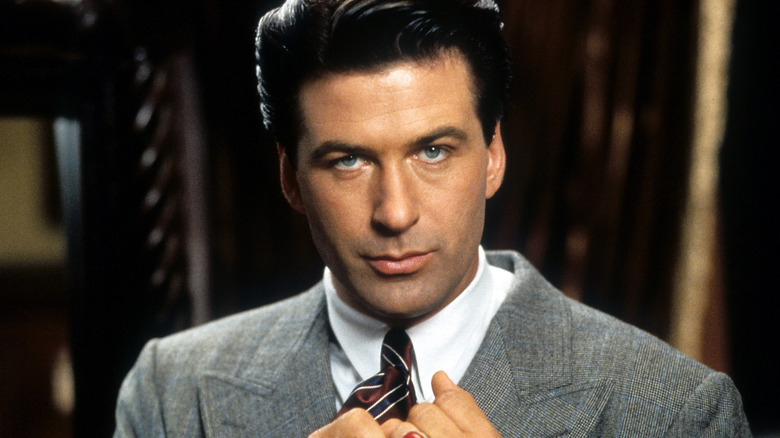
Another '90s superhero film that many have probably forgotten about is "The Shadow." Based on the 1930s pulp fiction character created by writer Walter B. Gibson, "The Shadow" follows post-WWI opportunist Lamont Cranston (Alec Baldwin) who takes up as a drug kingpin in Tibet following the war. As is often the case with handsome, fictional ne'er-do-wells, Cranston finds himself cosmically unable to avoid super-powered training that grants him abilities on the condition that he use them for good. Afterwards, he moves back to New York City, where Cranston maintains the facade of his former playboy lifestyle to avoid suspicion around his operations as a vigilante known as The Shadow.
The Shadow was invisible to movie-goers
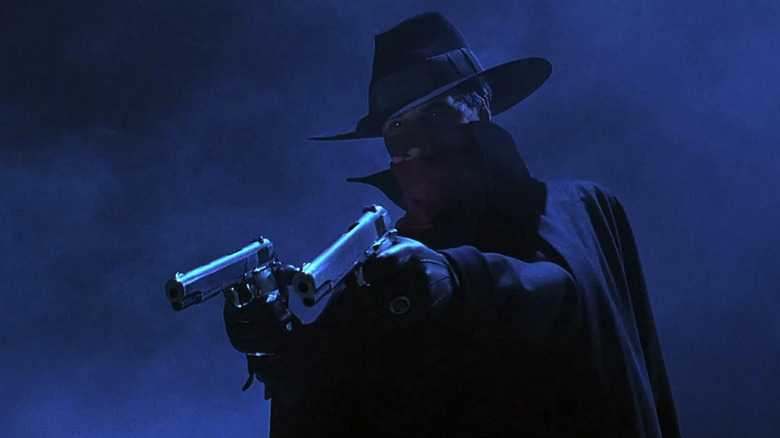
Despite Alec Baldwin's movie star status, a roster of well-cast supporting players in Ian McKellen, Penelope Ann Miller, and John Lone, and "Highlander" director Russell Mulcahey at the wheel, "The Shadow" did not perform nearly as well the studio had planned. Released as a summer blockbuster, one likely intended to spawn a franchise, it has since been practically forgotten all together, ranking among actor Ian McKellen's least memorable films.
Lamont Cranston's hero origin story is very familiar to fans of Christopher Nolan's Batman trilogy. In it, Wayne trains at a remote, Himalayan monastery under Ra's al Ghul before returning to his home city and resuming the life of a wealthy bachelor (it's worth noting that the Batman character was partially inspired by The Shadow and similar pulp figures).
Bruce didn't come back to the states with hypnotic powers, but there are still many similarities between the two stories. Where "The Shadow" fails is in its lack of balance between visual effects, onscreen atmosphere, and solid storytelling. Despite the many unique elements that make up The Shadow and his superhero M.O., this 1994 onscreen adaptation was simply no where near as memorable.