

Josephine Review: A Harrowing Look At Evil Through The Eyes Of A Child [SUNDANCE 2026]
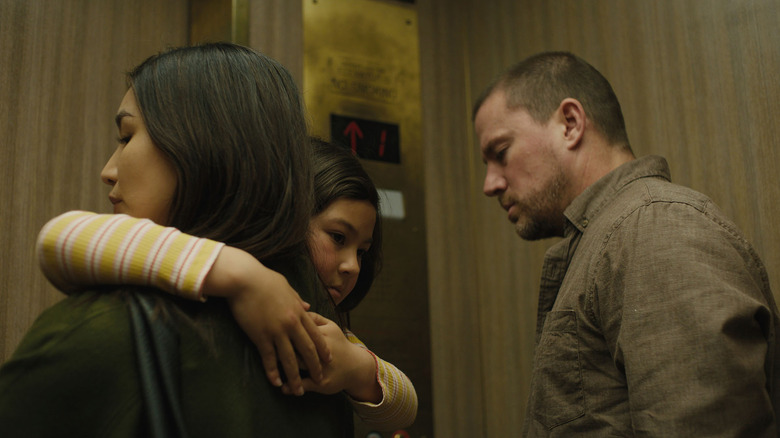
- Exceptional directing of extremely sensitive material
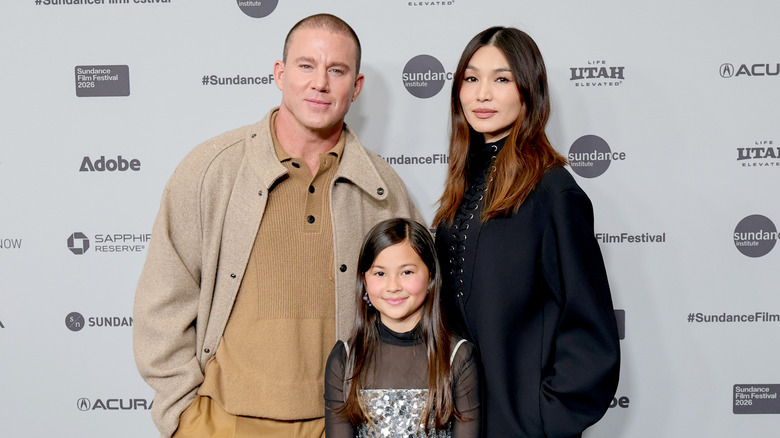
- Incredible performances from Channing Tatum, Gemma Chan, and newcomer Mason Reeves
- Probably the worst movie ever to go in blind to
This review contains discussion of sexual assault.
Some movies are best experienced knowing as little as possible about them before watching, all the better to be surprised by their startling originality or mind-blowing plot twists. "Josephine" is the exact opposite type of movie — you would not want to spring this film on anyone as a surprise. Knowing about the disturbing content ahead of time will help viewers decide if they can handle watching it, and knowing that filmmaker Beth de Araújo based this story on an experience from her own childhood goes a good way toward explaining why if you should watch it if you can handle it.
In the film's first 10 minutes, 8-year-old Josephine (Mason Reeves) takes a wrong turn in the park on an early morning run with her father Damien (Channing Tatum), and witnesses a man (Philip Ettinger) raping a woman (Syra McCarthy). Cinematographer Greta Zozula shoots the assault from Josephine's first-person point of view. It's hard to watch, but the technique serves two important purposes: to place the audience into the perspective of this child, whose exposure to such horrors is purely through seeing things she does not understand; and to stage the scene in such a way that the young actress doesn't have to see anything herself.
This first-person camera as child safety technique is actually introduced even earlier, in the very first shot, to perform a playful "stunt" that you can imagine a sporty girl doing with her jock dad but would be risky for a director to ask of a child performer. The careful construction of scenes like these does a lot of good to earn our trust that, while de Araújo is telling the story about loss of innocence, she's not going to steal such innocence from her star in the process. Reeves is not allowed to watch the full film; while I have questions about how the crew approached some uncomfortable scenes where Josephine describes what she's seen, I did note the film has a lot of ADR credits that might provide a satisfying answer.
Two different styles of parenting struggle to make sense of horror
Neither of Josephine's parents is well-equipped to help their daughter through the aftermath of this traumatic experience. Her mother Claire (Gemma Chan), a professional dancer, wants her to see a psychologist immediately; Josephine perceives that as punishment. Josephine's temperament is closer to her dad, who enrolls her in self-defense classes; her understanding of his instructions for when she's permitted to use "self-defense" soon gets her in trouble.
In different ways, Claire and Damien both struggle to speak clearly with their child about what happened. In Claire's case, the struggle is tied to her own past traumas — not long after Josephine is instructed on the importance of telling the truth, we see Claire answer one of her daughter's questions with a lie so unconvincing that even the 8-year-old understands the real answer. Damien, in contrast, is focused on toughing things out over talking them through, and his frustrations boil over into scary bouts of rage.
On the points Josephine's parents can speak clearly about, their advice conflicts. Most dramatically, when Josephine is called on to testify as a witness in the ongoing court case, Claire speaks from experience that Josephine shouldn't have to go through the process if she doesn't want to, while Damien is insistent that testifying is the only way the victim can have justice. Channing Tatum and Chan's performances are exceptionally heartbreaking, with Tatum drawing on his own experiences as a father. Young Mason Reeves, however much she even knows about the performance she's given, more than keeps up with their emotional power.
A realist drama that's also sort of a ghost story
Beth de Araújo fills "Josephine" with many thoughtful details, sometimes hitting the hardest with the most subtle follow-ups to earlier points of drama. For instance, it's a big deal when Josephine asks her anti-gun parents to buy a toy gun, but later on, after the free-on-bail suspect has threatened their family, it's not even remarked upon when Damien carries a gun with him. The arc of Josephine's growing fear of men in general escalates in dramatic, sometimes violent ways, but rather than moralize a resolution, the movie instead offers quieter challenges to her perspective — it's interesting to observe that the defense attorney asking the most uncomfortable questions in court is a woman.
Perhaps de Araújo's most ingenious creative decision is an element of fantasy that's also the most real thing in the movie: Josephine sees the rapist all around her as a "ghost." Sometimes he's standing in the corner. Sometimes he's chilling at the table eating Oreos. In one extremely unnerving scene, he plays with a push-pin and Josephine's pet mouse. You can decide whether or not this psychologically immersive bit of magical realism qualifies the film under the "horror" genre; either way, "Josephine" is one of the scariest movies you'll see this year.
Tense as this all is, Mason Reeves is able to sell the film's few moments of relief amidst the terror, and while nothing about Josephine's trauma can be wrapped up neatly, the ending manages to find appropriate grace notes of catharsis and hope. In its artful, brilliantly acted exploration of the moment one learns that the world isn't "fair" and how we keep going in the face of evil, "Josephine" sets a high bar for all movies to come in 2026.
"Josephine" premiered at the 2026 Sundance Film Festival. Further release plans have yet to be announced.
If you or anyone you know has been a victim of sexual assault, help is available. Visit the Rape, Abuse & Incest National Network website or contact RAINN's National Helpline at 1-800-656-HOPE (4673).