

10 Movies With Third-Act Twists That Actually Work
A lot is made of twist endings in film, where at the last minute something happens that completely upends your understanding of the entire story. M. Night Shyamalan has built his whole career around the twist ending. But something that's a little more interesting — and a great deal more difficult to execute effectively — is the third act twist. In the traditional three act structure, the last third of the film is often dedicated to reaching the climax that the whole story was leading up to, and then wrapping up all the loose ends.
But in a movie with a third act twist, a wrench is thrown into the proceedings with something unexpected that changes everything. Sometimes, this can seem to come out of left field, stretching the audience to the very edge of their suspension of disbelief. But when it's done right, it adds a richness and depth to the story that helps it truly land the ending. These films each have an excellently written twist — but it should go without saying, this article is primarily comprised of spoilers, so beware. Don't say we didn't warn you!
Get Out

Visiting your significant other's family for the first time can be a minefield in and of itself, but "Get Out" takes things to a whole different level. When Chris (Daniel Kaluuya) makes the decision to visit his girlfriend Rose's (Allison Williams) wealthy, seemingly liberal parents, the vibes are off from the beginning. But for most of the movie, there's a sense of plausible deniability where the weirdness could be attributed to microaggressions, well-intentioned but insensitive comments, or even paranoia on Chris's part. Chris feels uncomfortable, to be sure, but how much of that is just him feeling strange about being the only Black man surrounded by so many white people?
Well, it turns out that isn't actually the case. Or at least, Chris is right to be paranoid. Because Rose's family is actually engaging in a modern-day version of slavery, where their rich friends can literally buy a healthy Black body to transfer their consciousness into, allowing them to extend their lifespan by a number of years. What begins as a slightly awkward vacation ends up as a literal nightmare, allowing "Get Out" to function as not just an excellent horror film, but a metaphor for the Black experience in America.
The Others
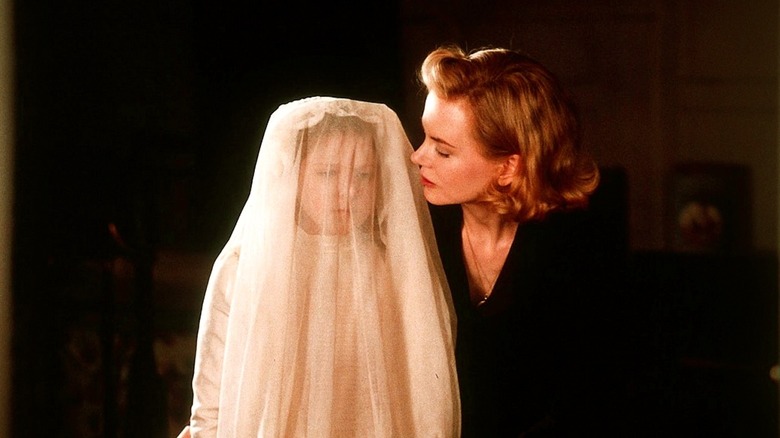
When "The Others" begins, it seems like it's going down a very traditional — but still genuinely spooky — ghost story path. It's post-World War II Jersey, and Grace (Nicole Kidman) lives in a large, atmospheric manor house with her two children who suffer from such extreme photosensitivity that they must be kept indoors with the curtains drawn at all time. And as one might expect from a mansion like this, it appears to be extremely haunted. That is, in fact, the case — only not in the way that the audience is expecting.
It turns out that the characters we've been following — Grace and her two children — are actually the ones who have been doing the haunting. The mysterious figures they glimpse from time to time, who they believe to be ghosts, are among the living. It's only when Grace comes to truth with the horrible truth — that she killed her children before dying by suicide herself — that the trio can find some peace.
Parasite

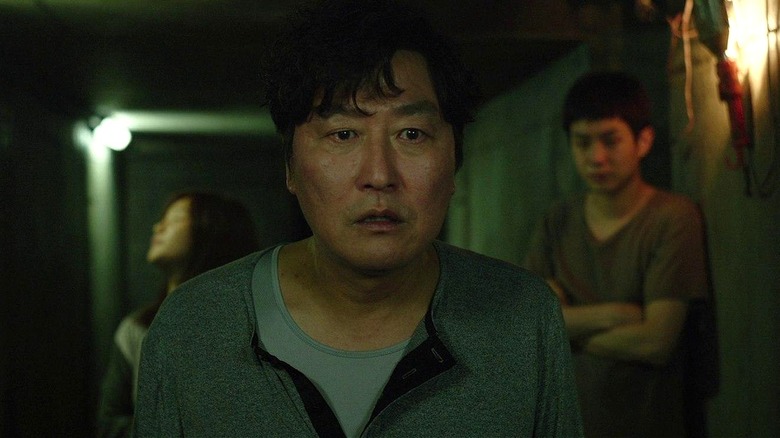
Let's be real, the third act twist in "Parasite" does more than just work — it makes the movie. When we meet the Kim family, they're struggling to make ends meet, taking on odd jobs wherever they can find them. But when son Ki-woo (Choi Woo-shik) gets a job working with the wealthy Parks as a tutor for their teenage daughter, he provides a window of opportunity for all of the Kims to con their way into lucrative positions as employees of the Park family. At least, until things go awry.
While the Parks are away on a camping trip, the Kims take the opportunity to live it up in their absence. But in doing so, they discover that they're not the only ones taking advantage of the Parks: The former housekeeper and her husband have been secretly living in the basement since the Kims took over, a fact that is revealed as the Kims accidentally expose their true identities. What begins as a clever satire of class power dynamics escalates quickly in the third act, becoming unexpectedly violent as these conflicts are made literal. "Parasite" captured the minds and hearts of American audiences, becoming the first non-English language film to win the best picture Oscar.
Crazy Stupid Love

Normally, twist endings (or third act twists, as the case may be) fall under the purview of horror or thriller films. But "Crazy Stupid Love" is a perfect example of how well a twist can be utilized in an unexpected genre, like the romantic comedy. This film stars Steve Carell as Cal, a middle-aged family man who is blind-sided to learn that his wife Emily (Julianne Moore) wants a divorce, and Ryan Gosling as Jacob, the hip man-about-town who helps him get his groove back. At the same time, "Crazy Stupid Love" explores the budding relationship between Jacob and Hannah (Emma Stone), where the one night stand guy begins to actually fall for someone.
These two storylines seem to be completely separate, with Jacob serving as the only connective tissue, since he's involved with both of them. But when Jacob goes with Hannah to meet her parents for the first time, audiences are walloped by the fact that Cal is actually Hannah's father, and they had her when they were just teenagers. Cal is, understandably, not pleased by the fact that the man who taught him how to sleep around is now dating his daughter. The revelation causes some comedic conflict, exacerbated by the fact that both their neighbor and Emily's new boyfriend, David Lindhagen (Kevin Bacon), turn up to take part in the chaos.
Shutter Island

"Shutter Island" is an interesting case because on the one hand, it has a third act twist that causes its viewers to completely reevaluate everything that came before it. But on the other, there are signs throughout the film that tell you exactly where it is headed. In this unsettling Martin Scorsese thriller, Leonardo DiCaprio stars as a detective investigating the case of a missing person on Shutter Island, a notorious psychiatric institution.
His time on Shutter Island is chaotic (to say the least) from start to finish, culminating in the revelation that he's actually a patient there who was committed after killing his wife, who had in turn murdered their three children. He struggles with lucidity, using his false identity as a U.S. Marshal as a subconscious attempt to deny the truth to himself. With this, "Shutter Island" goes from being a mystery thriller to a psychological drama, an exploration of guilt and its effect on the psyche rather than a much more straightforward detective yarn.
The Wicker Man

Let this be a lesson to you all: When you're a police officer given the task of investigating a mysterious disappearance on a remote island, maybe you just don't go? In "The Wicker Man," (the original — sorry, we're not here to talk about Nicolas Cage and his infamous bees) the devout copper Neil Howie (Edward Woodward) makes the long journey to a Scottish isle where the local inhabitants have gone a bit off the rails. For a while, this plays out like a traditional detective story, where Howie interviews the increasingly suspicious villagers who are reluctant to help in his investigation.
But eventually, we learn the truth of what's been going on in the pagan community on this creepy little island. The missing girl was bait set to lure Howie to the remote community, so that he could be sacrificed via the giant burning wicker man in a cult ritual to ensure their continued prosperity. By the time we — and Howie — discover their ruse, it's too late. But hey, at least Howie doesn't get the bee treatment in this folk horror classic.
Psycho
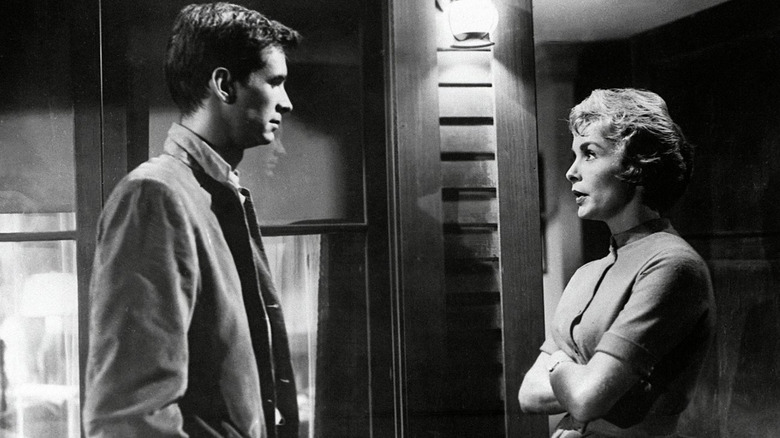
From the very beginning of "Psycho," director Alfred Hitchcock seems interested in little more than wrong-footing his audience. We the viewers are led to believe that the central storyline of "Psycho" is about Marion Crane (Janet Leigh) and the huge sum of money she impulsively stole from her job at the bank. That narrative is more or less abandoned when Marion arrives at the exceedingly creepy Bates Motel. We're conditioned by the way that movies work to expect that Marion is our point-of-view character, the one that we'll be following throughout the entire film — until she's unceremoniously killed.
Suddenly, the calculus of "Psycho" is completely different. We're no longer dealing with a thriller about a woman on the run, we've jumped into a murder mystery, where Marion's sister and lover team up to investigate her disappearance, crossing paths with the obviously unstable Norman Bates (Anthony Perkins). This perpetual misdirection is a huge part of what makes "Psycho" one of Hitchcock's most beloved films — in addition to its now-iconic shower scene, of course.
The Prestige
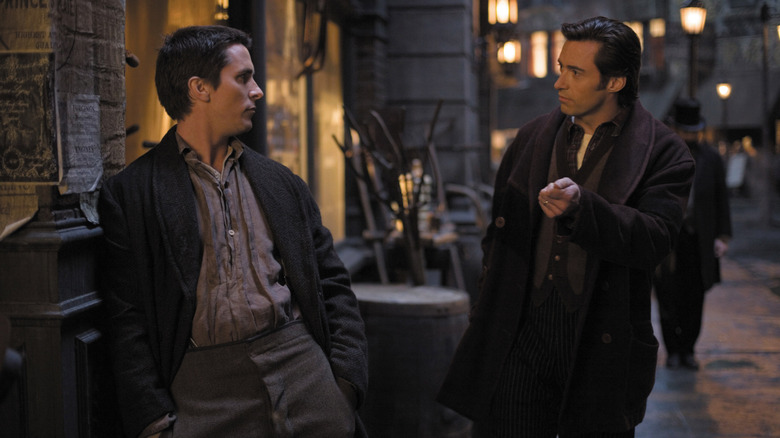
What's especially sneaky about the third act twist in "The Prestige" is that it's right there in the title. In this story of 19th-century magicians, we learn that every good magic trick is comprised of three parts: The "pledge," where the premise of the stunt is established; the "turn," where the magician does their little bits-of-business; and the "prestige," where all is revealed. In the prestige of "The Prestige," we learn the secret to Alfred's (Christian Bale) most famous trick, where he throws a ball across the stage, enters into a door leading to nowhere, and suddenly reappears several feet away in time to catch the ball.
This illusion, and his inability to figure out it, drives fellow magician Robert (Hugh Jackman) to near madness, and he becomes obsessed with attempting to replicate it. But all the science in the world (aided by no one less than Nikola Tesla, played by David Bowie) can't match the simplicity of the real trick. Alfred has been playing the long game, with a secret twin no one knows about, and they perform the act together. And not just the act, mind you: Since anyone finding out that there were actually two of them would ruin the illusion, they commited to sharing a single life. This is their triumph as well as their tragedy — they create a perfect magic trick, but in doing so end up each living a mere half-life.
Barbarian
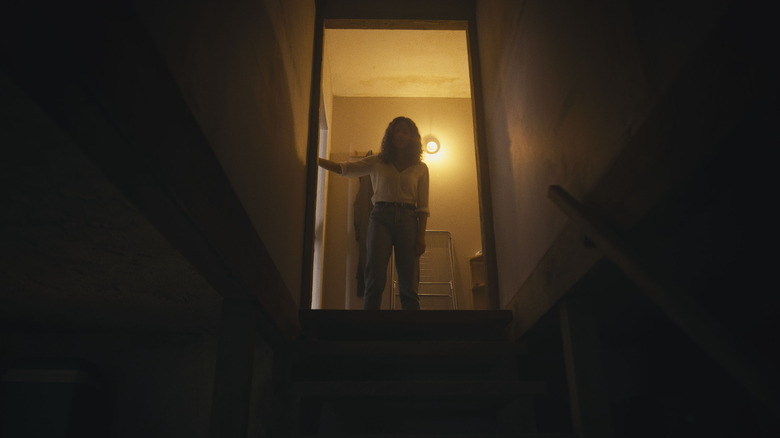
The twist in "Barbarian" is not so much a reveal of who the villain is, as you might expect from a horror film, but a narrative shift that makes it feel as though the third act is a completely different movie. Tess (Georgiana Mitchell) winds up in everyone's worst nightmare when it comes to AirBnB stays: She arrives at her destination only to discover that the house has apparently been double-booked, because there's a man (Keith, played by Bill Skarsgård) already there. With this set-up, audiences might think they know where the story is going.
But not so fast — "Barbarian" has a few more twists up its sleeve. Because it's not Keith who's the potential threat in the household, it's what lurks beneath its floors. In addition, we're introduced to a new protagonist (albeit a supremely unlikeable one) in Justin Long over halfway through the film, in a move worthy of Hitchcock in "Psycho." With these narrative shifts, "Barbarian" upends genre expectations and takes viewers in a new and terrifying direction.
Down With Love
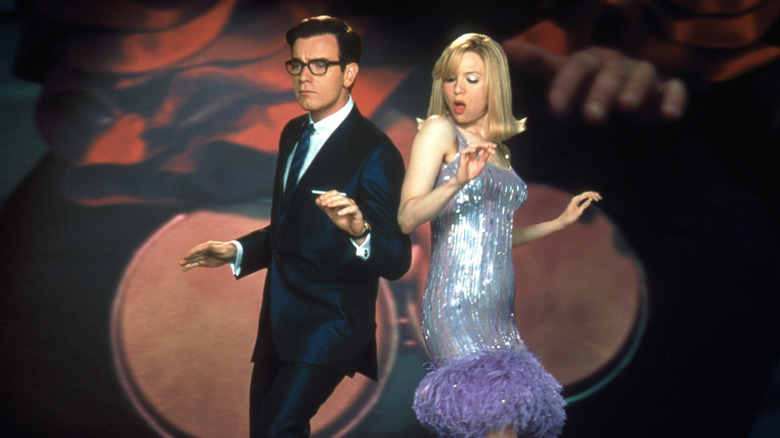
Like "Crazy Stupid Love," "Down With Love" showcases the power of the twist in the romantic comedy. Ewan McGregor, riding high off the success of "Moulin Rouge," stars as Catcher Block, a stylish early 1960s playboy in this send-up of mid-century rom-coms like, for example, "Pillow Talk" with Rock Hudson and Doris Day.
For a guy like Catcher, the city of Manhattan is his oyster, and he can date pretty much any woman he wants. So it gets to him when Barbara Novak (Renee Zellweger) comes out of nowhere with a bestselling book that teaches women how to date and have sex like the men in their lives do, with no strings attached. He's so affronted by this that he decides to make this supposedly man-hating woman fall in love with him, under an assumed identity as a humble yokel astronaut.
But as he spends more time with her, Catcher ends up the one smitten. So far, so obvious. The twist in "Down With Love" is Barbara is playing the player — as a former assistant of Catcher Block, she reinvents herself so that she can make him as head over heels for her as she was for him, and he can feel the pain of rejection himself. Of course, they end up happily ever after, but the double cross in there keeps things fresh.