

Tommy Lee Jones' Emotional 2014 Western Needs To Be On Your Prime Video Watchlist
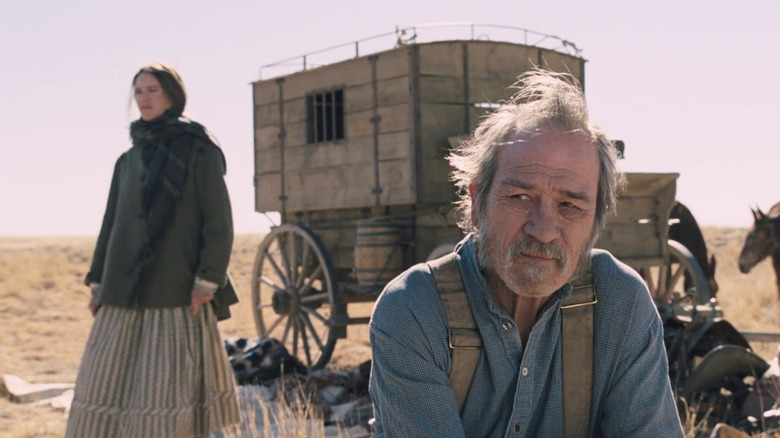
Out of the four films that the prickly Tommy Lee Jones has directed, three are Westerns ("The Good Old Boys," "The Three Burials of Melquiades Estrada," "The Homesman"), and none of them are typical. They do explore some of the classic Western themes, such as revenge, justice, or a grand adventure across a dangerous and lawless landscape, but they're hard to categorize within the genre. 2014's "The Homesman" is the strangest one of the bunch by far. On a first glance, it may strike you as the closest to an old-fashioned horse opera — it features a vast, mesmerizing wilderness, a melancholy soundtrack, and rumpled cowboys as well as vulnerable yet virtuous women — yet it's nothing like a usual western at all.
Its violence is measured yet potent, its leads are odd but intriguing, and its plot is straightforward yet layered with complex emotions that run underneath the surface. It's a story about women (and men) who are undesired, unwanted, and unable to fit into normal society, even if some of them try hard to do so. It's an uncannily sad and lonely movie that deftly refrains from being saccharine or manipulative — and one that even finds absurd humor in its sorrowful nature sometimes, laughing at but never mocking its own tragedies. "The Homesman" is good enough to come in at No. 12 on our ranking of Jones' films.
Although Jones is the director, one of the leads, and even co-writer of the screenplay alongside Kieran Fitzgerald and Wesley A. Oliver, he's not the star here. Hilary Swank (who has a hard time being cast these days), as Mary Bee Cuddy, who hires Jones to escort her and her coterie of ill women to their destination, dominates this movie with a magnificent portrayal of an honorable, if unlucky, woman.
The thankless job of being a good, honest, and kind woman in the old West

Based on Glendon Swarthout's 1988 novel of the same name, "The Homesman" tells the story of Cuddy — a spinster living in the Midwest in the 1850s and tending to her small farm — as she volunteers for a job that no man wants to take on. She steps up to transport three mentally ill women by carriage to a Methodist church in Iowa after their husbands gave up on them. It shouldn't be her duty, but all the men involved back out for various, cowardly reasons. While getting ready for the trip, Cuddy encounters George Briggs (Jones), tied up and left on horseback with a noose around his neck for stealing the land of a man. She saves him with one condition: he needs to help her escort the three women, no matter what. Briggs reluctantly agrees to the deal.
Although he is a drunken buffoon, Briggs eventually honors his word. All he asks for is a pistol, cartridges, and a jug of whiskey — while noting that he could abandon Cuddy whenever he wants. He won't, because she offers him $300 if he stays the entire journey. The three wives, Arabella (Grace Summers), Theoline (Miranda Otto), and Sonja (Gro Svendsen), have all suffered different traumas that shattered their state of mind. The causes are shown in flashbacks, and they're the most soul-stirring, potentially upsetting moments of the film. These women are so far gone that society renounces them.
Cuddy and Briggs, meanwhile, are outcasts of society, too. Which makes them fitting for the job, and for each other.
A heartbreaking journey to a doomed fate
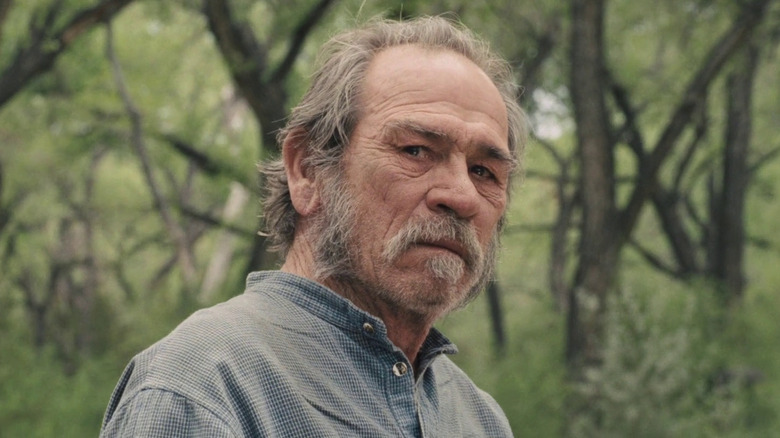
Although Cuddy is smart, educated, and savvy, she's slowly growing desperate due to being unable to find a man to marry her. They deem her too plain and bossy. Briggs, on the other hand, spent most of his life as a runaway, never committing to anything or anyone, and seeing that, falsely, as the ultimate freedom. He's harsh, callous, and sometimes volatile, but he's not blind to affection and kindness, even if he often acts like a heartless bastard.
When he sees Cuddy treat the helpless women with tenderness throughout the trip, it affects him, too. He appreciates her humanity and care, gradually growing closer to her. But he's no savior or hero — and Jones understands that perfectly both as an actor and filmmaker. Swank's determined yet soulful portrayal of Cuddy is the heart of the film, and Jones (as a director) never sways away from uplifting her in every way he can, even when the final act of the movie unexpectedly falls on Briggs' shoulders, forcing him to carry the story to its close.
"The Homesman" is far from an easy film, and many might struggle to interpret what its message is meant to be. It talks about loneliness, ostracism, and the power of kindness, but it never provides definite answers to some big questions. Viewers have to draw their own conclusions, and if you're willing to do that, you might find something precious, poignant, or even upsetting. The movie's power lies in being able to elicit all of those outcomes due to a wide range of emotions. For that alone, it's a special little western that every fan hungry for something different should watch at least once.